 The idea of autonomous labs may be in the air, but most labs are still mostly manual. In fact, self-driving labs today are roughly where self-driving cars were a decade ago: a handful work impressively in controlled conditions, but the infrastructure to make them general-purpose, which from instrument connectivity to data standards and workflow portability, scarcely exists. “Fully self-driving labs do exist in a few cases, but in reality they’re still very limited,” says Robert Zechlin, co-CEO of UniteLabs, a Munich-based lab automation startup.
For Zechlin, the problem sits lower in the stack than much of the current hype suggests. One of the main culprits that makes automation hard in labs is fragmentation. “Instead of a few general-purpose machines, you have lots of specialized instruments from different vendors, each optimized for a narrow task,” Zechlin said. For researchers in life sciences are not only dealing with the complexity of biology, but “also with the complexity of all these disconnected tools,” Zechlin said. Leading biotech companies typically have between five and 20 employees dedicated to laboratory automation, Zechlin has said, and he estimates that over half of their time is consumed by proprietary hardware integration rather than productive research.
Putting the lab equipment pieces together
The broader lab market has a significant need for translation, data sharing and more integrated infrastructure, Zechlin said. “Today there’s no really good resource for understanding what devices exist, how they fit together, or which workflows they support,” he said. “Standards are limited, libraries are limited, and that makes the space hard to navigate.”

Robert Zechlin is co-CEO and Founder of UniteLabs
GenAI can help by synthesizing that complexity, but there is still manual work that is required. “One thing we want to build toward with the UniteLabs Hub is a repository of instruments: what they do, their specifications, and how they relate to real scientific workflows,” Zechlin said. “If someone says, ‘I need a sample prep workflow for this assay,’ the goal would be to help them understand which instruments are typically involved. In other words, you start building an ontology of devices, workflows, and capabilities. AI makes the need for that more obvious, but it also makes it more possible to build.”
“In many cases, they’re not initially focused on AI. They just want better automation and better access to their data,” he says. Zechlin notes that before labs can seriously talk about autonomy, they first need instruments that connect reliably, workflows that run reproducibly, and data that can move cleanly between devices that span everything from liquid handlers to plate readers, robot arms and a host of other devices.
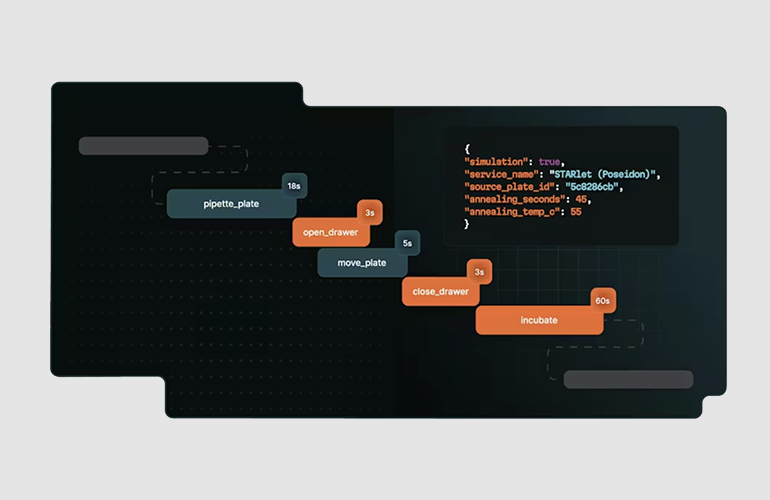
UniteLabs, which launched publicly at SLAS Boston 2026 after raising €2.77 million in pre-seed funding, sells a Python-based platform that connects lab instruments from different vendors through a common software layer. The pitch is essentially this: instead of juggling, say, four or five proprietary software tools to run a single workflow, scientists can control instruments, capture data and trigger automated steps from one environment. “In the traditional setup, the user defines a workflow in the vendor’s own software and then triggers it externally,” Zechlin said. “We remove that vendor software from the middle. That gives customers better observability into what the instrument is actually doing and makes it possible to control different instruments in a more consistent way.” Co-founder Lukas Bromig, who built an early prototype while researching lab digitalization during his PhD at TU Munich, has said UniteLabs grew from the frustration that proprietary black-box systems were constraining what was scientifically achievable. “During my PhD in industrial biotechnology at TUM, I kept hitting the same wall: lab instruments and software couldn’t talk to each other, forcing teams to waste months on brittle, one-off integrations,” as 5-HT quotes Bromig as saying.
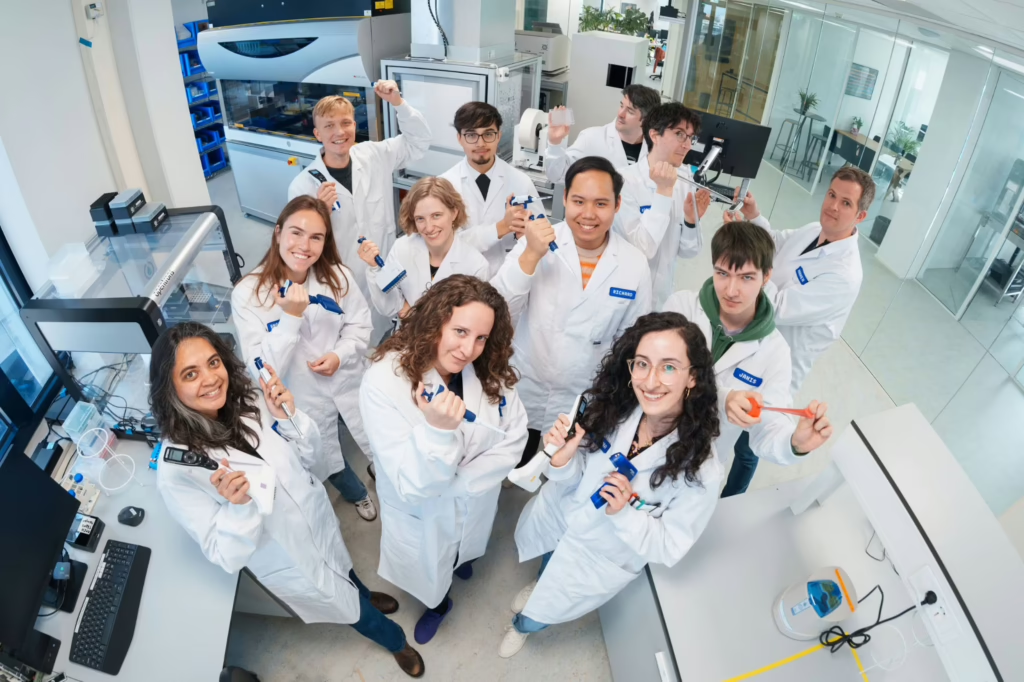
Scientists at Cradle’s Amsterdam lab. The AI biotech company used UniteLabs to automate protein QC workflows, cutting a 10-step manual process to three clicks. (Credit: UniteLabs/Cradle)
A network effect
The company says it supports connections to more than 100 instruments and prices by the number of devices connected rather than by seat. Its earliest customers include Cradle, a Dutch-Swiss AI biotech company that used UniteLabs to cut a protein QC workflow from a 10-step manual process to three clicks inside Benchling, saving roughly 2,500 hours of manual work per year. “There’s no really good resource for understanding what devices exist, how they fit together, or which workflows they support,” Zechlin says. “By standardizing how we communicate with instruments, we create a common lower-level language across workflows and vendors.”
Zechlin breaks the problem into three tiers: scientific AI at the top, workflow translation in the middle, and device-level control at the bottom. Most labs, he argues, are still struggling with the bottom two. Before an AI system can decide what experiment to run next, the instruments first have to be reachable, the workflow has to execute reliably, and the resulting data has to come back in a form the system can actually use.
Investors see a similar opportunity. “Biotech labs are at a turning point today,” said Claude Ritter, managing partner at NAP, which led UniteLabs’ pre-seed round. “While AI is enabling tremendous advances, most labs lack the technical foundation to realize this potential. Devices speak different languages, and valuable data remains isolated. UniteLabs creates the urgently needed infrastructure to equip labs for the use of AI.”