Research & Development World

  • R&D World Home
  • Topics
    • Aerospace
    • Automotive
    • Biotech
    • Careers
    • Chemistry
    • Environment
    • Energy
    • Life Science
    • Material Science
    • R&D Management
    • Physics
  • Technology
    • 3D Printing
    • A.I./Robotics
    • Software
    • Battery Technology
    • Controlled Environments
      • Cleanrooms
      • Graphene
      • Lasers
      • Regulations/Standards
      • Sensors
    • Imaging
    • Nanotechnology
    • Scientific Computing
      • Big Data
      • HPC/Supercomputing
      • Informatics
      • Security
    • Semiconductors
  • R&D Market Pulse
  • R&D 100
    • 2025 R&D 100 Award Winners
    • 2025 Professional Award Winners
    • 2025 Special Recognition Winners
    • R&D 100 Awards Event
    • R&D 100 Submissions
    • Winner Archive
  • Resources
    • Research Reports
    • Digital Issues
    • Educational Assets
    • Subscribe
    • Video
    • Webinars
    • Content submission guidelines for R&D World
  • Global Funding Forecast
  • Top Labs
  • Advertise
  • SUBSCRIBE

Unraveling the Jaw-Dropping Goblin Shark

By Hokkaido University | August 11, 2016

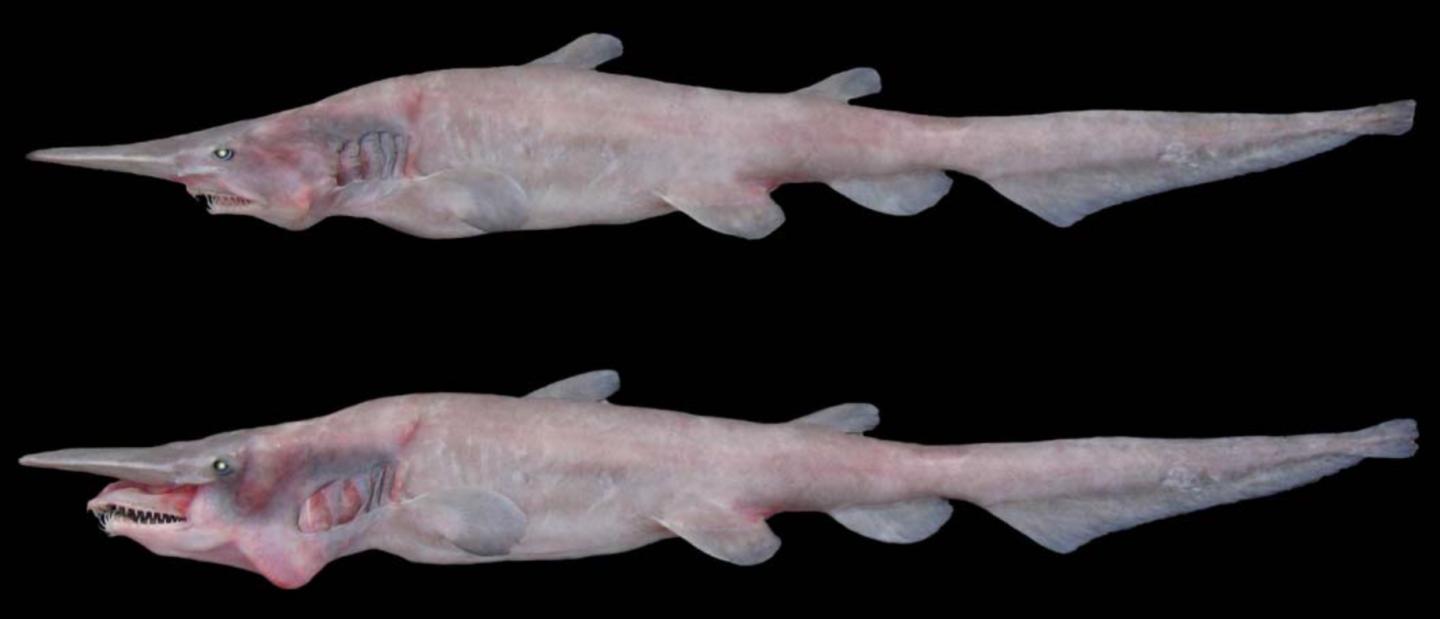
A goblin shark pre-jaw projection (above) and post-jaw projection (below). Source: Okinawa Churashima Foundation

A research team, led by Emeritus Professor Kazuhiro Nakaya of Japan’s Hokkaido University, analyzed world-first footage captured by public broadcaster NHK in which two goblin sharks separately captured prey on a total of five occasions. The research has unraveled a century-old mystery surrounding how the deep-sea shark utilizes its protruding jaws, among other factors, to feed itself.

The goblin shark (Mitsukurina owstoni) was first discovered in deep waters off Japan in 1898.

Please follow R&D Magazine on LinkedIn

The biting process, named “slingshot feeding” by the researchers, involved the projection of the jaws at speeds of up to 3.1 meters per second–the fastest speed recorded for a fish–over distances comparable to 8.6-9.4 percent of the total length of the shark’s body, far outranking the jaw protrusion of other kinds of shark. The researchers also newly discovered that the sharks opened and closed their mouths again during jaw-retraction, for unknown reasons.

The researchers concluded that the shark, which has a slow swimming speed, has evolved to adapt to deep-sea environments where food is scarce, possibly compensating for its slow swimming speed.

Known as Mitsukuri sharks in Japan, goblin sharks are so called in Western nations due to their somewhat alarming appearance: a pinkish body lacking proper pigment, exposed teeth and protruding jaws. Until now, few details were known about the species. The new findings on once shallow-water-dwelling sharks are likely to have a strong impact on future studies relating to how fish adapt to deep-sea environments.


Related Articles Read More >

Breakthrough in the Discovery of DNA in Ancient Bones Buried in Water
Traces of Crawling in Italian Cave Give Clues to Ancient Humans’ Social Behavior
Freshwater Mussel Shells Were Material of Choice For Prehistoric Craftsmen
Middle Pleistocene Human Skull Reveals Variation and Continuity in Early Asian Humans
rd newsletter
EXPAND YOUR KNOWLEDGE AND STAY CONNECTED
Get the latest info on technologies, trends, and strategies in Research & Development.

R&D World Digital Issues

Fall 2025 issue

Browse the most current issue of R&D World and back issues in an easy to use high quality format. Clip, share and download with the leading R&D magazine today.

R&D 100 Awards
Research & Development World
  • Subscribe to R&D World Magazine
  • Sign up for R&D World’s newsletter
  • Contact Us
  • About Us
  • Drug Discovery & Development
  • Pharmaceutical Processing
  • Global Funding Forecast

Copyright © 2026 WTWH Media LLC. All Rights Reserved. The material on this site may not be reproduced, distributed, transmitted, cached or otherwise used, except with the prior written permission of WTWH Media
Privacy Policy | Advertising | About Us

Search R&D World

  • R&D World Home
  • Topics
    • Aerospace
    • Automotive
    • Biotech
    • Careers
    • Chemistry
    • Environment
    • Energy
    • Life Science
    • Material Science
    • R&D Management
    • Physics
  • Technology
    • 3D Printing
    • A.I./Robotics
    • Software
    • Battery Technology
    • Controlled Environments
      • Cleanrooms
      • Graphene
      • Lasers
      • Regulations/Standards
      • Sensors
    • Imaging
    • Nanotechnology
    • Scientific Computing
      • Big Data
      • HPC/Supercomputing
      • Informatics
      • Security
    • Semiconductors
  • R&D Market Pulse
  • R&D 100
    • 2025 R&D 100 Award Winners
    • 2025 Professional Award Winners
    • 2025 Special Recognition Winners
    • R&D 100 Awards Event
    • R&D 100 Submissions
    • Winner Archive
  • Resources
    • Research Reports
    • Digital Issues
    • Educational Assets
    • Subscribe
    • Video
    • Webinars
    • Content submission guidelines for R&D World
  • Global Funding Forecast
  • Top Labs
  • Advertise
  • SUBSCRIBE