Research & Development World

  • R&D World Home
  • Topics
    • Aerospace
    • Automotive
    • Biotech
    • Careers
    • Chemistry
    • Environment
    • Energy
    • Life Science
    • Material Science
    • R&D Management
    • Physics
  • Technology
    • 3D Printing
    • A.I./Robotics
    • Software
    • Battery Technology
    • Controlled Environments
      • Cleanrooms
      • Graphene
      • Lasers
      • Regulations/Standards
      • Sensors
    • Imaging
    • Nanotechnology
    • Scientific Computing
      • Big Data
      • HPC/Supercomputing
      • Informatics
      • Security
    • Semiconductors
  • R&D Market Pulse
  • R&D 100
    • 2025 R&D 100 Award Winners
    • 2025 Professional Award Winners
    • 2025 Special Recognition Winners
    • R&D 100 Awards Event
    • R&D 100 Submissions
    • Winner Archive
  • Resources
    • Research Reports
    • Digital Issues
    • Educational Assets
    • R&D Index
    • Subscribe
    • Video
    • Webinars
    • Content submission guidelines for R&D World
  • Global Funding Forecast
  • Top Labs
  • Advertise
  • SUBSCRIBE

Wayne State to Develop Rigorous Computing System to Better Understand Internal Workings of the Human Body

By Wayne State University Division of Research | September 4, 2018

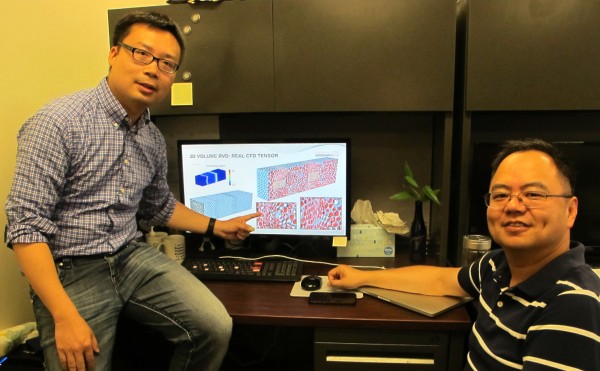
Zichun Zhong and Jing Hua, Department of Computer Science, College of Engineering, Wayne State University. (Credit: Julie O’Connor, Wayne State University)

A research team from Wayne State University’s College of Engineering received a nearly $500,000, three-year grant from the National Science Foundation to develop a rigorous computing system that will make it easier to understand and analyze the internal workings of the human body.

The project, “CHS: Small: High-Dimensional Euclidean Embedding for 4D Volumetric Shape with Multi-Tensor Fields,” centers on technical frameworks and theories that will make it possible to effectively and efficiently represent and process 4D Riemannian volumetric shapes from a new perspective. There is a pressing need to model and analyze these objects, which are captured by various imaging devices.

“In cardiology, for example, high-fidelity modeling and processing of 4D deformable volumes of cardiac organs and tissues with complex properties, shape geometry, motion and deformation at different phases of the cardiac cycle in real-time becomes important for building an effective and unified tool for doctors,” said Zichun Zhong, Ph.D., principal investigator of the research project and assistant professor of computer science at Wayne State. “This can assist physicians with accurately visualizing, tracking and diagnosing patient conditions.”

According to Zhong, the project will center around a high-d Euclidean geometric embedding framework that integrates Riemannian metric, tensor field and Nash embedding theory, making it possible to effectively and efficiently represent and process the 4D Riemannian volumetric shapes from a new perspective. Through this complicated process of validating the framework using 4D shape-tensor reconstruction and analysis, it will be possible to offer medical imaging and biomedicine communities an accurate, robust and rigorous approach for geometric reasoning and quantitative assessment of multiheterogenous features and properties across different objects.

Related Articles Read More >

Machine learning model predicts binding of molecules used for bioimaging
Sandia unveils Spectra, a reconfigurable supercomputer for nuclear stockpile simulations
NASA R&D 100 Winner enables high-speed data transfer from space
Inside the connected lab: Elemental Machines’ CEO on taming alarms, drift and data chaos
rd newsletter
EXPAND YOUR KNOWLEDGE AND STAY CONNECTED
Get the latest info on technologies, trends, and strategies in Research & Development.
RD 25 Power Index

R&D World Digital Issues

Fall 2025 issue

Browse the most current issue of R&D World and back issues in an easy to use high quality format. Clip, share and download with the leading R&D magazine today.

R&D 100 Awards
Research & Development World
  • Subscribe to R&D World Magazine
  • Sign up for R&D World’s newsletter
  • Contact Us
  • About Us
  • Drug Discovery & Development
  • Pharmaceutical Processing
  • Global Funding Forecast

Copyright © 2026 WTWH Media LLC. All Rights Reserved. The material on this site may not be reproduced, distributed, transmitted, cached or otherwise used, except with the prior written permission of WTWH Media
Privacy Policy | Advertising | About Us

Search R&D World

  • R&D World Home
  • Topics
    • Aerospace
    • Automotive
    • Biotech
    • Careers
    • Chemistry
    • Environment
    • Energy
    • Life Science
    • Material Science
    • R&D Management
    • Physics
  • Technology
    • 3D Printing
    • A.I./Robotics
    • Software
    • Battery Technology
    • Controlled Environments
      • Cleanrooms
      • Graphene
      • Lasers
      • Regulations/Standards
      • Sensors
    • Imaging
    • Nanotechnology
    • Scientific Computing
      • Big Data
      • HPC/Supercomputing
      • Informatics
      • Security
    • Semiconductors
  • R&D Market Pulse
  • R&D 100
    • 2025 R&D 100 Award Winners
    • 2025 Professional Award Winners
    • 2025 Special Recognition Winners
    • R&D 100 Awards Event
    • R&D 100 Submissions
    • Winner Archive
  • Resources
    • Research Reports
    • Digital Issues
    • Educational Assets
    • R&D Index
    • Subscribe
    • Video
    • Webinars
    • Content submission guidelines for R&D World
  • Global Funding Forecast
  • Top Labs
  • Advertise
  • SUBSCRIBE