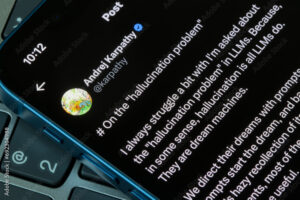
A 2023 Tweet from Karpathy who also helped popularize the term “vibe coding” and, later, agentic engineering. [Adobe Stock]
Anthropic has said little publicly about Karpathy beyond his role, but the pieces now line up. Karpathy will work inside pretraining, the part of the company responsible for the large training runs that give Claude its core capabilities. Nicholas Joseph, Anthropic’s head of pretraining, said Karpathy will build a team focused on using Claude to accelerate pretraining research itself, according to Reuters.
The move could give momentum to what Karpathy calls Software 3.0, a computing paradigm where the neural network is the host process and everything else is a co-processor. For the sake of comparison, Software 1.0 is traditional programming involving explicit instructions, logic and algorithms while Software 2.0 treats deep learning as a new way of programming, letting computers find the path instead of writing the behavior directly. “Software 1.0, I’m writing code. Software 2.0, I’m actually programming by creating data sets and training neural networks. So the programming is kind of like arranging data sets and maybe some objectives and neural network architectures,” Karpathy said. In Software 3.0, the “agent has its own intelligence that it packages up and then it kind of like follows the instructions and it looks at your environment, your computer, and it kind of like performs intelligent actions to make things work and it debugs things in the loop,” said Karpathy, using an OpenClaw project as an example.
Weeks earlier, Karpathy told Sequoia’s AI Ascent audience that LLMs had become “a new programmable layer for digital work.” Karpathy argued that the models’ context window would become the programmer’s main lever and agents carry out larger digital tasks.
The Stainless acquisition, announced on May 18, serves a different part of the same vision. Stainless, founded in 2022 by former Stripe engineer Alex Rattray and backed by Sequoia Capital and Andreessen Horowitz, built tooling that automatically generates SDKs and MCP (Model Context Protocol) server connectors across Python, TypeScript, Go, Java and other languages. Hundreds of companies relied on its hosted products, including OpenAI, Google and Cloudflare. Anthropic confirmed to TechCrunch that it will wind down all hosted Stainless products, folding the team into its own developer stack.
Serving as the translation layer between an agent and an API, MCP has become broadly popular. By March 2026, MCP had crossed 97 million monthly SDK downloads and 10,000 public servers, with formal adoption from every major AI provider, according to Toloka AI.
Anthropic released the standard in 2024, and later open-sourced it. By acquiring the company that mass-produces those connectors, Anthropic gains control of a bottleneck in the agent infrastructure supply chain.
Together, the Karpathy hire and the Stainless acquisition amount to a two-front move. Karpathy’s team will use Claude agents to improve Claude’s core model, a recursive loop that Anthropic is betting can keep it competitive against labs with larger compute budgets. Stainless gives Anthropic ownership of the tooling that lets agents reach the outside world, while removing a popular tooling option from competitors.
The timing also follows a month in which Anthropic’s unreleased Mythos model found thousands of zero-day vulnerabilities across every major operating system and web browser, and Claude Code creator Boris Cherny told Sequoia’s AI Ascent that coding is solved.
Karpathy also published a widely circulated gist on LLM-powered wikis in April, describing a pattern where an LLM incrementally builds and maintains a persistent knowledge base from raw sources, handling all the cross-referencing and bookkeeping that humans abandon over time. The gist has over 5,000 stars on GitHub and spawned dozens of open-source implementations.