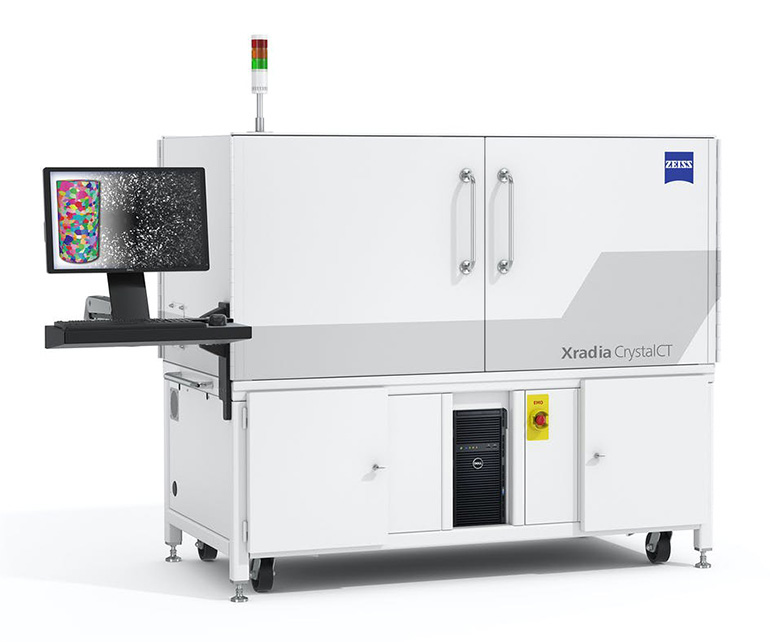
 ZEISS Research Microscopy Solutions introduces ZEISS Xradia CrystalCT micro-computed tomography (microCT) system to enable 3D crystallographic imaging of polycrystalline materials for a wide range of metal and alloy, additive manufacturing, ceramic and pharmaceutical samples in industrial and academic laboratories.
A world-first commercial implementation, ZEISS Xradia CrystalCT is purpose-built to deliver diffraction contrast tomography (DCT) on a traditional computed tomography system, allowing researchers to complement absorption contrast tomography data with crystallographic information in three dimensions. ZEISS Xradia CrystalCT is the latest Xradia platform to deliver DCT, developed in collaboration with Xnovo Technology ApS, the pioneer in lab-based diffraction imaging.
Seamless large volume grain mapping, increasing data volume representivity compared to traditional, destructive 3D crystallographic methods, is facilitated by advanced acquisition modes that provide stitch-free scanning for fast and accurate 3D grain data. Advanced scanning modes further remove the limitations of size and acquisition speed for a wide range of common samples in high-productivity lab settings. The ability to run larger sample sizes removes limitations in the lab, enabling more sample types and less prep-time resulting in a faster time to analysis. Faster acquisitions speeds enable shorter sample run times, increasing lab productivity.
The ability to image the grain structure and quantify the underlying crystallographic orientation in materials such as metals is instrumental to understanding and optimizing material properties. The non-destructive nature of microCT imaging facilitates the understanding of microstructural evolution in situ, characterizing the impact of thermal, mechanical or environmental conditions on material behavior. Such studies help to evaluate the performance and durability of new, lighter and stronger advanced materials, and address issues such as functionality, safety and improved economics.
DCT imaging was previously only available from a synchrotron until it was offered on the ZEISS Xradia 620 Versa 3D X-ray microscope as an extension module. In addition to being a DCT platform, ZEISS Xradia CrystalCT is also a class-leading microCT imaging system, providing superb resolution and image quality for a range of 3D imaging needs. It is built on the highly stable ZEISS Xradia Versa base.
“With CrystalCT, we bring years of leading innovation and advancements on our Xradia Versa platforms to a much wider audience. The market-shaping CrystalCT offers proven performance for a range of 3D imaging needs. Our customers additionally enjoy investment protection as this platform is highly extendable with a wide range of add-on capabilities and can be upgraded to the top of the line Versa models as their business and laboratory needs expand,” said Daniel Sims, head of ZEISS X-ray Microscopy.
“We are proud to support the next generation of lab-based diffraction imaging that now allows broader access to this capability. By building on our proven expertise in data reconstruction and analysis, we were able to transfer the DCT method to a micro-computed tomography platform. ZEISS’ microCT system provides an ideal environment for this implementation,” said Erik Lauridsen, CEO of Xnovo.
Note: LabDCT, CrystalCT and Xradia are trademarks of Carl Zeiss GmbH. GrainMapper3D is a trademark of Xnovo Technology ApS. Other trademarks that may be mentioned in this release are the intellectual property of their respective owners.