Research & Development World

  • R&D World Home
  • Topics
    • Aerospace
    • Automotive
    • Biotech
    • Careers
    • Chemistry
    • Environment
    • Energy
    • Life Science
    • Material Science
    • R&D Management
    • Physics
  • Technology
    • 3D Printing
    • A.I./Robotics
    • Software
    • Battery Technology
    • Controlled Environments
      • Cleanrooms
      • Graphene
      • Lasers
      • Regulations/Standards
      • Sensors
    • Imaging
    • Nanotechnology
    • Scientific Computing
      • Big Data
      • HPC/Supercomputing
      • Informatics
      • Security
    • Semiconductors
  • R&D Market Pulse
  • R&D 100
    • 2025 R&D 100 Award Winners
    • 2025 Professional Award Winners
    • 2025 Special Recognition Winners
    • R&D 100 Awards Event
    • R&D 100 Submissions
    • Winner Archive
  • Resources
    • Research Reports
    • Digital Issues
    • Educational Assets
    • Subscribe
    • Video
    • Webinars
    • Content submission guidelines for R&D World
  • Global Funding Forecast
  • Top Labs
  • Advertise
  • SUBSCRIBE

Discovered: Unexpected cooling effect on climate

By R&D Editors | May 7, 2013

University of Manchester scientists, writing in Nature Geoscience, have shown that natural emissions and manmade pollutants can both have an unexpected cooling effect on the world’s climate by making clouds brighter.

Clouds are made of water droplets, condensed on to tiny particles suspended in the air. When the air is humid enough, the particles swell into cloud droplets. It has been known for some decades that the number of these particles and their size control how bright the clouds appear from the top, controlling the efficiency with which clouds scatter sunlight back into space. A major challenge for climate science is to understand and quantify these effects which have a major impact in polluted regions.

The tiny seed particles can either be natural (for example, sea spray or dust) or manmade pollutants (from vehicle exhausts or industrial activity). These particles often contain a large amount of organic material and these compounds are quite volatile, so in warm conditions exist as a vapour (in much the same way as a perfume is liquid but gives off an aroma when it evaporates on warm skin).

The researchers found that the effect acts in reverse in the atmosphere as volatile organic compounds from pollution or from the biosphere evaporate and give off characteristic aromas, such as the pine smells from forest, but under moist cooler conditions where clouds form, the molecules prefer to be liquid and make larger particles that are more effective seeds for cloud droplets.

“We discovered that organic compounds such as those formed from forest emissions or from vehicle exhaust, affect the number of droplets in a cloud and hence its brightness, so affecting climate,” says study author Professor Gordon McFiggans, from the University of Manchester’s School of Earth, Atmospheric and Environmental Sciences.

“We developed a model and made predictions of a substantially enhanced number of cloud droplets from an atmospherically reasonable amount of organic gases.

“More cloud droplets lead to brighter cloud when viewed from above, reflecting more incoming sunlight. We did some calculations of the effects on climate and found that the cooling effect on global climate of the increase in cloud seed effectiveness is at least as great as the previously found entire uncertainty in the effect of pollution on clouds.”

Source: University of Manchester

Related Articles Read More >

How a new permafrost climate model fits a dangerous pattern in climate science
Trump administration to dismantle ocean observatories that provide data freely to researchers
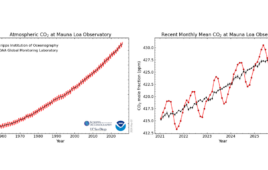
Atmospheric carbon dioxide hits record 431 ppm as Mauna Loa Observatory faces funding cuts
Microplastics may contribute to global warming new research indicates
rd newsletter
EXPAND YOUR KNOWLEDGE AND STAY CONNECTED
Get the latest info on technologies, trends, and strategies in Research & Development.

R&D World Digital Issues

Fall 2025 issue

Browse the most current issue of R&D World and back issues in an easy to use high quality format. Clip, share and download with the leading R&D magazine today.

R&D 100 Awards
Research & Development World
  • Subscribe to R&D World Magazine
  • Sign up for R&D World’s newsletter
  • Contact Us
  • About Us
  • Drug Discovery & Development
  • Pharmaceutical Processing
  • Global Funding Forecast

Copyright © 2026 WTWH Media LLC. All Rights Reserved. The material on this site may not be reproduced, distributed, transmitted, cached or otherwise used, except with the prior written permission of WTWH Media
Privacy Policy | Advertising | About Us

Search R&D World

  • R&D World Home
  • Topics
    • Aerospace
    • Automotive
    • Biotech
    • Careers
    • Chemistry
    • Environment
    • Energy
    • Life Science
    • Material Science
    • R&D Management
    • Physics
  • Technology
    • 3D Printing
    • A.I./Robotics
    • Software
    • Battery Technology
    • Controlled Environments
      • Cleanrooms
      • Graphene
      • Lasers
      • Regulations/Standards
      • Sensors
    • Imaging
    • Nanotechnology
    • Scientific Computing
      • Big Data
      • HPC/Supercomputing
      • Informatics
      • Security
    • Semiconductors
  • R&D Market Pulse
  • R&D 100
    • 2025 R&D 100 Award Winners
    • 2025 Professional Award Winners
    • 2025 Special Recognition Winners
    • R&D 100 Awards Event
    • R&D 100 Submissions
    • Winner Archive
  • Resources
    • Research Reports
    • Digital Issues
    • Educational Assets
    • Subscribe
    • Video
    • Webinars
    • Content submission guidelines for R&D World
  • Global Funding Forecast
  • Top Labs
  • Advertise
  • SUBSCRIBE