Research & Development World

  • R&D World Home
  • Topics
    • Aerospace
    • Automotive
    • Biotech
    • Careers
    • Chemistry
    • Environment
    • Energy
    • Life Science
    • Material Science
    • R&D Management
    • Physics
  • Technology
    • 3D Printing
    • A.I./Robotics
    • Software
    • Battery Technology
    • Controlled Environments
      • Cleanrooms
      • Graphene
      • Lasers
      • Regulations/Standards
      • Sensors
    • Imaging
    • Nanotechnology
    • Scientific Computing
      • Big Data
      • HPC/Supercomputing
      • Informatics
      • Security
    • Semiconductors
  • R&D Market Pulse
  • R&D 100
    • 2025 R&D 100 Award Winners
    • 2025 Professional Award Winners
    • 2025 Special Recognition Winners
    • R&D 100 Awards Event
    • R&D 100 Submissions
    • Winner Archive
  • Resources
    • Research Reports
    • Digital Issues
    • Educational Assets
    • Subscribe
    • Video
    • Webinars
    • PharmSci360
    • Content submission guidelines for R&D World
  • Global Funding Forecast
  • Top Labs
  • Advertise
  • SUBSCRIBE

Another Institution Joins Nationwide High-intensity Laser Network

By Chris Booker, Ohio State University | October 30, 2018

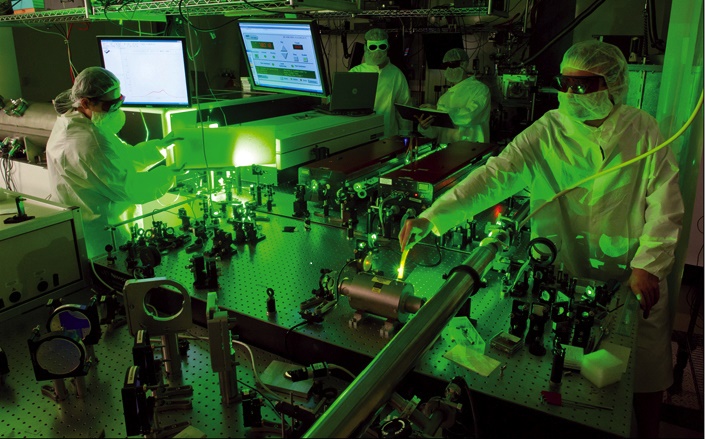
The Ohio State University has announced that it is part of a new research network called LaserNetUS.

The U.S. Department of Energy is backing the new network with $6.8 million in funding over the next two years to help restore the United States’ once-dominant position in high-intensity laser research. The department’s Fusion Energy Sciences program (FES) within the Office of Science is supporting the network that includes institutions nationwide operating high-intensity, ultrafast lasers.

Ohio State’s Scarlet Laser Facility, co-directed by Department of Physics professors Douglass Schumacher and Linn Van Woerkom, will receive $1 million to fund its part of the network.

“This is an exciting opportunity. High-intensity lasers generate extreme states of matter like those found near supernova explosions or in the earth’s interior and they have a broad range of applications in manufacturing and medicine,” Schumacher says.

“Best of all, this will connect our students with some of the most talented scientists in the country as they come here to do their research.”

LaserNetUS will provide U.S. scientists increased access to the unique high-intensity laser facilities at nine institutions: Ohio State, Colorado State University, University of Michigan, University of Nebraska-Lincoln, University of Texas at Austin, University of Rochester, and the SLAC, Lawrence Berkeley, and Lawrence Livermore national laboratories.

The network includes the most powerful lasers in the U.S., including those with powers approaching or exceeding a petawatt. Petawatt lasers generate light with at least a million billion watts of power, or nearly 100 times the output of all the world’s power plants — but only in the briefest of bursts.

High-intensity lasers can generate particles for high-energy physics research or intense X-ray pulses to probe matter as it evolves on ultrafast time scales.

They are also promising in many potential technological areas such as for generating intense neutron bursts, which could evaluate aging aircraft components, precisely cut materials or potentially deliver tightly focused radiation therapy to cancer tumors.

The U.S. was the dominant innovator and user of high-intensity laser technology in the 1990s, but now Europe and Asia have taken the lead, according to a recent report from the National Academies of Sciences, Engineering and Medicine.

Currently, 80 to 90 percent of the world’s high-intensity ultrafast laser systems are overseas, and all of the highest power research lasers currently in construction or already built are also overseas.

LaserNetUS follows the recommendation by the report’s authors to establish a national network of laser facilities to emulate successful efforts in Europe.

LaserNetUS will hold a nationwide call for proposals for access to the network’s facilities. The proposals will be peer reviewed by an independent proposal review panel. This call will allow any researcher in the U.S. to get time on one of the high-intensity lasers at the LaserNetUS host institutions.

Source: Ohio State University
Related Articles Read More >

The photon frontier: how O2O Lasercom is redefining deep-space data on Artemis II
laser reflect on optic table un quantum laboratory
2026 ultrafast laser buyer’s guide: 86 models compared
NASA R&D 100 Winner enables high-speed data transfer from space
Illustration of ultracold atoms (gold) flowing frictionlessly along a laser boundary (green), representing the quantum phenomenon of edge states.
MIT physicists directly observe frictionless ‘edge state’ flow in ultracold atoms, offering a glimpse of super-efficient electronics
rd newsletter
EXPAND YOUR KNOWLEDGE AND STAY CONNECTED
Get the latest info on technologies, trends, and strategies in Research & Development.

R&D World Digital Issues

Fall 2025 issue

Browse the most current issue of R&D World and back issues in an easy to use high quality format. Clip, share and download with the leading R&D magazine today.

R&D 100 Awards
Research & Development World
  • Subscribe to R&D World Magazine
  • Sign up for R&D World’s newsletter
  • Contact Us
  • About Us
  • Drug Discovery & Development
  • Pharmaceutical Processing
  • Global Funding Forecast

Copyright © 2026 Arrowfly LLC. All Rights Reserved. The material on this site may not be reproduced, distributed, transmitted, cached or otherwise used, except with the prior written permission of Arrowfly
Privacy Policy | Advertising | About Us

Search R&D World

  • R&D World Home
  • Topics
    • Aerospace
    • Automotive
    • Biotech
    • Careers
    • Chemistry
    • Environment
    • Energy
    • Life Science
    • Material Science
    • R&D Management
    • Physics
  • Technology
    • 3D Printing
    • A.I./Robotics
    • Software
    • Battery Technology
    • Controlled Environments
      • Cleanrooms
      • Graphene
      • Lasers
      • Regulations/Standards
      • Sensors
    • Imaging
    • Nanotechnology
    • Scientific Computing
      • Big Data
      • HPC/Supercomputing
      • Informatics
      • Security
    • Semiconductors
  • R&D Market Pulse
  • R&D 100
    • 2025 R&D 100 Award Winners
    • 2025 Professional Award Winners
    • 2025 Special Recognition Winners
    • R&D 100 Awards Event
    • R&D 100 Submissions
    • Winner Archive
  • Resources
    • Research Reports
    • Digital Issues
    • Educational Assets
    • Subscribe
    • Video
    • Webinars
    • PharmSci360
    • Content submission guidelines for R&D World
  • Global Funding Forecast
  • Top Labs
  • Advertise
  • SUBSCRIBE