Research & Development World

  • R&D World Home
  • Topics
    • Aerospace
    • Automotive
    • Biotech
    • Careers
    • Chemistry
    • Environment
    • Energy
    • Life Science
    • Material Science
    • R&D Management
    • Physics
  • Technology
    • 3D Printing
    • A.I./Robotics
    • Software
    • Battery Technology
    • Controlled Environments
      • Cleanrooms
      • Graphene
      • Lasers
      • Regulations/Standards
      • Sensors
    • Imaging
    • Nanotechnology
    • Scientific Computing
      • Big Data
      • HPC/Supercomputing
      • Informatics
      • Security
    • Semiconductors
  • R&D Market Pulse
  • R&D 100
    • 2025 R&D 100 Award Winners
    • 2025 Professional Award Winners
    • 2025 Special Recognition Winners
    • R&D 100 Awards Event
    • R&D 100 Submissions
    • Winner Archive
  • Resources
    • Research Reports
    • Digital Issues
    • Educational Assets
    • Subscribe
    • Video
    • Webinars
    • PharmSci360
    • Content submission guidelines for R&D World
  • Global Funding Forecast
  • Top Labs
  • Advertise
  • SUBSCRIBE

Jellyfish-Inspired Electronic Skin Glows When it Gets Hurt

By American Chemical Society | November 2, 2017

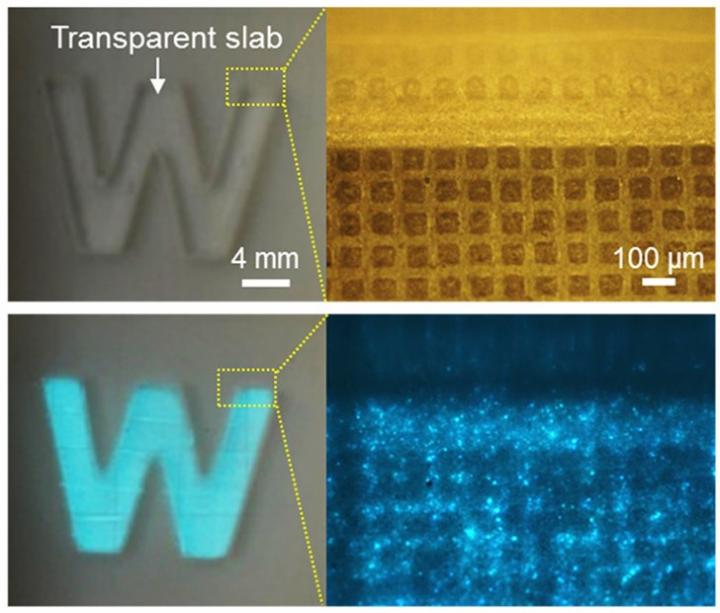
An electronic skin glows when a transparent ‘W’ is pressed onto it, and a voltage is applied (bottom).

Electronic-skin technologies for prosthetics and robots can detect the slightest touch or breeze. But oddly, the sensors that make this possible do not respond effectively to a harmful blow. Now researchers report in ACS Applied Materials & Interfaces the development of a jellyfish-inspired electronic skin that glows when the pressure against it is high enough to potentially cause an injury.

An electronic skin that can mimic the full range of biological skin’s sensitivity has great potential to transform prosthetics and robotics. Current technologies are very sensitive, but only within a narrow range of weak pressures. Under high pressures that could cause damage, the electronic skins’ sensitivity fades. To address this shortcoming, Bin Hu and colleagues at the Huazhong University of Science and Technology turned to the Atolla jellyfish for inspiration. This bioluminescent, deep-sea creature can feel changes in environmental pressure and flashes dramatically when it senses danger.

Building on the idea of a visual warning in response to a physical threat, the researchers combined electric and optical systems in a novel electronic skin to detect both slight and high-force pressures. They embedded two layers of stretchy, poly-dimethysiloxane, or PDMS, film with silver nanowires. These layers produce an electrical signal in response to slight pressures, such as those created by a breeze or contact with a leaf. Sandwiched in between the silver nanowire electrodes is a PDMS layer embedded with phosphors. This layer kicks in and glows with growing intensity as the physical force increases. The researchers say this approach more closely copies the wide range of pressures the human skin can feel.


Related Articles Read More >

Speaker Giving a Talk at Business Meeting. Audience in the conference hall. Business and Entrepreneurship. Panoramic composition suitable for banners.
BioPharma Supply Chain & Logistics Nexus returns to San Diego in November
How Cypris evolved from selling patent reports to agentic R&D intelligence
New video series: Travel for engineers
Advanced Manufacturing and Process Innovation Special Report: When you can’t hire, you automate
rd newsletter
EXPAND YOUR KNOWLEDGE AND STAY CONNECTED
Get the latest info on technologies, trends, and strategies in Research & Development.

R&D World Digital Issues

Fall 2025 issue

Browse the most current issue of R&D World and back issues in an easy to use high quality format. Clip, share and download with the leading R&D magazine today.

R&D 100 Awards
Research & Development World
  • Subscribe to R&D World Magazine
  • Sign up for R&D World’s newsletter
  • Contact Us
  • About Us
  • Drug Discovery & Development
  • Pharmaceutical Processing
  • Global Funding Forecast

Copyright © 2026 Arrowfly LLC. All Rights Reserved. The material on this site may not be reproduced, distributed, transmitted, cached or otherwise used, except with the prior written permission of Arrowfly
Privacy Policy | Advertising | About Us

Search R&D World

  • R&D World Home
  • Topics
    • Aerospace
    • Automotive
    • Biotech
    • Careers
    • Chemistry
    • Environment
    • Energy
    • Life Science
    • Material Science
    • R&D Management
    • Physics
  • Technology
    • 3D Printing
    • A.I./Robotics
    • Software
    • Battery Technology
    • Controlled Environments
      • Cleanrooms
      • Graphene
      • Lasers
      • Regulations/Standards
      • Sensors
    • Imaging
    • Nanotechnology
    • Scientific Computing
      • Big Data
      • HPC/Supercomputing
      • Informatics
      • Security
    • Semiconductors
  • R&D Market Pulse
  • R&D 100
    • 2025 R&D 100 Award Winners
    • 2025 Professional Award Winners
    • 2025 Special Recognition Winners
    • R&D 100 Awards Event
    • R&D 100 Submissions
    • Winner Archive
  • Resources
    • Research Reports
    • Digital Issues
    • Educational Assets
    • Subscribe
    • Video
    • Webinars
    • PharmSci360
    • Content submission guidelines for R&D World
  • Global Funding Forecast
  • Top Labs
  • Advertise
  • SUBSCRIBE