Research & Development World

  • R&D World Home
  • Topics
    • Aerospace
    • Automotive
    • Biotech
    • Careers
    • Chemistry
    • Environment
    • Energy
    • Life Science
    • Material Science
    • R&D Management
    • Physics
  • Technology
    • 3D Printing
    • A.I./Robotics
    • Software
    • Battery Technology
    • Controlled Environments
      • Cleanrooms
      • Graphene
      • Lasers
      • Regulations/Standards
      • Sensors
    • Imaging
    • Nanotechnology
    • Scientific Computing
      • Big Data
      • HPC/Supercomputing
      • Informatics
      • Security
    • Semiconductors
  • R&D Market Pulse
  • R&D 100
    • 2025 R&D 100 Award Winners
    • 2025 Professional Award Winners
    • 2025 Special Recognition Winners
    • R&D 100 Awards Event
    • R&D 100 Submissions
    • Winner Archive
  • Resources
    • Research Reports
    • Digital Issues
    • Educational Assets
    • Subscribe
    • Video
    • Webinars
    • Content submission guidelines for R&D World
  • Global Funding Forecast
  • Top Labs
  • Advertise
  • SUBSCRIBE

New Dinosaur Discovery Sheds Light on Europe, Africa Connection

By Kenny Walter | January 29, 2018

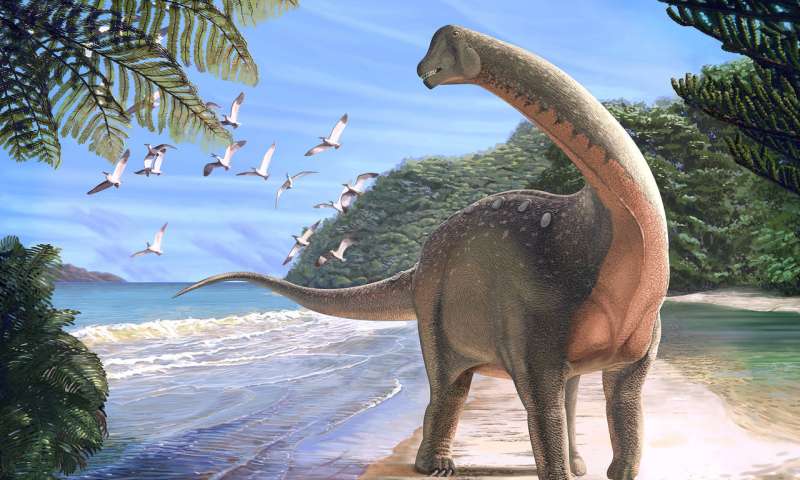
Life reconstruction of the new titanosaurian dinosaur Mansourasaurus shahinae on a coastline in what is now the Western Desert of Egypt approximately 80 million years ago. Credit: Andrew McAfee, Carnegie Museum of Natural History

The discovery of a new species of dinosaur in the Sahara Desert may fill in some unanswered questions on the ancient link between Africa and Europe. 

Researchers do not currently have a firm grasp on the final days of dinosaurs in Africa due to a lack of fossils found on the continent from the Late Cretaceous period—between 100-to-66 million years ago.

However, the discovery of Mansourasaurus shahinae—a school-bus length, long-necked plant-eater with bony plates embedded in its skin—in Egypt is bringing scientists one step closer to piecing together the puzzle of dinosaurs’ final days.

“Mansourasaurus shahinae is a key new dinosaur species, and a critical discovery for Egyptian and African paleontology,” Eric Gorscak, Ph.D., a postdoctoral research scientist at The Field Museum and a contributing author on the study, said in a statement. “Africa remains a giant question mark in terms of land-dwelling animals at the end of the Age of Dinosaurs.

“Mansourasaurus helps us address longstanding questions about Africa’s fossil record and paleobiology—what animals were living there, and to what other species were these animals most closely related?”

Late Cretaceous dinosaur fossils are rare in Africa because much of the land where the fossils might be uncovered include lush vegetation, rather than the exposed rock of dinosaur treasure troves.

Throughout much of the Triassic and Jurassic periods, all the continents were joined together as the supercontinent  known as Pangaea. However, during the Cretaceous Period the continents began to break apart and shift towards the current configuration.

It remains unclear how well connected Africa was to other Southern Hemisphere landmasses and Europe during this time and to what degree Africa’s animals may have been cut off from their neighbors and evolved on their own separate tracks.

The researchers analyzed features of the new species bones and found that Mansourasaurus was more closely related to dinosaurs from Europe and Asia than it is to species found farther south in Africa or South America.

This reveals that at least some dinosaurs could move between Africa and Europe towards the end of their existence.

“Africa’s last dinosaurs weren’t completely isolated, contrary to what some have proposed in the past,” says Gorscak. “There were still connections to Europe.”

Mansourasaurus belongs to the Titanosauria, a group of sauropods that were common throughout much of the world during the Cretaceous and includes the largest land animals known to science.

The dinosaur represents the most complete dinosaur discovered from the end of the Cretaceous period in Africa. The discovery includes part of the skull, the lower jaw, neck and back vertebrae, ribs, most of the shoulder and forelimb, part of the hind foot and pieces of dermal plates preserved.

“When I first saw pics of the fossils, my jaw hit the floor,” Matt Lamanna, Ph.D., of the Carnegie Museum of Natural History and co-author of the study, said in a statement. “This was the Holy Grail—a well-preserved dinosaur from the end of the Age of Dinosaurs in Africa—that we paleontologists had been searching for for a long, long time.”


 

Related Articles Read More >

Beyond the sequence: how Ötzi the Iceman exposed the blind spots of pure metagenomics
Breakthrough in the Discovery of DNA in Ancient Bones Buried in Water
Traces of Crawling in Italian Cave Give Clues to Ancient Humans’ Social Behavior
Freshwater Mussel Shells Were Material of Choice For Prehistoric Craftsmen
rd newsletter
EXPAND YOUR KNOWLEDGE AND STAY CONNECTED
Get the latest info on technologies, trends, and strategies in Research & Development.

R&D World Digital Issues

Fall 2025 issue

Browse the most current issue of R&D World and back issues in an easy to use high quality format. Clip, share and download with the leading R&D magazine today.

R&D 100 Awards
Research & Development World
  • Subscribe to R&D World Magazine
  • Sign up for R&D World’s newsletter
  • Contact Us
  • About Us
  • Drug Discovery & Development
  • Pharmaceutical Processing
  • Global Funding Forecast

Copyright © 2026 WTWH Media LLC. All Rights Reserved. The material on this site may not be reproduced, distributed, transmitted, cached or otherwise used, except with the prior written permission of WTWH Media
Privacy Policy | Advertising | About Us

Search R&D World

  • R&D World Home
  • Topics
    • Aerospace
    • Automotive
    • Biotech
    • Careers
    • Chemistry
    • Environment
    • Energy
    • Life Science
    • Material Science
    • R&D Management
    • Physics
  • Technology
    • 3D Printing
    • A.I./Robotics
    • Software
    • Battery Technology
    • Controlled Environments
      • Cleanrooms
      • Graphene
      • Lasers
      • Regulations/Standards
      • Sensors
    • Imaging
    • Nanotechnology
    • Scientific Computing
      • Big Data
      • HPC/Supercomputing
      • Informatics
      • Security
    • Semiconductors
  • R&D Market Pulse
  • R&D 100
    • 2025 R&D 100 Award Winners
    • 2025 Professional Award Winners
    • 2025 Special Recognition Winners
    • R&D 100 Awards Event
    • R&D 100 Submissions
    • Winner Archive
  • Resources
    • Research Reports
    • Digital Issues
    • Educational Assets
    • Subscribe
    • Video
    • Webinars
    • Content submission guidelines for R&D World
  • Global Funding Forecast
  • Top Labs
  • Advertise
  • SUBSCRIBE