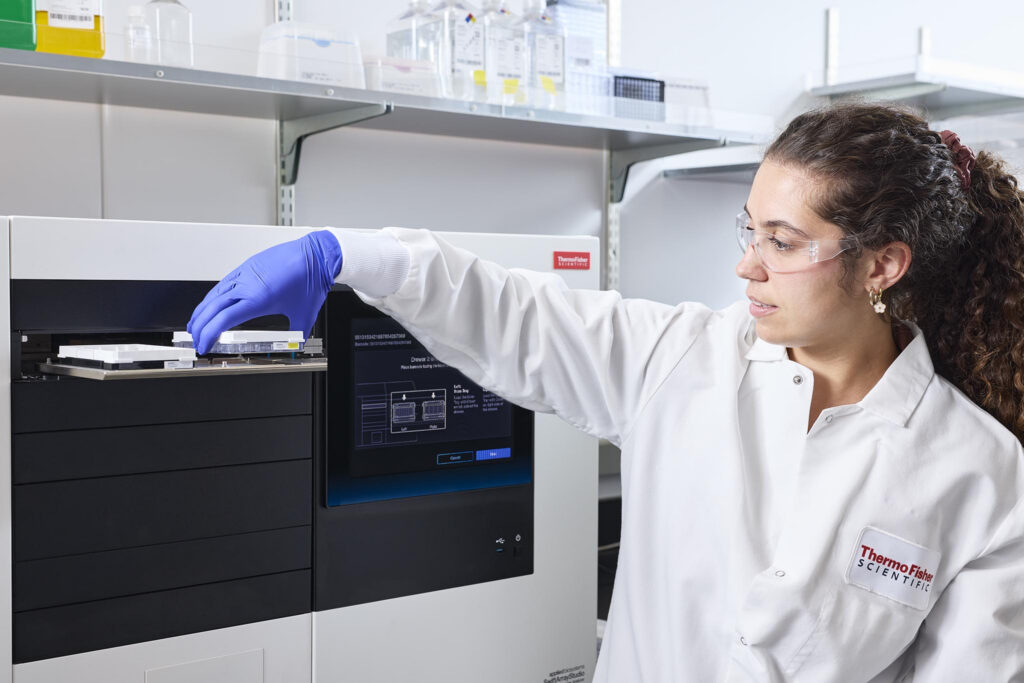
A technician loads samples into the SwiftArrayStudio microarray analyzer. (Image credit: Thermo Fisher Scientific)
Precision medicine has reached a turning point largely due to rapid technological advances. The constraint against future scale is no longer whether researchers can generate genomic data, but whether programs can turn that data into repeatable, clinically relevant insight at the pace and scale that modern healthcare systems and drug discovery pipelines demand. In many organizations, the hardest part is building an end-to-end workflow that reliably converts biodata into interpretable genetic information, then delivers that information in a form that downstream teams can use without delay, rework or quality concerns.
Demand for multiomics insights have created the need for larger cohorts and study designs that are more dynamic and reveal the deeper biological interplay behind disease. Yet the day-to-day reality in many genomics operations still includes workflow complexity, inconsistent turnaround times and escalating costs that slow translation from population datasets to actionable outputs. When those operational pressures mount, scientific ambition simply gets trapped in the pipeline.
In response to these real-world needs, technology providers have engineered a new generation of microarray analyzers with workflows designed explicitly for scale. When paired with standardized quality controls that keep outputs consistent from run to run, next-generation microarrays can be used as a practical foundation for multiomics programs that aim to produce repeatable, scalable insights.
Precision medicine will not be limited by the size of genomic datasets. It will be limited by whether programs can turn those datasets into repeatable insight, delivered at a cadence that supports real decisions. —Gupta
Pain points associated with scaling multiomics research
There’s not typically a single breaking point when it comes to scaling research, however, the accumulation of handoffs and variability across workflows significantly hinders progress. Each additional manual step increases the opportunity for delays, inconsistencies and human errors that are difficult to troubleshoot later. Modern labs are also facing the reality of labor shortages and shrinking budgets, which make programs even more vulnerable to shifting priorities in long-running studies. Each time outputs are not comparable across runs, operators or sites, downstream teams must spend extra time separating biological signal from procedural noise.
This is why repeatability has become the prerequisite for insight. When cohorts expand in population-scale studies, new hypotheses may emerge after initial analyses. A genetic baseline that is stable across time allows teams to iterate without constantly revalidating initial assumptions. When genomics is used to define sub-cohorts for deeper profiling, the entire downstream strategy depends on whether that foundational layer is consistent enough to support confident selection and integration. Without repeatability, multiomics becomes slower, more expensive and less conclusive. In that context, next-generation microarrays have gained renewed relevance as an enabling layer for scale.
How next-generation microarray analyzers reduce friction from sample to answer
Microarrays are not new to genomics. In fact, the National Human Genome Research Institute (NHGRI) has recorded the technology’s foundational role in breakthrough discoveries for decades, including accurately diagnosing hard-to-distinguish childhood cancers and completing the Human Genome Project. However, the way microarray analyzers are being applied to modern research pipelines – and the expectations placed on them – have changed.
The modern requirement is producing genotyping calls through workflows that behave predictably under real-world constraints, where sample volumes fluctuate, staffing varies and timelines are tight. For many cohort-scale programs, high-throughput genotyping remains the practical entry point for building a consistent genetic foundation, and modern microarray approaches are increasingly designed to reduce the friction that historically made scaling difficult.
A useful way to think about these advances is through the lens of integration. Traditional sample-to-answer workflows often include multiple stages that require manual handling, scheduling and coordination. At small scale, those handoffs can be managed. At cohort scale, they become a source of variability and delay. Modern microarray workflows increasingly aim to streamline core steps, reduce unnecessary touchpoints and make the process more consistent across operators. The benefit is operational predictability.
Equally important is how quality is managed. Quality control (QC) is sometimes positioned as a downstream analytics problem, but at scale it is a study design problem. When QC guardrails are unclear or applied late, bioinformatics teams and program leaders lose time confirming results and reconciling discrepancies. Modern microarrays are built with QC in mind. With system-driven pass/fail thresholds and automated workflows, the technology inherently supports early identification of outliers. In practice, cleaner data and reduced uncertainty in analytics enables faster time to insights.
Real world implementation: a microarrays case study
A case study from a large integrated health system illustrates why this operational framing matters. In that program, approximately 8,000 biobank participants were genotyped using arrays spanning more than 800,000 markers. The resulting dataset supported pharmacogenomics across more than 300 medications, with relevance across oncology, cardiology, infectious disease and other therapy areas. Those numbers underscore something that is easy to miss when genomics is discussed in abstract terms: once genetic variability is mapped at population scale, the question is no longer whether variability exists, but how efficiently a program can use it to inform strategy.
The value of this example is not that it involves a large number of participants, though scale is clearly part of the story. The deeper point is that cohort-scale pharmacogenomics only becomes feasible when genotyping can be operationalized as a repeatable capability. A program that intends to support many genes across hundreds of medications cannot behave like a one-off research project. It requires a pipeline that produces consistent outputs, supports expansion over time, and can be relied upon as new questions arise. That is the difference between genomics as a periodic effort and genomics as infrastructure. In this instance, microarray technology is the backbone for data that creates a foundation that multiple teams can build upon.
Moving genetic information closer to decision points
When pipelines are consistent, genetic information can arrive earlier in the research cycle, and that timing can change what is possible. In multi-omics programs, reliable genotyping can help teams decide where deeper profiling is most likely to be informative, rather than applying expensive assays broadly and hoping signal emerges. In pharmacogenomics and related domains, cohort-scale data can inform how R&D teams think about response variability, adverse event risk and stratification strategies. As translational pathways mature, stable genetic data could support more timely decision making in settings where genomic information may eventually be used to guide healthcare choices. The critical point is that these possibilities depend less on generating additional data and more on making data operationally dependable.
 Precision medicine will not be limited by the size of genomic datasets. It will be limited by whether programs can turn those datasets into repeatable insight, delivered at a cadence that supports real decisions. The organizations that succeed will be the ones that remove friction from sample-to-answer pipelines, standardize quality early and treat scalable genotyping as the kind of infrastructure that modern research depends on.
Ravi Gupta leads the Microarray business strategy through innovation, cross-business collaborations, and leading commercial and business development initiatives to expand the portfolio. He assimilates and optimizes Thermo Fisher company tools, infrastructure, and operating principles into the business, while carrying out the overall business strategy. As a business professional with vast domain knowledge, he has engaged with thought leaders to develop programs and solutions targeted at solving complex genetic analysis challenges. Ravi joined the company in 2001 (formerly Applied Biosystems) and holds MBAdegree, from Haas School of Business, Berkeley and Columbia Business School, New York as well as a MSc in Biotechnology and BSc in Chemistry.