A research team at the University of Kentucky has converted waste from bourbon distillation into electrodes for supercapacitors. They presented their work at the American Chemical Society’s meeting in Atlanta, Georgia, last month, and it is currently under review at a journal.
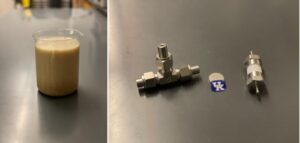
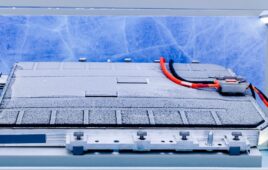
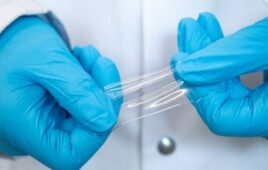
Researchers converted bourbon distillery waste (left image) into electrodes for supercapacitors (right image) that store more energy per kilogram than commercial devices. Credit: Josiel Barrios Cossio
For every barrel of bourbon produced, there are up to 10 barrels of stillage waste, a mixture of grain and water. Stillage is usually sold to farmers as livestock feed or a soil additive, but it needs to be dried out to reduce its weight and make it easier to process. This requires time and space for evaporation, or an expensive heating process.
This problem drove the researchers to find a way to transform the waste into components for supercapacitors, repurposing an industrial byproduct in a way that could help to stabilize the electrical grid.
“We could take the stillage as it is, in a dispersion with a lot of water and use that disadvantage as an advantage,” said Josiel Barrios Cossio, a graduate student involved in the research.
More than 95% of all bourbon is made in Kentucky, and distilleries in the state have increased by 250% over the past 15 years.
Turning sludge into carbon electrodes
The team used a technique called hydrothermal carbonization (HTC), a chemical process for converting organic compounds into structured carbons, to convert the stillage into a carbonaceous material called hydrochar. HTC occurs in a reactor at temperatures ranging from 180 to 250 degrees Celsius. The stillage’s high water content makes the process possible without pre-drying. Under these conditions, liquid water behaves as a reactant, solvent and reaction medium for the biomass, leading to its degradation through heterogeneous chemical reactions.
The process involves multiple reactions: hydrolysis, dehydration, decarboxylation and aromatization, occurring under high temperature and pressure to produce the carbon-rich hydrochar. HTC has been successfully applied to sewage sludge, algae and municipal solid waste.
The team then heated the resulting hydrochar in a furnace to create two types of carbon electrodes: hard carbon, ideal for absorbing lithium ions to boost energy storage, and activated carbon, a highly porous material that can store massive amounts of charge. By applying this process to bourbon stillage, the Kentucky team was able to use a single agricultural waste source to derive both electrode types needed for a hybrid device.
“It was a huge discovery for me that you can make hybrid devices from this waste,” Barrios Cossio said. “Hybrid devices are not common. Not common and not easy to make.”
Performance rivals commercial devices
The team created a proof-of-concept electric double-layer capacitor with a liquid electrolyte between activated carbon electrodes made from the bourbon stillage. The capacitor achieved an energy density of up to 48 Wh/kg, similar to the performance of currently available devices.
The Kentucky team collaborated with a group at Friedrich Schiller University in Germany to develop the hybrid lithium-ion supercapacitors. The researchers built devices with one capacitor-type activated carbon electrode and one battery-type hard carbon electrode, both infused with lithium ions.
The scientists partnered with distilleries across the U.S. and Canada to access stillage samples.
The team’s hybrid lithium-ion supercapacitors stored up to 25 times more energy per kilogram than conventional supercapacitors. They also retained 96% of their capacity after 15,000 cycles.
The researchers are now pursuing life cycle and feasibility analyses to assess whether the approach can be scaled, with a long-term goal of grid-scale energy storage to support renewable power integration.