A new study published in Nature found that Antarctic ice loss is remarkably predictable for the next few decades, but varies by glacier.
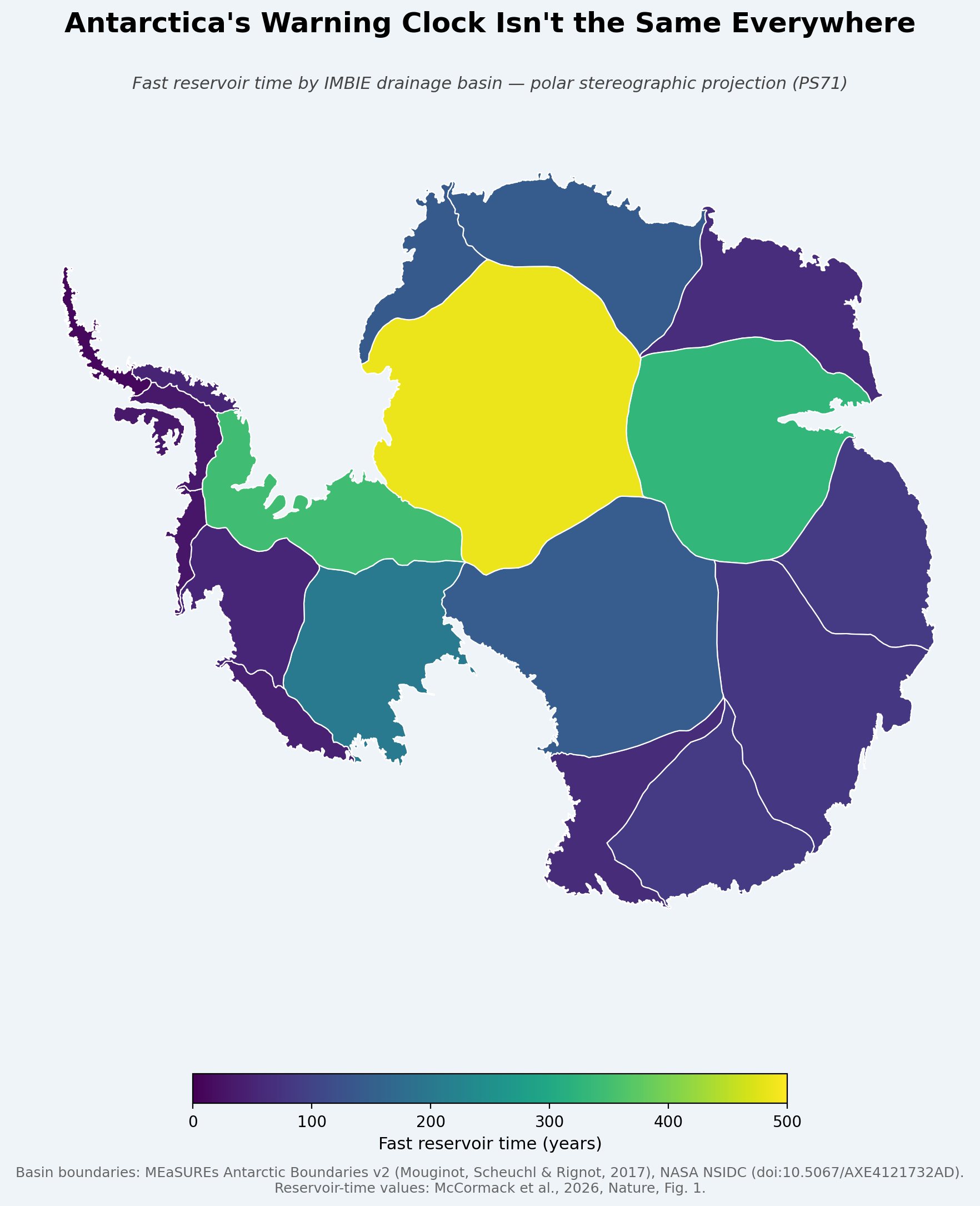
Fast reservoir time by Antarctic drainage basin — a measure of how quickly each region responds to melt or ocean forcing, ranging from 11 years on the Antarctic Peninsula to nearly 500 years in parts of East Antarctica. Source: McCormack et al., 2026, Nature; basin boundaries via NASA NSIDC
Near-term Antarctic ice loss is linearly predictable through the mid-21st century, but this predictability isn’t a single number. Instead, it’s governed by a physical property called “reservoir timescale” which swings from roughly a decade to nearly 500 years depending on the glacier basin.
In relatively good news, the study ruled out the Intergovernmental Panel on Climate Change’s (IPCC’s) low-likelihood/high-impact 2050 sea-level scenarios, finding that the near-term rate of Antarctic ice loss is a strong predictor of the rate decades out. However, after 2080, this predictability gradually breaks down, and by 2100 there’s little relationship left.
Reservoir time: the physical property behind the prediction
“Ice sheets will generally respond on two timescales — a slow timescale and a fast timescale… The slow reservoir time is on the order of thousands to tens of thousands of years. But then we have this fast timescale, which is really governed by what’s happening near the margin as the ice sheet comes into contact with the dynamic ocean,” said first author Felicity McCormack, a senior lecturer at Monash University.
“I like to think of this reservoir timescale as a bit like the memory that an ice sheet has… it holds on to its memory, if you like, a couple of decades before the response can really be seen in this marked acceleration,” she said.
Fast reservoir time is a function of grounding-line ice thickness and surface mass balance. Basins with thinner margins and higher snowfall rates have shorter fast-timescale memories, responding to melt or ocean changes within decades. But every basin also has a separate, much longer slow reservoir time, governing how long it takes snow that falls deep in the interior to work its way out to the coast, and those numbers run into the thousands to tens of thousands of years. A basin can react at its edge within decades while its interior is still carrying the imprint of snowfall from millennia ago.
The Amundsen Sea sector of Antarctica is the fastest-melting region, and has a short timescale of only 53 years. This means that the ice sheet there takes approximately 53 years to respond to external conditions, such as the warming of the planet.
In contrast, some of the bigger ice basins in East Antarctica have short-term memories of a century or more. Basins in the center of the continent have short-term memories of 330 to 485 years. The Antarctic Peninsula has the shortest timescale of only 11 years.
The Peninsula isn’t losing ice as fast as the Amundsen sector, but its 11-year short timescale means it will show a fully accelerated response to today’s changes far sooner than any other section of the continent.
“What we do now — we might not see the response of the ice sheet for what we’re doing now till decades into the future… if an ice shelf collapses today, we will see some acceleration in ice loss from the continent into the ocean, but the kind of really sustained acceleration is going to obey this reservoir timescale,” McCormack said.
Basins with shorter memories are already responding to the warming planet, but those with longer memories won’t respond for decades. The effects of global warming on the largest ice basins have yet to be seen.
The same physics that rules out the IPCC’s worst case scenario also means that policy decisions and other actions won’t show their full cost for a generation.
Where the model’s predictive power breaks down
The predictability of Antarctic ice loss holds strongly through the middle of this century and then droops below a workable confidence level around 2080, which the authors state is “a practical threshold rather than a distinct physical boundary.”
After 2080, the effects of several feedback mechanisms, such as marine ice-sheet instability (MISI), subglacial hydrology, seawater intrusion and ice-sheet-climate feedbacks, which barely register in the near-term, begin to increase.
Low-lying island nations are among those who will be most affected by Antarctic ice loss, McCormack said.
“I was in the Maldives a couple of years ago, and the ocean — the sea levels are already lapping right at the road that goes around the main island. And already, you know, Pacific Island nations are having to plan for, in the absolute worst case, relocation,” she said.
“Now is the time to use the best evidence that we have for what that could look like, to help plan,” she added.