 In April, Anthropic acquired the biotech Coefficient Bio for $400 million. In June, the company signaled its intent to automate science more broadly, starting with its Claude Science platform. In August, it announced a research preview of Model Hardware Standard (MHS), an open interface specification that lets AI agents operate physical devices such as microscopes.
Now Novo Nordisk and Anthropic are expanding an existing relationship to test Claude Science on drug discovery problems chosen by Novo’s own scientists. The Danish drugmaker is trying to speed up research after a series of obesity-pipeline setbacks, including CagriSema, which failed to show non-inferiority to Lilly’s tirzepatide.
Under the collaboration announced Sept. 16, the companies will work together on drug discovery challenges identified by Novo’s scientists and computational teams. They will also build targeted tools and workflows to support “biological reasoning.” The first step is a trial run in which Novo will test Claude Science on specific R&D workflows. Novo said the work is being done under data governance and human oversight that follow its ethics and compliance standards.
In the announcement, Novo CEO Mike Doustdar presented the deal as part of the company’s push to become “the world’s most AI-driven healthcare company.” He said AI could raise R&D productivity and “compress the path from research to marketed product.” Beyond speed, he said, AI tools could open “completely new scientific opportunities” and help researchers understand human biology and how drugs work.
Anthropic CEO Dario Amodei used similar language on a larger scale. “AI’s increasing capability brings with it the potential to compress a century’s worth of biological and medical breakthroughs into a decade,” he said. Giving leading researchers access to frontier models, he added, could shorten research timelines and lead to medicines that significantly improve human life. “That is exactly what our collaboration with Novo is built to achieve.”
The companies did not disclose specific therapeutic programs, benchmarks, timelines or financial terms.
The Anthropic pact is the latest of several AI partnerships at Novo. The company announced a collaboration with OpenAI in April and named AWS a strategic partner last month. Both deals were described in similarly broad terms around scientific discovery and operational efficiency. In June 2025, Novo and the Danish Centre for AI Innovation (DCAI) partnered with NVIDIA, which gave Novo access to DCAI’s Gefion supercomputer. The planned work included predicting how cells respond to drug candidates, designing molecules with drug-like properties and building biomedical language models.
Claude already has a role at Novo
Novo had embraced AI early when it was near the height of its semaglutide-fueled run. In 2024, it described NovoScribe, an AI-powered documentation platform with the help of Claude, Amazon Bedrock and MongoDB that cut the time required to generate complex Clinical Study Reports (CSRs) from weeks or months down to 10 minutes.
In the intervening years, however, the company has seen its fortunes reverse after its stock worth was briefly worth more than the entire economy of Denmark in 2024. In February 2026, Novo forecast that 2026 sales would fall 5% to 13%, while Eli Lilly projected as much as $83 billion in revenue and reclaimed a $1 trillion market valuation. Novo’s U.S.-listed shares, which topped $140 in 2024, closed at $41.71 on Sept. 16, down nearly 18% over five years.
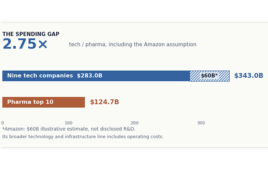
Lilly also spends more in terms of overall R&D, reporting $13.3 billion in R&D expense in 2025. That amounts to roughly $5.5 billion more than Novo’s DKK52.0 billion, or roughly $7.9 billion at the year’s average exchange rate. Research accounted for 20.5% of Lilly’s revenue and 16.8% of Novo’s.
Tell Us What You Think!
You must be logged in to post a comment.