Research & Development World

  • R&D World Home
  • Topics
    • Aerospace
    • Automotive
    • Biotech
    • Careers
    • Chemistry
    • Environment
    • Energy
    • Life Science
    • Material Science
    • R&D Management
    • Physics
  • Technology
    • 3D Printing
    • A.I./Robotics
    • Software
    • Battery Technology
    • Controlled Environments
      • Cleanrooms
      • Graphene
      • Lasers
      • Regulations/Standards
      • Sensors
    • Imaging
    • Nanotechnology
    • Scientific Computing
      • Big Data
      • HPC/Supercomputing
      • Informatics
      • Security
    • Semiconductors
  • R&D Market Pulse
  • R&D 100
    • 2025 R&D 100 Award Winners
    • 2025 Professional Award Winners
    • 2025 Special Recognition Winners
    • R&D 100 Awards Event
    • R&D 100 Submissions
    • Winner Archive
  • Resources
    • Research Reports
    • Digital Issues
    • Educational Assets
    • Subscribe
    • Video
    • Webinars
    • Content submission guidelines for R&D World
  • Global Funding Forecast
  • Top Labs
  • Advertise
  • SUBSCRIBE

Scientists Discover Oldest Evidence of Human Evolution in South Africa

By Kenny Walter | June 25, 2018

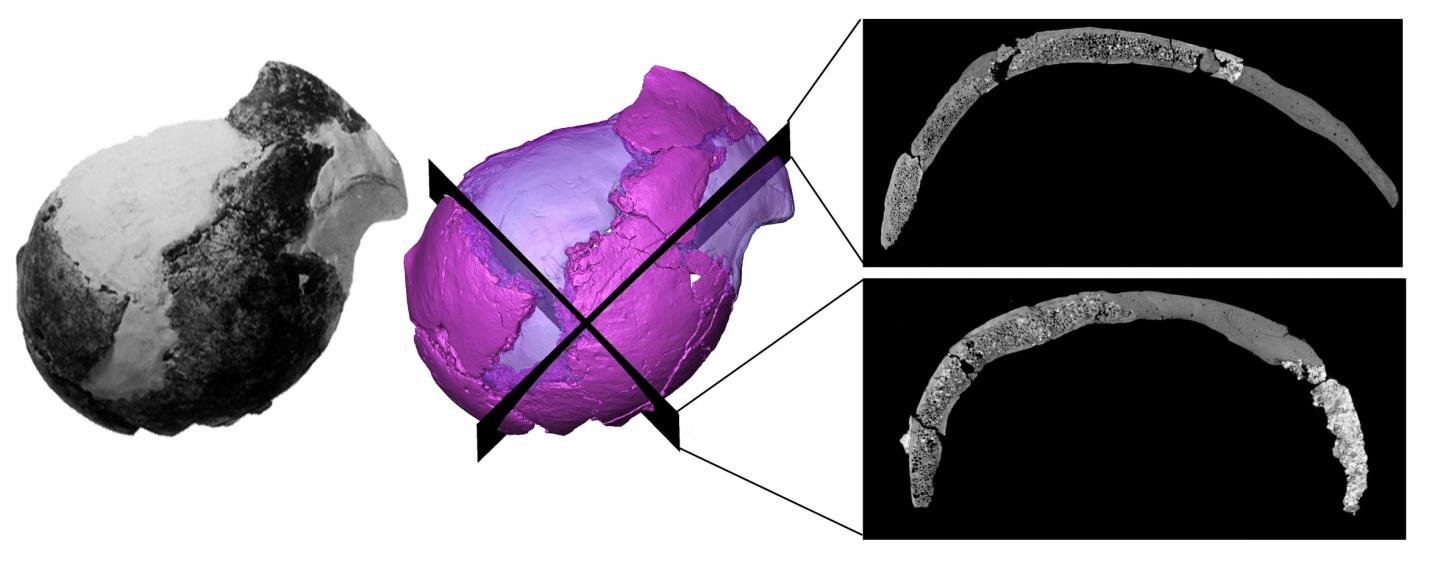
Original picture (left) and virtual rendering of the Jacovec cranium (middle) with two sections revealing the inner structure (right).

Researchers have discovered that a four-million-year-old cranium fossil found 23 years ago—recently scanned through high resolution imaging systems—has similar features to modern human craniums.

The cranium was found in the lower-lying deposits of the Jacovec Cavern in the Sterkfontein Caves of South Africa in 1995. The fossil, which is believed to be the oldest evidence of human evolution in South Africa, is from the extinct Australopithecus genus.

“The Jacovec cranium represents a unique opportunity to learn more about the biology and diversity of our ancestors and their relatives and, ultimately, about their evolution,” Amelie Beaudet, PhD, from the School of Geography, Archaeology and Environmental Studies of the University of the Witwatersrand, said in a statement. “Unfortunately, the cranium is highly fragmentary and not much could be said about the identity nor the anatomy of the Jacovec specimen before.”

The researchers scanned the cranium and applied advanced imaging techniques in virtual paleontology to further explore the anatomy of the fossil. This allowed them to non-invasively explore the fine details of its inner anatomy.

“Our study revealed that the cranium of the Jacovec specimen and of the Ausralopithecus specimens from Sterkfontein in general was thick and essentially composed of spongy bone,” Beaudet said. “This large portion of spongy bone, also found in our own cranium, may indicate that blood flow in the brain of Australopithecus may have been comparable to us, and/or that the braincase had an important role in the protection of the evolving brain.”

The researchers then compared the cranium to a cranium from the Paranthropus, another extinct group that lived in South Africa along with the first humans less than two-million-years ago.

“We also found that the Paranthropus cranium was relatively thin and essentially composed of compact bone,” Beaudet said. “This result is of particular interest, as it may suggest a different biology.”

Situated in the Cradle of humankind, a Unesco World Heritage Site, the South African paleontological sites have played a pivotal role in the exploration of our origins. The Sterkfontein Caves in particular have featured abundant supplies of fossils with more than 800 hominin remains representing three genera of hominin recovered since 1936.

The treasure trove of fossils recovered include the first adult Australopithecus, the iconic “Mrs Ples” and “Little Foot,” the most complete single skeleton of an early hominin yet found.

“The Jacovec cranium exemplifies the relevance of the Sterkfontein fossil specimens for our understanding of human evolution,” Beaudet said. “Imaging techniques open unique perspectives for revisiting the South African fossil assemblage.”

The study was published in the Journal of Human Evolution.
Related Articles Read More >

Beyond the sequence: how Ötzi the Iceman exposed the blind spots of pure metagenomics
Breakthrough in the Discovery of DNA in Ancient Bones Buried in Water
Traces of Crawling in Italian Cave Give Clues to Ancient Humans’ Social Behavior
Freshwater Mussel Shells Were Material of Choice For Prehistoric Craftsmen
rd newsletter
EXPAND YOUR KNOWLEDGE AND STAY CONNECTED
Get the latest info on technologies, trends, and strategies in Research & Development.

R&D World Digital Issues

Fall 2025 issue

Browse the most current issue of R&D World and back issues in an easy to use high quality format. Clip, share and download with the leading R&D magazine today.

R&D 100 Awards
Research & Development World
  • Subscribe to R&D World Magazine
  • Sign up for R&D World’s newsletter
  • Contact Us
  • About Us
  • Drug Discovery & Development
  • Pharmaceutical Processing
  • Global Funding Forecast

Copyright © 2026 WTWH Media LLC. All Rights Reserved. The material on this site may not be reproduced, distributed, transmitted, cached or otherwise used, except with the prior written permission of WTWH Media
Privacy Policy | Advertising | About Us

Search R&D World

  • R&D World Home
  • Topics
    • Aerospace
    • Automotive
    • Biotech
    • Careers
    • Chemistry
    • Environment
    • Energy
    • Life Science
    • Material Science
    • R&D Management
    • Physics
  • Technology
    • 3D Printing
    • A.I./Robotics
    • Software
    • Battery Technology
    • Controlled Environments
      • Cleanrooms
      • Graphene
      • Lasers
      • Regulations/Standards
      • Sensors
    • Imaging
    • Nanotechnology
    • Scientific Computing
      • Big Data
      • HPC/Supercomputing
      • Informatics
      • Security
    • Semiconductors
  • R&D Market Pulse
  • R&D 100
    • 2025 R&D 100 Award Winners
    • 2025 Professional Award Winners
    • 2025 Special Recognition Winners
    • R&D 100 Awards Event
    • R&D 100 Submissions
    • Winner Archive
  • Resources
    • Research Reports
    • Digital Issues
    • Educational Assets
    • Subscribe
    • Video
    • Webinars
    • Content submission guidelines for R&D World
  • Global Funding Forecast
  • Top Labs
  • Advertise
  • SUBSCRIBE