Research & Development World

  • R&D World Home
  • Topics
    • Aerospace
    • Automotive
    • Biotech
    • Careers
    • Chemistry
    • Environment
    • Energy
    • Life Science
    • Material Science
    • R&D Management
    • Physics
  • Technology
    • 3D Printing
    • A.I./Robotics
    • Software
    • Battery Technology
    • Controlled Environments
      • Cleanrooms
      • Graphene
      • Lasers
      • Regulations/Standards
      • Sensors
    • Imaging
    • Nanotechnology
    • Scientific Computing
      • Big Data
      • HPC/Supercomputing
      • Informatics
      • Security
    • Semiconductors
  • R&D Market Pulse
  • R&D 100
    • 2025 R&D 100 Award Winners
    • 2025 Professional Award Winners
    • 2025 Special Recognition Winners
    • R&D 100 Awards Event
    • R&D 100 Submissions
    • Winner Archive
  • Resources
    • Research Reports
    • Digital Issues
    • Educational Assets
    • R&D Index
    • Subscribe
    • Video
    • Webinars
    • Content submission guidelines for R&D World
  • Global Funding Forecast
  • Top Labs
  • Advertise
  • SUBSCRIBE

A ‘Recipe Book’ that Creates Color Centers in Silicon Carbide Crystals

By American Institute of Physics | October 1, 2018

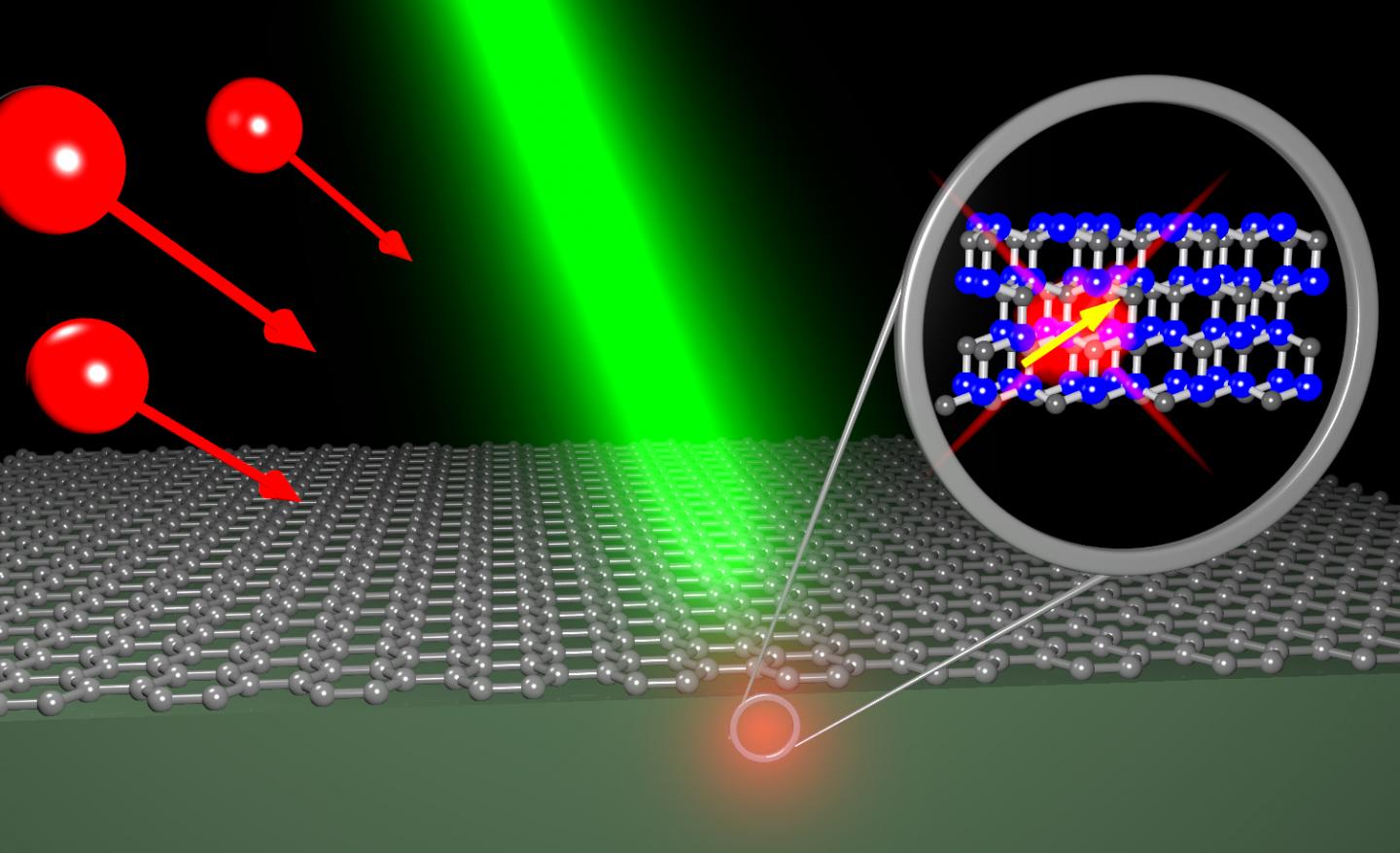
Green SiC substrate at the bottom with the graphene layer on top irradiated by protons, generating a luminescent defect in the SiC crystal. Credit: Maximilian Rühl

Silicon carbide (SiC), a material known for its toughness with applications from abrasives to car brakes, to high-temperature power electronics, has enjoyed renewed interest for its potential in quantum technology. Its ability to house optically excitable defects, called color centers, has made it a strong candidate material to become the building block of quantum computing.

Now, a group of researchers has created a list of “recipes” physicists can use to create specific types of defects with desired optical properties in SiC. In one of the first attempts to systematically explore color centers, the group used proton irradiation techniques to create the color centers in silicon carbide. They adjusted proton dose and temperature to find the right conditions that reliably produce the desired type of color center. The team reports their findings in Applied Physics Letters, from AIP Publishing.

Atomic defects in the lattice of SiC crystals create color centers that can emit photons with unique spectral signatures. While some materials considered for quantum computing require cryogenically low temperatures, color centers in SiC can emit at room temperature. As the push to create increasingly smaller devices continues into atom-scale sensors and single-photon emitters, the ability to take advantage of existing SiC integrated circuit technology makes the material a standout candidate.

To create the defects, Michael Krieger and his colleagues bombarded SiC samples with protons. The team then let the SiC go through a heating phase called annealing. “We’re doing a lot of damage to these crystals,” Krieger said. “However, during annealing, the crystal structure recovers, but defects are also formed — some of them are the desired color centers.”

To ensure that their recipes are compatible with usual semiconductor technology, the group opted to use proton irradiation. Moreover, this approach doesn’t require electron accelerators or nuclear reactors like other techniques used to create color centers.

The data from using different doses and annealing temperatures showed that producing defects in SiC follows a pattern. Initially protons generate predominantly silicon vacancies in the crystal, then those vacancies sequentially transform into other defect complexes.

Studying the defects’ low-temperature photoluminescence spectra led the team to discover three previously unreported signatures. The three temperature-stable (TS) lines were shown to correlate with proton dose and annealing temperature.

Krieger said these TS lines have exciting properties and further research is already going on as the group hopes to utilize and control those defects for use in SiC-based quantum technology devices.

Related Articles Read More >

Researchers could be one step closer to understanding the origin of matter thanks to a new study
The Milky Way is glowing: these scientists think dark matter may be the cause
Three scientists awarded Nobel Prize in physics for showing quantum properties could exist in large-scale systems
ORNL named on 20 R&D 100 Awards, including carbon-capture and AM tools
rd newsletter
EXPAND YOUR KNOWLEDGE AND STAY CONNECTED
Get the latest info on technologies, trends, and strategies in Research & Development.
RD 25 Power Index

R&D World Digital Issues

Fall 2025 issue

Browse the most current issue of R&D World and back issues in an easy to use high quality format. Clip, share and download with the leading R&D magazine today.

R&D 100 Awards
Research & Development World
  • Subscribe to R&D World Magazine
  • Sign up for R&D World’s newsletter
  • Contact Us
  • About Us
  • Drug Discovery & Development
  • Pharmaceutical Processing
  • Global Funding Forecast

Copyright © 2025 WTWH Media LLC. All Rights Reserved. The material on this site may not be reproduced, distributed, transmitted, cached or otherwise used, except with the prior written permission of WTWH Media
Privacy Policy | Advertising | About Us

Search R&D World

  • R&D World Home
  • Topics
    • Aerospace
    • Automotive
    • Biotech
    • Careers
    • Chemistry
    • Environment
    • Energy
    • Life Science
    • Material Science
    • R&D Management
    • Physics
  • Technology
    • 3D Printing
    • A.I./Robotics
    • Software
    • Battery Technology
    • Controlled Environments
      • Cleanrooms
      • Graphene
      • Lasers
      • Regulations/Standards
      • Sensors
    • Imaging
    • Nanotechnology
    • Scientific Computing
      • Big Data
      • HPC/Supercomputing
      • Informatics
      • Security
    • Semiconductors
  • R&D Market Pulse
  • R&D 100
    • 2025 R&D 100 Award Winners
    • 2025 Professional Award Winners
    • 2025 Special Recognition Winners
    • R&D 100 Awards Event
    • R&D 100 Submissions
    • Winner Archive
  • Resources
    • Research Reports
    • Digital Issues
    • Educational Assets
    • R&D Index
    • Subscribe
    • Video
    • Webinars
    • Content submission guidelines for R&D World
  • Global Funding Forecast
  • Top Labs
  • Advertise
  • SUBSCRIBE