By Christina Nunez

Applications for Argonne’s thermal energy storage system include combined heat and power systems, power plants, desalination plants, heavy-duty trucks, and more. (Image by Factory_Easy/Shutterstock.)
Many processes that generate electricity also produce heat, a potent energy resource that often goes untapped everywhere from factories to vehicles to power plants. An innovative system currently being developed at the U.S. Department of Energy’s (DOE) Argonne National Laboratory can quickly store heat and release it for use when needed, surpassing conventional storage options in both flexibility and efficiency.
Argonne’s thermal energy storage system, or TESS, was originally developed to capture and store surplus heat from concentrated solar power facilities. It is also suitable for a variety of commercial applications, including desalination plants, combined heat and power (CHP) systems, industrial processes, and heavy-duty trucks.
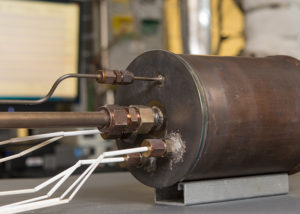
The size of a garbage bin, Argonne’s thermal energy storage system can be scaled up or down to meet the needs of virtually any commercial application. (Image by Argonne National Laboratory.)
Being able to recover and use waste heat can raise efficiency and cut costs by extracting more energy from the same amount of fuel. In the case of an electricity or desalination plant running on concentrated solar power, the TESS can capture heat during the day and release it at night to keep the plant running. Argonne’s work to develop the system is funded by DOE’s Solar Energy Technologies Office.
“Any time you have a combustion process, you are wasting about 60% of the energy as heat,” said Dileep Singh, a senior materials scientist at Argonne who has led the TESS development. “In a sense, this is a thermal version of a battery, where you charge and discharge heat rather than electricity.”
Argonne’s TESS is a form of latent heat storage, where the energy is contained within a phase-change material such as molten salt. While such materials are good at retaining heat, they are typically poor conductors, so it takes too long for them to absorb and release energy.
To get around this limitation, researchers at Argonne devised a way to embed phase-change materials within porous, highly thermally conductive foam. They then seal the foam with inert gas inside a module, preventing moisture or oxygen from getting inside and degrading the components. Stored heat inside a unit can then be transferred to water, for example, where it becomes steam that moves a turbine. The TESS also can be tuned to a specific application by selecting different phase-change materials.
“One of the big advantages of our technology is that it’s modular, so you don’t need a huge storage structure,” Singh said. “You can make these modules of a certain manageable size, such as a 55-gallon drum or smaller, and install them in whatever number you require.”
Researchers have demonstrated the TESS to operate in temperatures over 700°C (1,292°F). Its high energy density makes it smaller and more flexible than commonly used sensible heat storage systems, which rely on raising and lowering a material’s temperature. The technology won a 2019 R&D 100 award, and researchers are now working to integrate it within CHP systems from Capstone Turbine Corporation to boost heat recovery.
With the help of industry partners, Singh and colleagues continue to refine the TESS technology, and they have developed an in-house testing facility to test performance with repeated charging and discharging. In addition to enhancing CHP systems and extending the dispatchability of desalination and power plants, the TESS could convert waste heat to mechanical energy in heavy-duty trucks or to interior heating for electric vehicles. And just as the TESS can function as a battery for heat, it can do the same for cold, possibly offering a cooling option for commercial buildings.
Companies interested in licensing or partnering on this technology can email partners@anl.gov.
For more information, visit energy.gov/science.


Link to energy.gov/science is broken
Thank you for pointing it out. It’s fixed now. – Heather Hall, assoc. editor
The Argonne concept has many similar benefits/applications to another technology patented by Dae Kim in 1996 (US 5,560,350); namely, a rotating ceramic core that stores hot gases under pressure. Another of his patents using a similar technology offers an economical and environmentally friendly solution to disposal of medical wastes associated with the current Covid-19 pandemic (US 5632210). The title of that invention is “High temperature incinerator for bio-active solid wastes” which was issued May 27, 1997. For more information on related inventions of Dr. Kim see: http://www.iprsinc.org/IPRS_InvHighlight1.htm