Research & Development World

  • R&D World Home
  • Topics
    • Aerospace
    • Automotive
    • Biotech
    • Careers
    • Chemistry
    • Environment
    • Energy
    • Life Science
    • Material Science
    • R&D Management
    • Physics
  • Technology
    • 3D Printing
    • A.I./Robotics
    • Software
    • Battery Technology
    • Controlled Environments
      • Cleanrooms
      • Graphene
      • Lasers
      • Regulations/Standards
      • Sensors
    • Imaging
    • Nanotechnology
    • Scientific Computing
      • Big Data
      • HPC/Supercomputing
      • Informatics
      • Security
    • Semiconductors
  • R&D Market Pulse
  • R&D 100
    • 2025 R&D 100 Award Winners
    • 2025 Professional Award Winners
    • 2025 Special Recognition Winners
    • R&D 100 Awards Event
    • R&D 100 Submissions
    • Winner Archive
  • Resources
    • Research Reports
    • Digital Issues
    • Educational Assets
    • Subscribe
    • Video
    • Webinars
    • PharmSci360
    • Content submission guidelines for R&D World
  • Global Funding Forecast
  • Top Labs
  • Advertise
  • SUBSCRIBE

ALMA Measures Size of Seeds of Planets

By National Institute of Natural Sciences | December 5, 2016

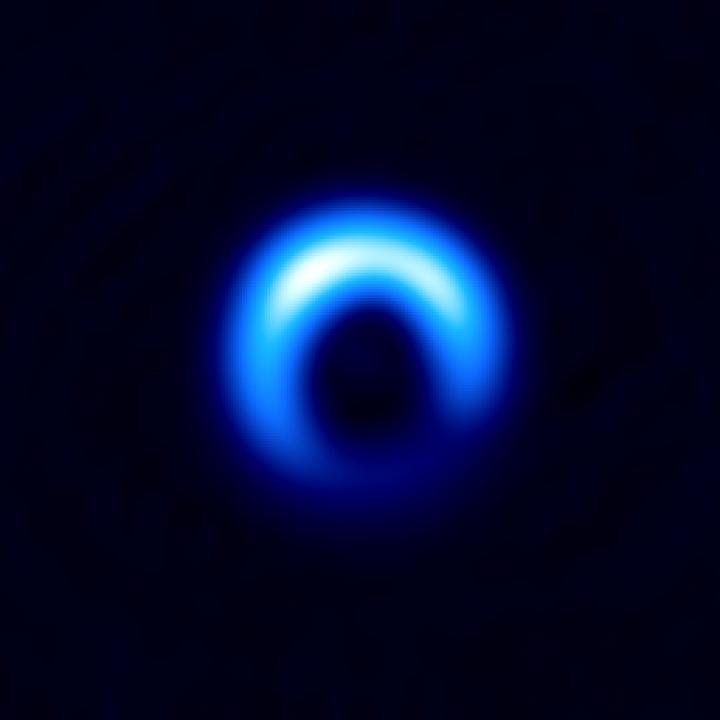
Dust disk around the young star HD 142527 observed with ALMA. Source: ALMA (ESO/NAOJ/NRAO), Kataoka et al.

Researchers using the Atacama Large Millimeter/submillimeter Array (ALMA), have for the first time, achieved a precise size measurement of small dust particles around a young star through radio-wave polarization. ALMA’s high sensitivity for detecting polarized radio waves made possible this important step in tracing the formation of planets around young stars.

Astronomers have believed that planets are formed from gas and dust particles, although the details of the process have been veiled. One of the major enigmas is how dust particles as small as 1 micrometer aggregate to form a rocky planet with a diameter of 10 thousand kilometers. Difficulty in measuring the size of dust particles has prevented astronomers from tracing the process of dust growth.

Akimasa Kataoka, a Humboldt Research Fellow stationed at Heidelberg University and the National Astronomical Observatory of Japan, tackled this problem. He and his collaborators have theoretically predicted that, around a young star radio waves scattered by the dust particles should carry unique polarization features. He also noticed that the intensity of polarized emissions allows us to estimate the size of dust particles far better than other methods.

To test their prediction, the team led by Kataoka observed the young star HD 142527 with ALMA (note 1) and discovered, for the first time, the unique polarization pattern in the dust disk around the star. As predicted, the polarization has a radial direction in most parts of the disk, but at the edge of the disk, the direction is flipped perpendicular to the radial direction.

Comparing the observed intensity of the polarized emissions with the theoretical prediction, they determined that the size of the dust particles is at most 150 micrometers. This is the first estimation of the dust size based on polarization. Surprisingly, this estimated size is more than 10 times smaller than previously thought.

“In the previous studies, astronomers have estimated the size based on radio emissions assuming hypothetical spherical dust particles,” explains Kataoka. “In our study, we observed the scattered radio waves through polarization, which carries independent information from the thermal dust emission. Such a big difference in the estimated size of dust particles implies that the previous assumption might be wrong.”

The team’s idea to solve this inconsistency is to consider fluffy, complex-shaped dust particles, not simple spherical dust (note 2.). In the macroscopic view, such particles are indeed large, but in the microscopic view, each small part of a large dust particle scatters radio waves and produces unique polarization features. According to the present study, astronomers obtain these “microscopic” features through polarization observations. This idea might prompt astronomers to reconsider the previous interpretation of observational data.

“The polarization fraction of radio waves from the dust disk around HD 142527 is only a few percent. Thanks to ALMA’s high sensitivity, we have detected such a tiny signal to derive information about the size and shape of the dust particles,” said Kataoka. “This is the very first step in the research on dust evolution with polarimetry, and I believe the future progress will be full of excitement.”

Related Articles Read More >

July 2026 issue of Medical Design & Outsourcing: Robotic stroke telesurgery’s time is now
Perseverance uncovers buried evidence of Mars’ ancient water history using ground-penetrating radar
University of Michigan researchers identify higher-order protein rings that regulate programmed cell death
JWST spots a 6-mile moon hiding in Uranus’ rings
rd newsletter
EXPAND YOUR KNOWLEDGE AND STAY CONNECTED
Get the latest info on technologies, trends, and strategies in Research & Development.

R&D World Digital Issues

Fall 2025 issue

Browse the most current issue of R&D World and back issues in an easy to use high quality format. Clip, share and download with the leading R&D magazine today.

R&D 100 Awards
Research & Development World
  • Subscribe to R&D World Magazine
  • Sign up for R&D World’s newsletter
  • Contact Us
  • About Us
  • Drug Discovery & Development
  • Pharmaceutical Processing
  • Global Funding Forecast

Copyright © 2026 Arrowfly LLC. All Rights Reserved. The material on this site may not be reproduced, distributed, transmitted, cached or otherwise used, except with the prior written permission of Arrowfly
Privacy Policy | Advertising | About Us

Search R&D World

  • R&D World Home
  • Topics
    • Aerospace
    • Automotive
    • Biotech
    • Careers
    • Chemistry
    • Environment
    • Energy
    • Life Science
    • Material Science
    • R&D Management
    • Physics
  • Technology
    • 3D Printing
    • A.I./Robotics
    • Software
    • Battery Technology
    • Controlled Environments
      • Cleanrooms
      • Graphene
      • Lasers
      • Regulations/Standards
      • Sensors
    • Imaging
    • Nanotechnology
    • Scientific Computing
      • Big Data
      • HPC/Supercomputing
      • Informatics
      • Security
    • Semiconductors
  • R&D Market Pulse
  • R&D 100
    • 2025 R&D 100 Award Winners
    • 2025 Professional Award Winners
    • 2025 Special Recognition Winners
    • R&D 100 Awards Event
    • R&D 100 Submissions
    • Winner Archive
  • Resources
    • Research Reports
    • Digital Issues
    • Educational Assets
    • Subscribe
    • Video
    • Webinars
    • PharmSci360
    • Content submission guidelines for R&D World
  • Global Funding Forecast
  • Top Labs
  • Advertise
  • SUBSCRIBE