In the Amazon rainforest, scientists are pumping carbon dioxide into the canopy to simulate atmospheric conditions that may arise due to climate change to study how the biome adapts to heightened levels of carbon dioxide.
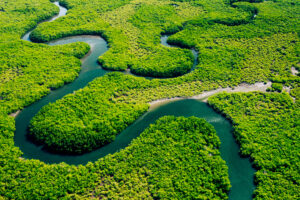
The Amazon rainforest. Credit: Adobe
Predicting the future
The project is called AmazonFACE, short for Free-Air CO2 Enrichment. It is located near Manaus, the largest city in the Amazon. Six rings of steel towers surround groups of 50 to 70 mature trees. The scientists will fumigate trees in three of the rings with CO2, with the rest serving as control samples. The experimental groups will be exposed to a concentration of CO2 50% higher than the current atmospheric concentration.
The team will study carbon fluxes and storage in plant tissues, litter and soil; cycling of nutrients; the flow of water; and biodiversity to answer the question of how the increase in CO2 affects the rainforest.
The FACE technology has been used around the world: at national labs in the U.S. and in Australia and the U.K. AmazonFACE is the first time this experiment has been implemented in a tropical forest with high biodiversity.
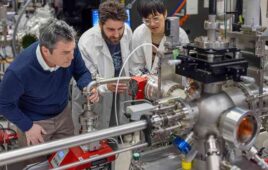
Each of the FACE rings consists of 16 towers covering an area of 30 meters in diameter and 35 meters in height. The towers are connected to a CO2 storage tank. Computational sensors control the release of CO2 according to the wind speed and direction.
A project decades in the making
The project started in 2015 with baseline measurements of the working conditions of the forest before CO2 enrichment. In 2022, the construction and testing of the FACE rings began. Cranes installed next to each ring provide access to the treetops for measurements. The construction of the rings was completed in 2024, and the experiment, which will run for ten years, began.
Sensors record the forest’s response to changing conditions every ten minutes, showing how foliage absorbs CO2 while releasing oxygen and water vapor in response to weather conditions, forestry engineer Gustavo Carvalho said.
“If a model predicts a certain amount (of carbon dioxide in the atmosphere) in 2050 or 2060, then we’ll increase to that amount in these plots to try to understand how the forest responds,” Carvalho told Reuters. “We’ll have a small plot here in the forest that we can enter and know what will happen in the future.”
The AmazonFACE team has published dozens of articles since 2013 in journals such as Nature, Science and Plant-Environment Interactions. AmazonFACE is supported by the Brazilian government and the U.K.