The detrimental effects of petroleum-derived plastics are well known. As pollution levels rise and concerns about microplastics and forever chemicals intensify, the need for a sustainable solution becomes increasingly evident.
In response to this need, researchers are developing biodegradable plastics. However, bioplastics are not as strong as traditional plastics and only degrade in a high-temperature composting system, making them an unattractive alternative to petroleum-derived plastics.
Researchers at Washington University in St. Louis may have solved both problems. Inspired by leaves, the chemical engineers integrated cellulose nanofibers into a new bioplastic design, called Layered, Ecological, Advanced and multi-Functional Film (LEAFF).
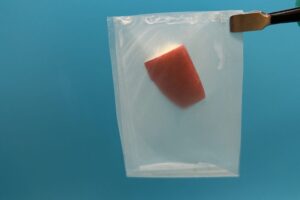
LEAFF bioplastic packaging holds an apple slice. The original form of this fermented sugar-based plastic requires high-temperature composting to degrade, but WashU’s engineers have a new form of this packaging that degrades into harmless organic material at room temperature. Credit: Puneet Dhatt
Cellulose saves the day
The researchers created a multilayer structure, with cellulose in the center and bioplastic on either side, making it stronger than others. The researchers applied this design to two of the most common bioplastics, polyhydroxybutrate (PHB) and polylactic acid (PLA). They published two studies showing the variations of their design.
The PLA version of LEAFF made the plastic biodegradable at room temperature. LEAFF also decreases the permeability of bioplastics, which helps keep food stable and creates a printable surface, saving materials and money from extra labels.
“On top of all of this, the LEAFF’s underlying cellulose structure gives it a higher tensile strength than even petrochemical plastics like polyethylene and polypropylene,” explained Puneet Dhatt, a PhD student in Yuan’s lab and first author on the article.
Creating a circular economy
The bioplastics industry has a unique opportunity to create a circular economy, where waste products are reused. LEAFF could help to close this loop. Engineers from WashU’s McKelvey School of Engineering created bioplastics from wastes such as carbon dioxide, lignin and food waste. Now, those bioplastics can be altered with LEAFF to be fully biodegradable, creating a process that decreases the amount of waste.
The U.S.’s strong agricultural industry positions the country as a strong competitor in bioplastics, said Joshua Yuan, the Lucy and Stanley Lopata Professor and chair of energy, environmental and chemical engineering at the McKelvey School of Engineering. Bioplastic production requires the products of corn or starch fermentation by microbes, lactic acid, acetate or fatty acids.
Yuan believes the U.S. can provide the “feedstock” for bioplastic production at a lower price than other countries.
The bioplastic market
A report from Grand View Research estimated that the bioplastic industry was valued at $13.36 billion in 2022, and predicted it will grow at a compound annual growth rate of %18.8, reaching $44.77 billion by 2030.
As of 2022, the market was dominated by Europe, according to analyst Meerub Anjum. Anjum also reported that the top five bioplastic companies include the Celanese Corporation, LG Chem, Ltd., LyondellBasell Industries, Dow Inc. and BASF SE.