A team of researchers at Southern Illinois University Carbondale is using microbes to turn single-use plastics into biodegradable plastics and bioproducts, including biodegradable jet fuel, nylon and chemicals used in chemotherapy and child myopia treatments. They published their findings in Trends in Biotechnology.
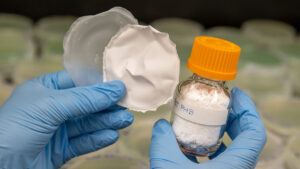
Credit: SIU
Common recycling practices can only use a fraction of plastic waste in new plastic products. For example, only about 30% of a plastic bottle can be recycled, said Lahiru Jayakody, who led the research.
“Every time you recycle, the material properties go down. You must get virgin plastic to make the new plastic bottle, so it’s not very sustainable,” Jayakody said.
The research aims to put plastic waste back into the economy, Jayakody said. To do this, he turned to biological processes, which can degrade plastic waste into the original compounds. Then, these compounds can be used to make other products, such as biodegradable plastics and pharmaceuticals.
Using CRISPR-Cas9 to engineer microbe
Jayakody and his colleague, Jeff Linger, decided to look for a microbe that could break down lignin, a material from waste biomass. They searched various sites across the United States for months before finally discovering a potential microbe in Linger’s backyard. They named the microbe Erwinia spp. Strain LJJL01 after their initials.
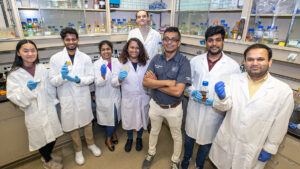
Jayakody and his student research team showcase pieces of their biodegradable plastic, pharmaceutical product, and plastic-derived chemicals as well as a plate containing microbial strain, Erwinia LJJL01. Photo by Russell Bailey.
Many of the Erwinia strains are plant pathogens, although nonpathogenic Erwinia strains have been found on other continents. LJJL01 was the first nonpathogenic Erwinia strain to be found in North America. It lacks the major type III secretion system (T3SS) factors that are found in pathogenic Erwinia strains.
The strain can survive on waste biomass-derived substrates, including lignin, and on synthetic plastic-degraded compounds. LJJL01 has a high tolerance to toxic inhibitors found in biomass and plastic waste. It can also thrive in a wide pH range, from 4.0 to 9.0 and salt concentrations up to 900 mM.
Over the past six years, Jayakody and his research team used advanced CRISPR methods to engineer the microbe to consume waste and produce high-value bioproducts. They established a λ-Red recombinase-assisted CRISPR-Cas9 system for precise genome editing, achieving editing efficiencies of 10 to 17.5% for knockouts and knock-ins. They also developed a dual-inducible CRISPRi (dCas9) system for tunable gene knockdown, showing an approximately 80-fold reduction in target transcript levels.
The high-value chemicals LJJL01 produces can be used to make biodegradable plastic, advanced materials like fiberglass-reinforced plastic and replacements for toxic chemicals such as phthalates for PVC pipe.
“This is a robust and versatile microbe,” Jayakody said. “This strain has remarkably genetic traits that can be used in the bio-industry, not only for plastic waste deconstruction but also for making products that address the plastic pollution problem.”
LJJL01’s pathways include:
- Tea leaves and coffee waste and plastic → microbe → muconic acid → chemical for bio-degradable plastic
- Sugar or textile waste → microbe → acetoin → bio-degradable jet fuels
- Tea leaves and coffee waste and plastic → microbe → compound for chemotherapy and child myopia
- Excess agriculture waste carbon → microbe → polyhydroxybutyrate and polylactic → food packaging
- Soy waste → microbe → polyester amides → bio-degradable nylon
What’s next for LJJL01?
Each chemical process the microbe enables must clear regulatory approval to allow for industrial use of the microbe and its products.
“In science, what is most important is reproducibility and translation acceptance,” Jayakody added. “I don’t want to put out something that’s unrepeatable, not helping humankind, and damaging our environment.”
The work was funded by the U.S. National Science Foundation-Faculty Early Career Development Program, U.S. Department of Energy, industrial partner Green Core LLC, Japan, and EREF, as well as the Southern Illinois University Carbondale REACH (Research-Enriched Academic Challenge) program.