A research project in Hawaii is turning recycled plastic waste into asphalt, aiming to reduce the environmental impact of marine debris and improve the state’s infrastructure. The program, called Nets-to-Roads, is run by Hawaii Pacific University’s Center for Marine Debris Research (CMDR).
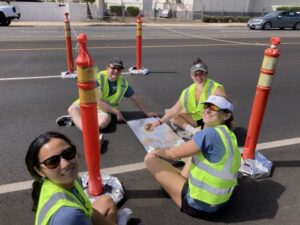
Researchers collect road dust samples from a section of road paved with recycled plastic-reinforced asphalt. Pictured left to right: Rachel Nakamoto, Simon Williams, Cara Megill and Cate Wardinski. Credit: Marquesa Calderon
The CMDR pulls approximately 200 tons of plastic from the ocean each year, said the center’s director, Jennifer Lynch.
“We have an incinerator that can burn the plastic for electricity, but that’s a single use of the plastics, and they instantly become greenhouse gases when they burn. So we were looking for ways to embed this plastic that we’re pulling out of the ocean into our long-term infrastructure here in the state,” Lynch said.
Since 2020, most roads have been paved with polymer-modified asphalt (PMA), a blend of a petroleum-based binder and a synthetic polymer that makes the surface more resistant to cracking, water damage and heat. The Nets-to-Roads project aims to replace that polymer with recycled plastic.
The project was awarded a $3 million grant by the National Oceanic and Atmospheric Administration (NOAA) in 2023. Under the initiative, researchers detect debris at sea and forecast its arrival near Hawaii’s shores to remove it from the ocean and transport the waste to a centralized storage facility for sorting.
The plastic debris is then converted into pellets that are compatible for use in asphalt roads in partnership with the Hawaii Department of Transportation. A road in Oahu was paved with materials from this project in 2025.
Modeling the North Pacific Garbage Patch
Nikolai Maximenko, a researcher and physical oceanographer at the University of Hawaii Manoa, uses advanced ocean drift models to track the location of the North Pacific Garbage Patch (NPGP), an accumulation of floating plastic and marine debris trapped by ocean currents. Maximenko has been modeling the garbage patch’s location for over 30 years, said Lynch.
The model displays the daily location of floating marine debris concentrations across the entire North Pacific and provides a month-long forecast for debris quantities arriving at the islands. The model is available in the open-access repository, where users can view the NPGP’s daily location and the forecast.
The model has shown that the NPGP travels on a four to six-year cycle. “We’ll have two or three years with it really close and impacting us, and then two to three years where it’s farther away, more towards California,” Lynch explained.
The CMDR still removes about 150 tons of plastic a year in the quiet years, compared to over 200 tons when the patch is closer to Hawaii, Lynch said.
The public can also report marine debris in Hawaii to the CMDR via a web form or phone call. The reports are dispatched directly to non-profit cleanup organizations on respective islands for the removal of large marine debris.
Processing and polymerization
The Nets-to-Roads process begins with the collection of plastic waste from the ocean, mainly discarded fishing nets from the Pacific Ocean. The project focuses on high-density polyethylene (HDPE), a durable plastic found in fishing nets, milk jugs, yogurt containers and more. The CMDR also operates a program that pays commercial fishers to remove derelict gear from the ocean, an initiative that has recovered over 90 metric tons of waste as of April 8, 2026.
Under the pilot program, plastic waste that was collected from the ocean was shipped to the U.S. mainland to be cleaned, shredded and ground into small pellets or a fine powder. This product was then shipped back to Oahu to be used as a polymer modifier in asphalt. However, several groups are looking to bring this capability to the Hawaiian islands, eliminating the need to ship the plastic to the mainland.
“Nets-to-Roads cuts the greenhouse gas emissions in half compared to Nets-to-Energy. If you ship the nets to the mainland and have it converted, it’s two times more greenhouse gases than just burning it here for electricity,” Lynch said. The CMDR is looking to bring mechanical plastic recycling to Hawaii so the entire process can take place within the state.
The recycled road in action
The Oahu road was paved with three types of asphalt: standard polymer-modified asphalt, asphalt containing recycled polyethylene from household waste and asphalt made with polyethylene from fishing nets.
After 11 months, the researchers collected dust from each section to determine if the road was shedding microplastics. Scientists analyzed the samples using pyrolysis gas chromatography-mass spectrometry.
They found that the pavement made with recycled plastic did not release more polymer material than standard asphalt. This is likely because the plastic is melted into the asphalt binder, the researchers hypothesized. The researchers will continue to study the durability of the road over time.
They also found that the plastic binder allows the road to flex slightly under the weight of heavy vehicles without cracking. It also has a higher melting point than traditional asphalt, preventing tires from making grooves in the pavement.
Lynch and Ricardo Arcilla, a researcher from the University of Hawaii Manoa, are currently working on a final report evaluating the performance of the recycled plastic pavement. This report will help the Hawaii Department of Transportation decide whether to move forward with the initiative and pave more roads with recycled marine debris.