Research & Development World

  • R&D World Home
  • Topics
    • Aerospace
    • Automotive
    • Biotech
    • Careers
    • Chemistry
    • Environment
    • Energy
    • Life Science
    • Material Science
    • R&D Management
    • Physics
  • Technology
    • 3D Printing
    • A.I./Robotics
    • Software
    • Battery Technology
    • Controlled Environments
      • Cleanrooms
      • Graphene
      • Lasers
      • Regulations/Standards
      • Sensors
    • Imaging
    • Nanotechnology
    • Scientific Computing
      • Big Data
      • HPC/Supercomputing
      • Informatics
      • Security
    • Semiconductors
  • R&D Market Pulse
  • R&D 100
    • 2025 R&D 100 Award Winners
    • 2025 Professional Award Winners
    • 2025 Special Recognition Winners
    • R&D 100 Awards Event
    • R&D 100 Submissions
    • Winner Archive
  • Resources
    • Research Reports
    • Digital Issues
    • Educational Assets
    • R&D Index
    • Subscribe
    • Video
    • Webinars
    • Content submission guidelines for R&D World
  • Global Funding Forecast
  • Top Labs
  • Advertise
  • SUBSCRIBE

An anode-free zinc battery that could someday store renewable energy

By Heather Hall | February 7, 2021

Renewable energy sources, such as wind and solar power, could help decrease the world’s reliance on fossil fuels. But first, power companies need a safe, cost-effective way to store the energy for later use. Massive lithium-ion batteries can do the job, but they suffer from safety issues and limited lithium availability.

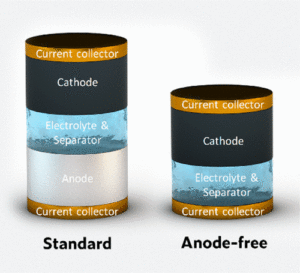
Aqueous zinc-based batteries have been previously explored for grid-scale energy storage because of their safety and high energy density. In addition, the materials used to make them are naturally abundant. However, the rechargeable zinc batteries developed so far have required thick zinc metal anodes, which contain a large excess of zinc that increases cost. Also, the anodes are prone to forming dendrites –– crystalline projections of zinc metal that deposit on the anode during charging –– that can short-circuit the battery. Yunpei Zhu, Yi Cui and Husam Alshareef wondered whether a zinc anode was truly needed. Drawing inspiration from previous explorations of “anode-free” lithium and sodium-metal batteries, the researchers decided to make a battery in which a zinc-rich cathode is the sole source for zinc plating onto a copper current collector.

In their battery, the researchers used a manganese dioxide cathode that they pre-intercalated with zinc ions, an aqueous zinc trifluoromethanesulfonate electrolyte solution and a copper foil current collector. During charging, zinc metal gets plated onto the copper foil, and during discharging the metal is stripped off, releasing electrons that power the battery. To prevent dendrites from forming, the researchers coated the copper current collector with a layer of carbon nanodiscs. This layer promoted uniform zinc plating, thereby preventing dendrites, and increased the efficiency of zinc plating and stripping. The battery showed high efficiency, energy density and stability, retaining 62.8% of its storage capacity after 80 charging and discharging cycles. The anode-free battery design opens new directions for using aqueous zinc-based batteries in energy storage systems, the researchers say.

Download the full report here.

The authors acknowledge funding from King Abdullah University of Science and Technology.
 

Related Articles Read More >

Solving the EV charger problem with streetlights
New scalable supercapacitors store more energy using graphene
Probiotics power a bioresorbable battery that can run from 4 to 100+ minutes
MIT’s new sodium fuel cell beats lithium three-to-one for regional aviation
rd newsletter
EXPAND YOUR KNOWLEDGE AND STAY CONNECTED
Get the latest info on technologies, trends, and strategies in Research & Development.
RD 25 Power Index

R&D World Digital Issues

Fall 2024 issue

Browse the most current issue of R&D World and back issues in an easy to use high quality format. Clip, share and download with the leading R&D magazine today.

Research & Development World
  • Subscribe to R&D World Magazine
  • Sign up for R&D World’s newsletter
  • Contact Us
  • About Us
  • Drug Discovery & Development
  • Pharmaceutical Processing
  • Global Funding Forecast

Copyright © 2025 WTWH Media LLC. All Rights Reserved. The material on this site may not be reproduced, distributed, transmitted, cached or otherwise used, except with the prior written permission of WTWH Media
Privacy Policy | Advertising | About Us

Search R&D World

  • R&D World Home
  • Topics
    • Aerospace
    • Automotive
    • Biotech
    • Careers
    • Chemistry
    • Environment
    • Energy
    • Life Science
    • Material Science
    • R&D Management
    • Physics
  • Technology
    • 3D Printing
    • A.I./Robotics
    • Software
    • Battery Technology
    • Controlled Environments
      • Cleanrooms
      • Graphene
      • Lasers
      • Regulations/Standards
      • Sensors
    • Imaging
    • Nanotechnology
    • Scientific Computing
      • Big Data
      • HPC/Supercomputing
      • Informatics
      • Security
    • Semiconductors
  • R&D Market Pulse
  • R&D 100
    • 2025 R&D 100 Award Winners
    • 2025 Professional Award Winners
    • 2025 Special Recognition Winners
    • R&D 100 Awards Event
    • R&D 100 Submissions
    • Winner Archive
  • Resources
    • Research Reports
    • Digital Issues
    • Educational Assets
    • R&D Index
    • Subscribe
    • Video
    • Webinars
    • Content submission guidelines for R&D World
  • Global Funding Forecast
  • Top Labs
  • Advertise
  • SUBSCRIBE