Research & Development World

  • R&D World Home
  • Topics
    • Aerospace
    • Automotive
    • Biotech
    • Careers
    • Chemistry
    • Environment
    • Energy
    • Life Science
    • Material Science
    • R&D Management
    • Physics
  • Technology
    • 3D Printing
    • A.I./Robotics
    • Software
    • Battery Technology
    • Controlled Environments
      • Cleanrooms
      • Graphene
      • Lasers
      • Regulations/Standards
      • Sensors
    • Imaging
    • Nanotechnology
    • Scientific Computing
      • Big Data
      • HPC/Supercomputing
      • Informatics
      • Security
    • Semiconductors
  • R&D Market Pulse
  • R&D 100
    • 2025 R&D 100 Award Winners
    • 2025 Professional Award Winners
    • 2025 Special Recognition Winners
    • R&D 100 Awards Event
    • R&D 100 Submissions
    • Winner Archive
  • Resources
    • Research Reports
    • Digital Issues
    • Educational Assets
    • R&D Index
    • Subscribe
    • Video
    • Webinars
    • Content submission guidelines for R&D World
  • Global Funding Forecast
  • Top Labs
  • Advertise
  • SUBSCRIBE

An easier way to separate rare earth elements

By Julia Rock-Torcivia | October 1, 2025

Scientists at the Department of Energy’s (DOE) Argonne National Laboratory have revealed the molecular movement of lanthanide separation, an essential step in rare earth element extraction. Their study was published in Chemical Science. 

Illustration capturing the “molecular dance” of lanthanide separation. Credit: Argonne National Laboratory

The team studied lanthanides, a rare earth element with a wide variety of uses, from TV screens to oil refining. The DOE classifies lanthanides as critical materials because of their importance and the supply risk, explained Michael Servis, an Argonne chemist. 

Lanthanides are a group of 15 metallic elements, atomic numbers 57-71. They are essential for technologies like magnets, but they are often found in ores, which makes them difficult to separate. Lanthanides are typically separated through solvent extraction, where they are dissolved in an acidic solution and selectively separated into an oil phase. 

Metadynamic simulation

The team used advanced computer simulations to reveal the choreography of molecules during the lananthide extraction process. They found that extractant molecules – other ions and water molecules – surround the lanthanide ions and try to bond with them. The molecule that binds with the ion determines which element gets separated during extraction. 

Using a simulation technique called metadynamics, the researchers created a map of the energy landscape during the extraction process. ​“Metadynamics helps us see all the possible ways molecules can arrange themselves around the lanthanide. This technique gives us clues about why some lanthanides are easier to separate than others,” said Servis. 
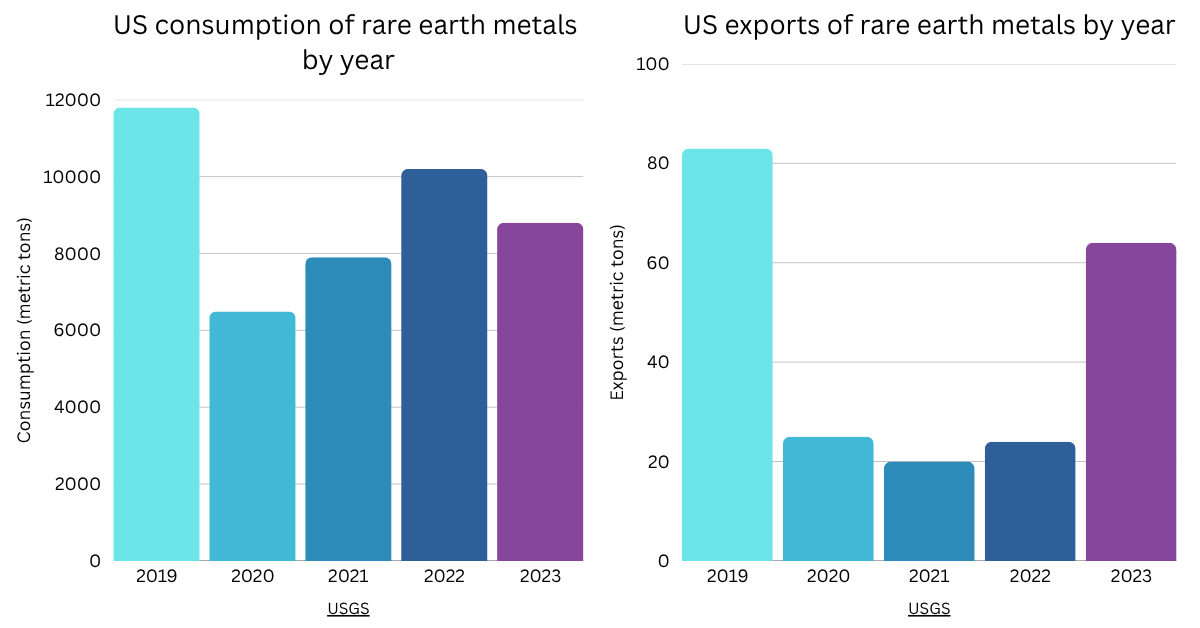
US consumption and exports of rare earth metals. Data from USGS

The scientists found that lighter lanthanides, such as lanthanum and europium, form stronger bonds with the extractant molecules than heavier lanthanides, which struggle due to crowding. 

Revealing other factors

The water molecules also play an important role in this process. Some water molecules bind to the lanthanide ion and help stabilize interactions by forming hydrogen bonds. This expands the possible movements of the molecules. 

The simulations showed how ligand crowding at the metal center can control selectivity as it causes Lu – the lightest lanthanide – to lose coordination with the extractant, resulting in an extraction trend opposite to the current system. The simulation separates lighter molecules more easily than heavy molecules, which is the opposite of the current system. 

This study could pave the way for more efficient extraction and separation of rare earth elements. The team is exploring other solvents and extractant molecules to improve the selectivity of their process.


Related Articles Read More >

R&D 100 red carpet recap: NETL team turns plastic waste into battery-grade graphite
R&D 100 Spotlight: Looping nylon recycles fishnets into medical grade nylon
R&D 100 Winner Spotlight: How Qnity beat the industry timeline on PFAS-free lithography
R&D 100 Red Carpet: DuPont’s triple win
rd newsletter
EXPAND YOUR KNOWLEDGE AND STAY CONNECTED
Get the latest info on technologies, trends, and strategies in Research & Development.
RD 25 Power Index

R&D World Digital Issues

Fall 2025 issue

Browse the most current issue of R&D World and back issues in an easy to use high quality format. Clip, share and download with the leading R&D magazine today.

R&D 100 Awards
Research & Development World
  • Subscribe to R&D World Magazine
  • Sign up for R&D World’s newsletter
  • Contact Us
  • About Us
  • Drug Discovery & Development
  • Pharmaceutical Processing
  • Global Funding Forecast

Copyright © 2026 WTWH Media LLC. All Rights Reserved. The material on this site may not be reproduced, distributed, transmitted, cached or otherwise used, except with the prior written permission of WTWH Media
Privacy Policy | Advertising | About Us

Search R&D World

  • R&D World Home
  • Topics
    • Aerospace
    • Automotive
    • Biotech
    • Careers
    • Chemistry
    • Environment
    • Energy
    • Life Science
    • Material Science
    • R&D Management
    • Physics
  • Technology
    • 3D Printing
    • A.I./Robotics
    • Software
    • Battery Technology
    • Controlled Environments
      • Cleanrooms
      • Graphene
      • Lasers
      • Regulations/Standards
      • Sensors
    • Imaging
    • Nanotechnology
    • Scientific Computing
      • Big Data
      • HPC/Supercomputing
      • Informatics
      • Security
    • Semiconductors
  • R&D Market Pulse
  • R&D 100
    • 2025 R&D 100 Award Winners
    • 2025 Professional Award Winners
    • 2025 Special Recognition Winners
    • R&D 100 Awards Event
    • R&D 100 Submissions
    • Winner Archive
  • Resources
    • Research Reports
    • Digital Issues
    • Educational Assets
    • R&D Index
    • Subscribe
    • Video
    • Webinars
    • Content submission guidelines for R&D World
  • Global Funding Forecast
  • Top Labs
  • Advertise
  • SUBSCRIBE