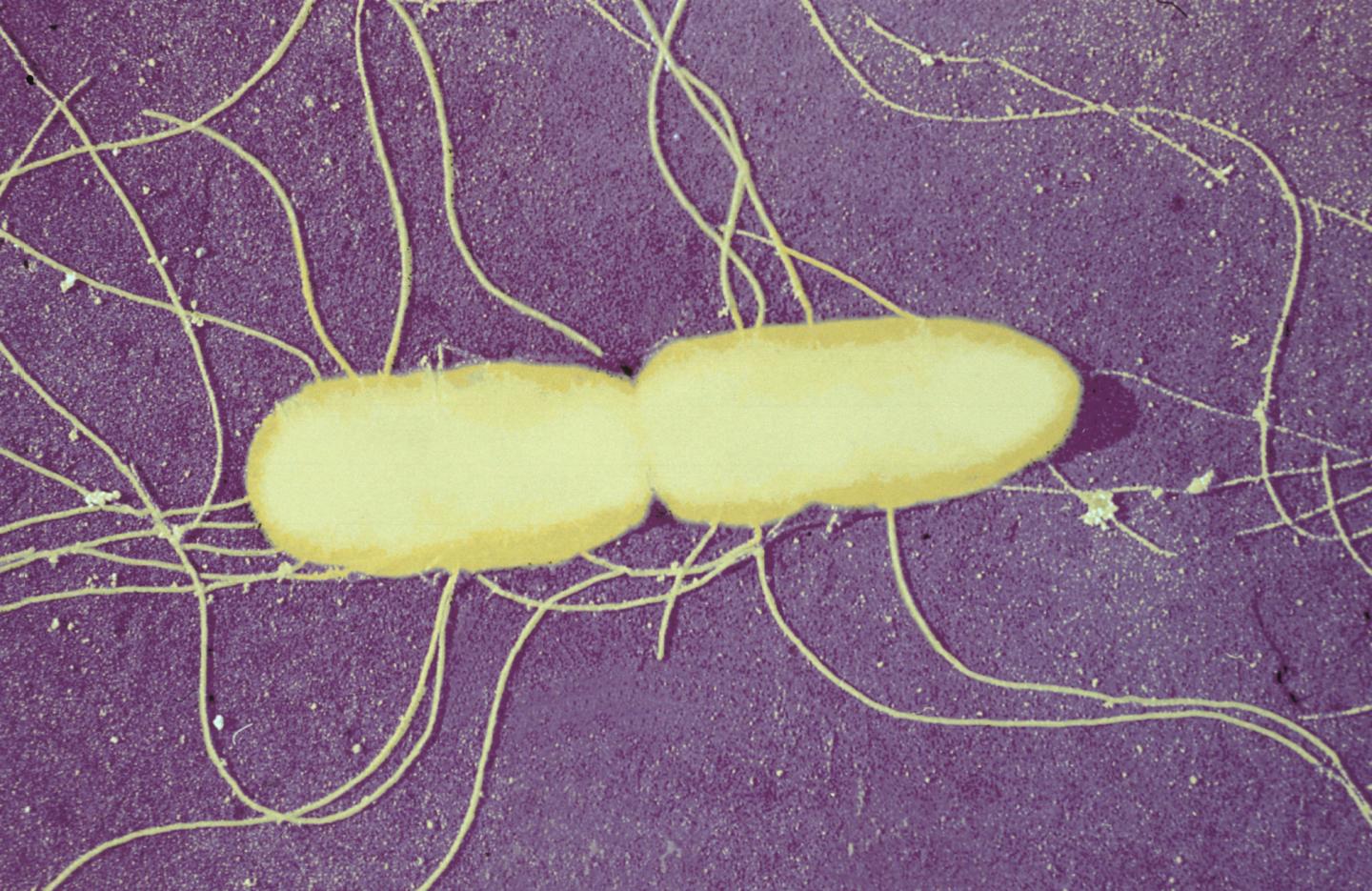
Salmonella typhimurium is a bacterium responsible of serious food poisoning.
Researchers from the Institut Pasteur have shed light on the rise of ampicillin resistance back in the 60s. Through the genome sampling of historical Salmonella strains, they proved that antibiotic resistance can be traced back prior to the release of ampicillin on the UK market. As such, their discovery suggests that low doses of penicillin routinely fed to livestock in the 1950s in North America and Europe may have encouraged antibiotic-resistant bacteria to evolve and spread. These results will be published in The Lancet Infectious Diseases on Wednesday, November 29th.
Antibiotic resistance kills around 25,000 people a year in Europe, and this is predicted to rise to over 10 million people worldwide by 2050. Many bacteria that cause serious infections humans like Salmonella, have already developed resistance to common antibiotics.
Ampicillin, one of the most commonly used antibiotics today and the first broad-spectrum penicillin for the treatment of infections due to Enterobacteria(1), was released on European markets at the start of the sixties, notably on the UK market in 1961. Shortly after (in 1962-1964), the first outbreaks of disease in humans caused by ampicillin-resistant strains of the common zoonotic (which cause disease that can be spread between animals and humans) bacterium, Salmonella Typhimurium, were identified in this country.
This short timeline prompted the researchers at the Institut Pasteur to investigate the emergence of ampicillin resistance. They found that bacteria that can pass on genes resistant to ampicillin emerged several years before the widespread use of this antibiotic in humans.
In this study, they tested 288 historical samples of S. Typhimurium bacteria collected from humans, animals, and food and feed in Europe, Asia, Africa, and America between 1911 and 1969. Samples were tested for antibiotic susceptibility and were analysed by whole genome sequencing, in order to identify the mechanisms of resistance to ampicillin.
Hence, molecular analysis suggests that the ampicillin resistance gene (blaTEM-1) emerged in Salmonella, several years before the antibiotic was released onto the pharmaceutical market. The findings also indicate that a possible cause was the common practice of adding low doses of narrow-spectrum penicillin G (also known as benzylpenicillin) to animal feed in the 1950s and 60s.
“Our findings suggest that antibiotic residues in farming environments such as soil, waste water, and manure may have a much greater impact on the spread of resistance than previously thought”, says Dr Francois-Xavier Weill, Institut Pasteur, who led the study.
The researchers found various ampicillin-resistance genes in 11 isolates (3.8%) from human samples. Importantly, the blaTEM-1 gene was found on plasmids (mobile DNA that can be easily copied and transferred between different bacteria) in three isolates taken from humans in France and Tunisia in 1959 and 1960.
The authors note that despite the close proximity between the countries, the vectors of ampicillin resistance (mostly from France) differed from those in the strains responsible for the first outbreaks in the UK in the 1960s. Dr Weill says: “This indicates that the early emergence of ampicillin resistance was due to multiple independent acquisitions of these resistant genes by different bacterial populations and their varying spread across several countries.”
In further analyses, the authors confirm that ampicillin resistance genes can be successfully transferred between wild type S. Typhimurium strains after exposure to relatively low levels of penicillin G, similar to those found in the livestock environment during the fifties-seventies.
According to Dr Weill, “Although our study cannot identify a causal link between the use of penicillin G and the emergence of transmissible ampicillin-resistance in livestock, our results suggest that the non-clinical use of penicillins like benzylpenicillin may have encouraged the evolution of ampicillin resistance genes in the late 1950s. There is an urgent need to re-evaluate the use of antibiotics in animals and for a ‘one health’ approach to tackling resistance, recognising that bacteria know no borders. This must include close international monitoring and surveillance of resistance in both human and animal health.”
The study comes just weeks after WHO(2) called for the end to routine antibiotic use to promote growth and prevent disease in healthy farm animals.