Research & Development World

  • R&D World Home
  • Topics
    • Aerospace
    • Automotive
    • Biotech
    • Careers
    • Chemistry
    • Environment
    • Energy
    • Life Science
    • Material Science
    • R&D Management
    • Physics
  • Technology
    • 3D Printing
    • A.I./Robotics
    • Software
    • Battery Technology
    • Controlled Environments
      • Cleanrooms
      • Graphene
      • Lasers
      • Regulations/Standards
      • Sensors
    • Imaging
    • Nanotechnology
    • Scientific Computing
      • Big Data
      • HPC/Supercomputing
      • Informatics
      • Security
    • Semiconductors
  • R&D Market Pulse
  • R&D 100
    • 2025 R&D 100 Award Winners
    • 2025 Professional Award Winners
    • 2025 Special Recognition Winners
    • R&D 100 Awards Event
    • R&D 100 Submissions
    • Winner Archive
  • Resources
    • Research Reports
    • Digital Issues
    • Educational Assets
    • R&D Index
    • Subscribe
    • Video
    • Webinars
    • Content submission guidelines for R&D World
  • Global Funding Forecast
  • Top Labs
  • Advertise
  • SUBSCRIBE

Beetle-Inspired Ultra-White Coating

By University of Cambridge | March 13, 2018

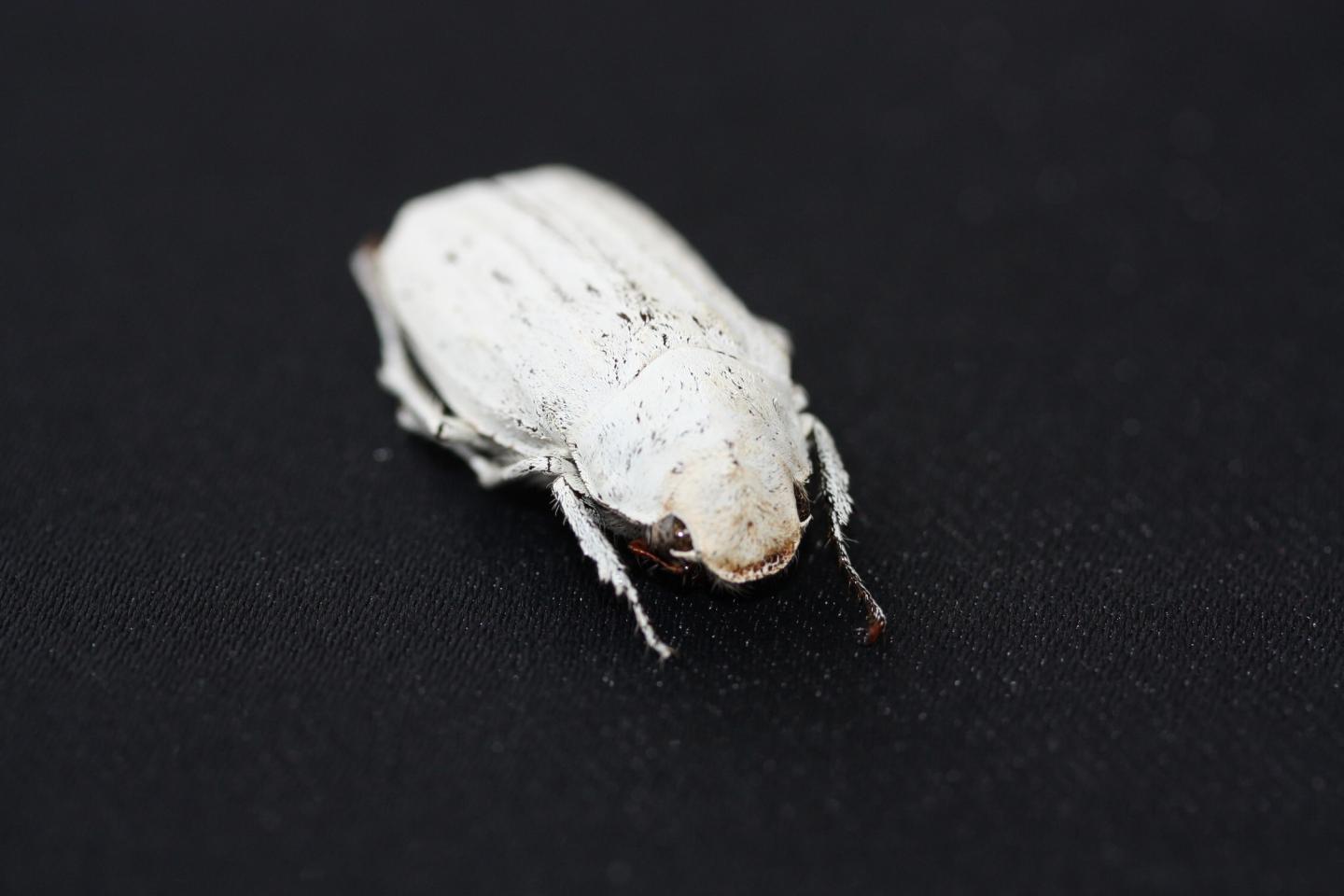
Researchers have developed a super-thin, non-toxic, lightweight, edible ultra-white coating that could be used to make brighter paints and coatings, for use in the cosmetic, food or pharmaceutical industries.

The material – which is 20 times whiter than paper – is made from non-toxic cellulose and achieves such bright whiteness by mimicking the structure of the ultra-thin scales of certain types of beetle. The results are reported in the journal Advanced Materials.

Bright colours are usually produced using pigments, which absorb certain wavelengths of light and reflect others, which our eyes then perceive as colour.

To appear as white, however, all wavelengths of light need to be reflected with the same efficiency. Most commercially-available white products – such as sun creams, cosmetics and paints – incorporate highly refractive particles (usually titanium dioxide or zinc oxide) to reflect light efficiently. These materials, while considered safe, are not fully sustainable or biocompatible.

In nature, the Cyphochilus beetle, which is native to Southeast Asia, produces its ultra-white colouring not through pigments, but by exploiting the geometry of a dense network of chitin – a molecule which is also found in the shells of molluscs, the exoskeletons of insects and the cell walls of fungi. Chitin has a structure which scatters light extremely efficiently – resulting in ultra-white coatings which are very thin and light.

“White is a very special type of structural colour,” said paper co-author Dr Olimpia Onelli, from Cambridge’s Department of Chemistry. “Other types of structural colour – for example butterfly wings or opals – have a specific pattern in their structure which results in vibrant colour, but to produce white, the structure needs to be as random as possible.”

The Cambridge team, working with researchers from Aalto University in Finland, mimicked the structure of chitin using cellulose, which is non-toxic, abundant, strong and bio-compatible. Using tiny strands of cellulose, or cellulose nanofibrils, they were able to achieve the same ultra-white effect in a flexible membrane.

By using a combination of nanofibrils of varying diameters, the researchers were able to tune the opacity, and therefore the whiteness, of the end material. The membranes made from the thinnest fibres were more transparent, while adding medium and thick fibres resulted in a more opaque membrane. In this way, the researchers were able to fine-tune the geometry of the nanofibrils so that they reflected the most light.

“These cellulose-based materials have a structure that’s almost like spaghetti, which is how they are able to scatter light so well,” said senior author Dr Silvia Vignolini, also from Cambridge’s Department of Chemistry. “We need to get the mix just right: we don’t want it to be too uniform, and we don’t want it to collapse.”

Like the beetle scales, the cellulose membranes are extremely thin: just a few millionths of a metre thick, although the researchers say that even thinner membranes could be produced by further optimising their fabrication process. The membranes scatter light 20 to 30 times more efficiently than paper, and could be used to produce next-generation efficient bright sustainable and biocompatible white materials.


Related Articles Read More >

R&D 100 red carpet recap: NETL team turns plastic waste into battery-grade graphite
R&D 100 Spotlight: Looping nylon recycles fishnets into medical grade nylon
R&D 100 Winner Spotlight: How Qnity beat the industry timeline on PFAS-free lithography
R&D 100 Red Carpet: DuPont’s triple win
rd newsletter
EXPAND YOUR KNOWLEDGE AND STAY CONNECTED
Get the latest info on technologies, trends, and strategies in Research & Development.
RD 25 Power Index

R&D World Digital Issues

Fall 2025 issue

Browse the most current issue of R&D World and back issues in an easy to use high quality format. Clip, share and download with the leading R&D magazine today.

R&D 100 Awards
Research & Development World
  • Subscribe to R&D World Magazine
  • Sign up for R&D World’s newsletter
  • Contact Us
  • About Us
  • Drug Discovery & Development
  • Pharmaceutical Processing
  • Global Funding Forecast

Copyright © 2026 WTWH Media LLC. All Rights Reserved. The material on this site may not be reproduced, distributed, transmitted, cached or otherwise used, except with the prior written permission of WTWH Media
Privacy Policy | Advertising | About Us

Search R&D World

  • R&D World Home
  • Topics
    • Aerospace
    • Automotive
    • Biotech
    • Careers
    • Chemistry
    • Environment
    • Energy
    • Life Science
    • Material Science
    • R&D Management
    • Physics
  • Technology
    • 3D Printing
    • A.I./Robotics
    • Software
    • Battery Technology
    • Controlled Environments
      • Cleanrooms
      • Graphene
      • Lasers
      • Regulations/Standards
      • Sensors
    • Imaging
    • Nanotechnology
    • Scientific Computing
      • Big Data
      • HPC/Supercomputing
      • Informatics
      • Security
    • Semiconductors
  • R&D Market Pulse
  • R&D 100
    • 2025 R&D 100 Award Winners
    • 2025 Professional Award Winners
    • 2025 Special Recognition Winners
    • R&D 100 Awards Event
    • R&D 100 Submissions
    • Winner Archive
  • Resources
    • Research Reports
    • Digital Issues
    • Educational Assets
    • R&D Index
    • Subscribe
    • Video
    • Webinars
    • Content submission guidelines for R&D World
  • Global Funding Forecast
  • Top Labs
  • Advertise
  • SUBSCRIBE