Adobe Stock
After months of agency layoffs and program cuts, Washington still ended FY2025 with a $1.8 trillion deficit, essentially unchanged from last year, CBO estimates, while the shutdown idled large parts of the federal science enterprise.
Across DOE labs, operations are continuing for now on prior-year funds, with limited visibility beyond the near term. Sandia told subcontractors on October 1 it would “continue normal operations in the short-term,” according to a Sandia statement obtained by the University of Wisconsin. Federal News Network reports agencies are tapping carryover funds to bridge the lapse, but “next steps [are] unclear.” And Energy Secretary Chris Wright warned NNSA had ‘about eight more days’ of full operational funding absent appropriations.
At Oak Ridge National Laboratory, a spokesperson confirmed the facility “has sufficient funding to continue operating for the near-term,” according to an article in the local Oak Ridger paper.
The spokesperson added a caveat: “non-essential travel and purchases will be curtailed.” Sandia National Laboratories sent an automated reply noting they “will operate in the short term using unspent funding,” though their media relations team warned they “may not be able to help with inquiries during this time.”
While many federal scientists and civil servants are staying silent: NIH staff have been told not to speak with the media. Some, however, are speaking publicly. Jenna Norton, a program director at NIH’s National Institute of Diabetes and Digestive and Kidney Diseases, joined a press conference near the U.S. Capitol last week and warned: “As a federal worker, I am here to tell you that every awful thing that would happen in a shutdown — shuttering programs that Americans rely on, damaging our economy, firing federal workers — all of this is already happening.” She is currently furloughed and aware that speaking out could carry professional risk, according to NPR.
Norton’s work focuses on health disparities research, understanding, for instance, why Black Americans are four times more likely to progress to end-stage kidney disease. Early this year, the Trump administration canceled hundreds of NIH grants in her portfolio as part of its DEI purge. The grants were temporarily restored by court order, then the Supreme Court intervened, and now the shutdown has frozen everything again.
Beyond HHS, furlough shares underscore how much of the federal science enterprise is idle. NASA has furloughed about 15,000 employees (83%), with exceptions for life- and property-protection and select priority programs such as Artemis; the agency’s formal contingency plan outlines excepted activities. Commerce Department components (including NOAA and NIST) are also operating with sharply reduced staffing under their lapse plans.
A few operational carve-outs persist. For example, Interior is maintaining certain energy-permitting work under its contingency posture, and DOE’s Energy Information Administration is continuing weekly petroleum data releases, as Reuters noted. But grantmaking, peer review, and most research support functions remain paused until appropriations resume.
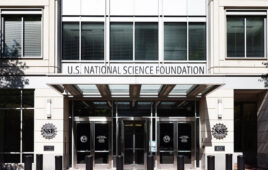
Funding pipelines have also constricted recently. NIH has suspended initial peer-review meetings and advisory council sessions for the duration of the lapse; most staff cannot respond to emails, and new awards (excepted programs aside) aren’t being processed. NSF says it is closed during the shutdown, though it will still accept proposals; award actions and panel operations are generally paused until reopening guidance is issued.
NSF issued 7,180 awards totaling $3.70B (nominal) in FY2025, down from 10,420 awards/$5.55B in FY2024. The median award was $329k (mean $515k; 90th percentile $952k). September 2025 was the heaviest month: 1,603 awards totaling $914M. Largest recipient states by dollars were CA ($425M), TX ($251M), NY ($248M), MA ($231M), IL ($150M). Top recipient institutions included Georgia Tech Research Corporation ($73.1M; 91 awards), University of Michigan–Ann Arbor ($55.3M; 105), UC San Diego ($54.3M; 55), University of Washington ($49.3M; 98), and Purdue ($47.1M; 100)