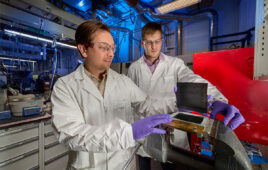
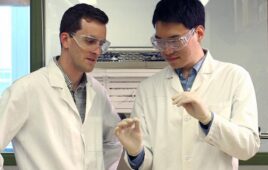
Susumu Kitagawa, Richard Robson and Omar M. Yaghi were awarded the Nobel Prize in Chemistry on Wednesday for the creation of molecular structures with spaces large enough for gases and other chemicals to flow through. These structures are called metal-organic frameworks (MOF) and can be used to harvest water from the air, capture carbon dioxide, store toxic gases and catalyze chemical reactions.

Top: Susumu Kitagawa and Omar Yaghi
Bottom: Richard Robson
In MOFs, metal ions are linked by long organic molecules, which are organized to form crystals that contain large gaps. Chemists can design the MOFs to capture specific substances by changing the molecules in the framework.
Building the pyramids
Robson started this work in 1989, when he began testing the inherent properties of atoms. He was inspired by the structure of diamonds, in which carbon atoms bond to four others, creating a pyramid. Robson built a similar structure using positively charged copper ions in place of the carbons. He combined the copper ions with a four-armed molecule that had a nitrile group on each arm; nitrile groups are attracted to copper ions. Together, the molecules formed a spacious crystal.
Robson published his findings, showing that one of his structures could exchange ions, meaning substances could flow in and out of the construction. He also showed that rational design could be used to change MOFs to capture specific chemicals. Robson’s work was promising, but his structures were unstable and collapsed easily.

Robson’s structure was inspired by the pyramid structure of a diamond. Credit: ©Johan Jarnestad/The Royal Swedish Academy of Sciences
A few years later, Kitagawa started trying to create a porous molecular structure. He created a two-dimensional structure with cavities that captured acetone molecules. Like Robson, he also used copper ions in his structure.
In 1997, Kitagawa and his team created three-dimensional MOFs with open channels. When these structures were dried, the spaces could be filled with gases. It could absorb and release methane, nitrogen and oxygen. Kitagawa showed that gases can flow through MOFs and hypothesized that they could be made flexible. This was crucial because it separated the potential of MOFs from existing structures called zeolites that absorb gases, which are hard materials.
Meanwhile, Yaghi created a stable MOF and showed that it could be modified using rational design, giving it new properties. In 1995, Yaghi created two two-dimensional materials that acted like nets held together by copper or cobalt. The cobalt-based structure could host guest molecules in the cavities and was so stable that it could be heated to 350 °C without collapsing. Yaghi coined the term “metal-organic framework” in the article he wrote about these materials, which was published in Nature.
Kitagawa succeeded in creating flexible MOFs, creating a material that changed shape when filled with water or methane, and returned to its original shape when emptied. In 2002 and 2003, Yaghi showed that it is possible to change MOFs in a rational manner to give them different properties. He produced 16 variants of an MOF with varying cavity sizes.

Yaghi showed it was possible to tailor MOFs to hold specific substances. Credit: ©Johan Jarnestad/The Royal Swedish Academy of Sciences
These discoveries have enabled chemists to build tens of thousands of MOFs. Some can separate PFAS from water or break down traces of pharmaceuticals in the environment. Others can capture toxic gases or trap the ethylene gas from fruit so they ripen more slowly.
About the laureates
Kitagawa is Executive Vice President and a Distinguished Professor of coordination chemistry at Kyoto University. He received his Ph.D. in hydrocarbon chemistry from Kyoto University. He has taught at several universities, including Kindai University, Tokyo Metropolitan University and Kyoto University. He co-founded the Institute for Integrated Cell-Material Sciences at Kyoto University in 2007.
Richard Robson is an honorary professor at the School of Chemistry at the University of Melbourne. He received his Ph.D. in chemistry from the University of Oxford in 1962. Robson is a fellow of the Australian Academy of Science and the Royal Society.
Yaghi is the James and Neeltje Tretter Chair Professor of Chemistry at UC Berkeley. He received his Ph.D. in inorganic chemistry from the University of Illinois at Urbana-Champaign in 1990. He is also the Founding Director of the Berkeley Global Science Institute, a team of educators and scientists who work to provide opportunities for emerging scholars in research and mentoring.