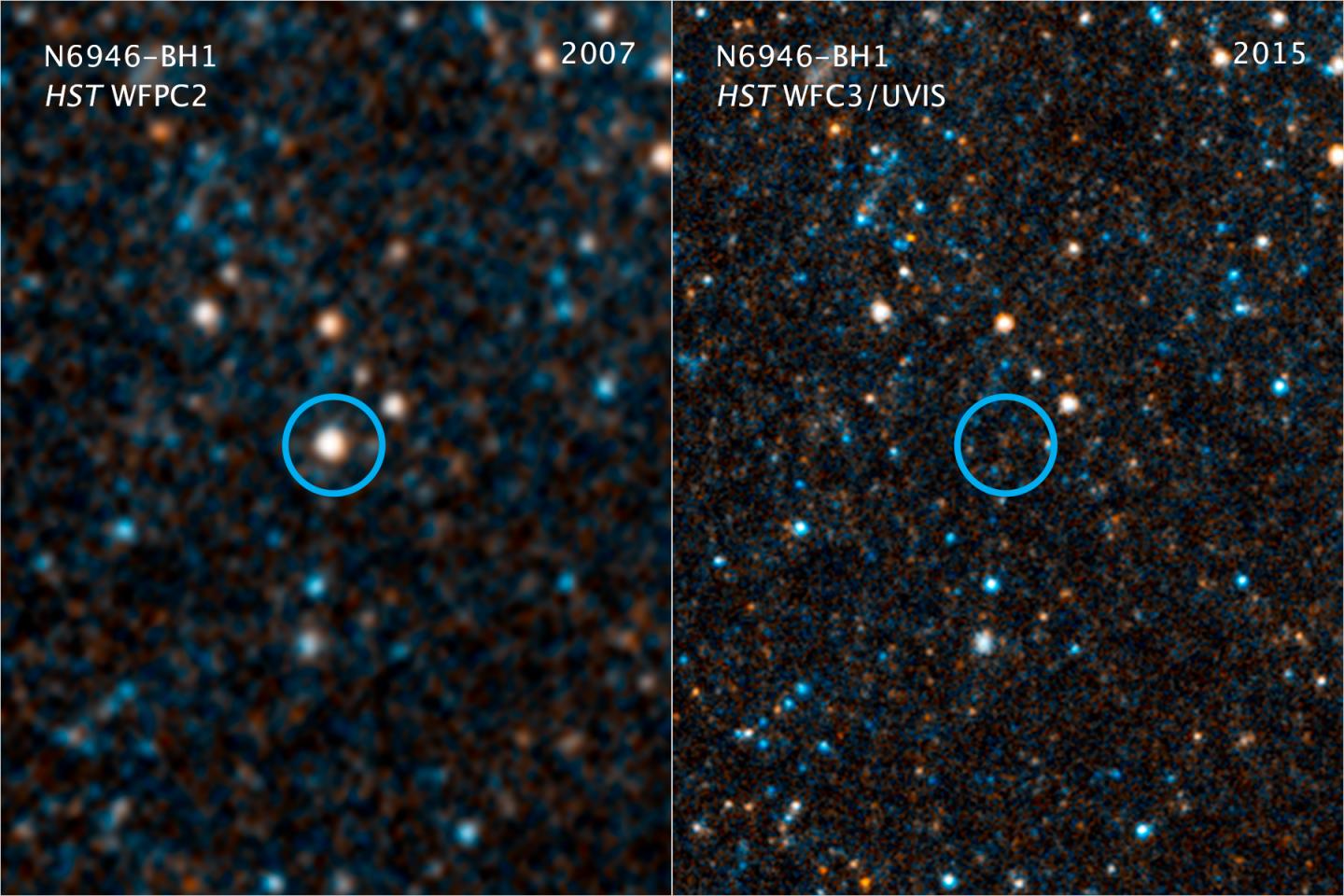
This pair of visible-light and near-infrared Hubble Space Telescope photos shows the giant star N6946-BH1 before and after in vanished out of sight by imploding to form a black hole. The left image shows the 25 solar mass star as it looked in 2007. In 2009, the star shot up in brightness to become over 1 million times more luminous than our sun for several months. But then it seemed to vanish, as seen in the right panel image from 2015. A small amount of infrared light has been detected from where the star used to be. This radiation probably comes from debris falling onto a black hole. The black hole is located 22 million light-years away in the spiral galaxy NGC 6946. Source:
Astronomers have watched as a massive, dying star was likely reborn as a black hole. It took the combined power of the Large Binocular Telescope (LBT), and NASA’s Hubble and Spitzer space telescopes to go looking for remnants of the vanquished star, only to find that it disappeared out of sight.
It went out with a whimper instead of a bang.
The star, which was 25 times as massive as our sun, should have exploded in a very bright supernova. Instead, it fizzled out–and then left behind a black hole.
“Massive fails” like this one in a nearby galaxy could explain why astronomers rarely see supernovae from the most massive stars, said Christopher Kochanek, professor of astronomy at The Ohio State University and the Ohio Eminent Scholar in Observational Cosmology.
As many as 30 percent of such stars, it seems, may quietly collapse into black holes — no supernova required.
“The typical view is that a star can form a black hole only after it goes supernova,” Kochanek explained. “If a star can fall short of a supernova and still make a black hole, that would help to explain why we don’t see supernovae from the most massive stars.”
He leads a team of astronomers who published their latest results in the Monthly Notices of the Royal Astronomical Society.
Among the galaxies they’ve been watching is NGC 6946, a spiral galaxy 22 million light-years away that is nicknamed the “Fireworks Galaxy” because supernovae frequently happen there — indeed, SN 2017eaw, discovered on May 14th, is shining near maximum brightness now. Starting in 2009, one particular star, named N6946-BH1, began to brighten weakly. By 2015, it appeared to have winked out of existence.
After the LBT survey for failed supernovas turned up the star, astronomers aimed the Hubble and Spitzer space telescopes to see if it was still there but merely dimmed. They also used Spitzer to search for any infrared radiation emanating from the spot. That would have been a sign that the star was still present, but perhaps just hidden behind a dust cloud.
All the tests came up negative. The star was no longer there. By a careful process of elimination, the researchers eventually concluded that the star must have become a black hole.
It’s too early in the project to know for sure how often stars experience massive fails, but Scott Adams, a former Ohio State student who recently earned his doctorate doing this work, was able to make a preliminary estimate.
“N6946-BH1 is the only likely failed supernova that we found in the first seven years of our survey. During this period, six normal supernovae have occurred within the galaxies we’ve been monitoring, suggesting that 10 to 30 percent of massive stars die as failed supernovae,” he said.
“This is just the fraction that would explain the very problem that motivated us to start the survey, that is, that there are fewer observed supernovae than should be occurring if all massive stars die that way.”
To study co-author Krzysztof Stanek, the really interesting part of the discovery is the implications it holds for the origins of very massive black holes — the kind that the LIGO experiment detected via gravitational waves. (LIGO is the Laser Interferometer Gravitational-Wave Observatory.)
It doesn’t necessarily make sense, said Stanek, professor of astronomy at Ohio State, that a massive star could undergo a supernova — a process which entails blowing off much of its outer layers — and still have enough mass left over to form a massive black hole on the scale of those that LIGO detected.
“I suspect it’s much easier to make a very massive black hole if there is no supernova,” he concluded.