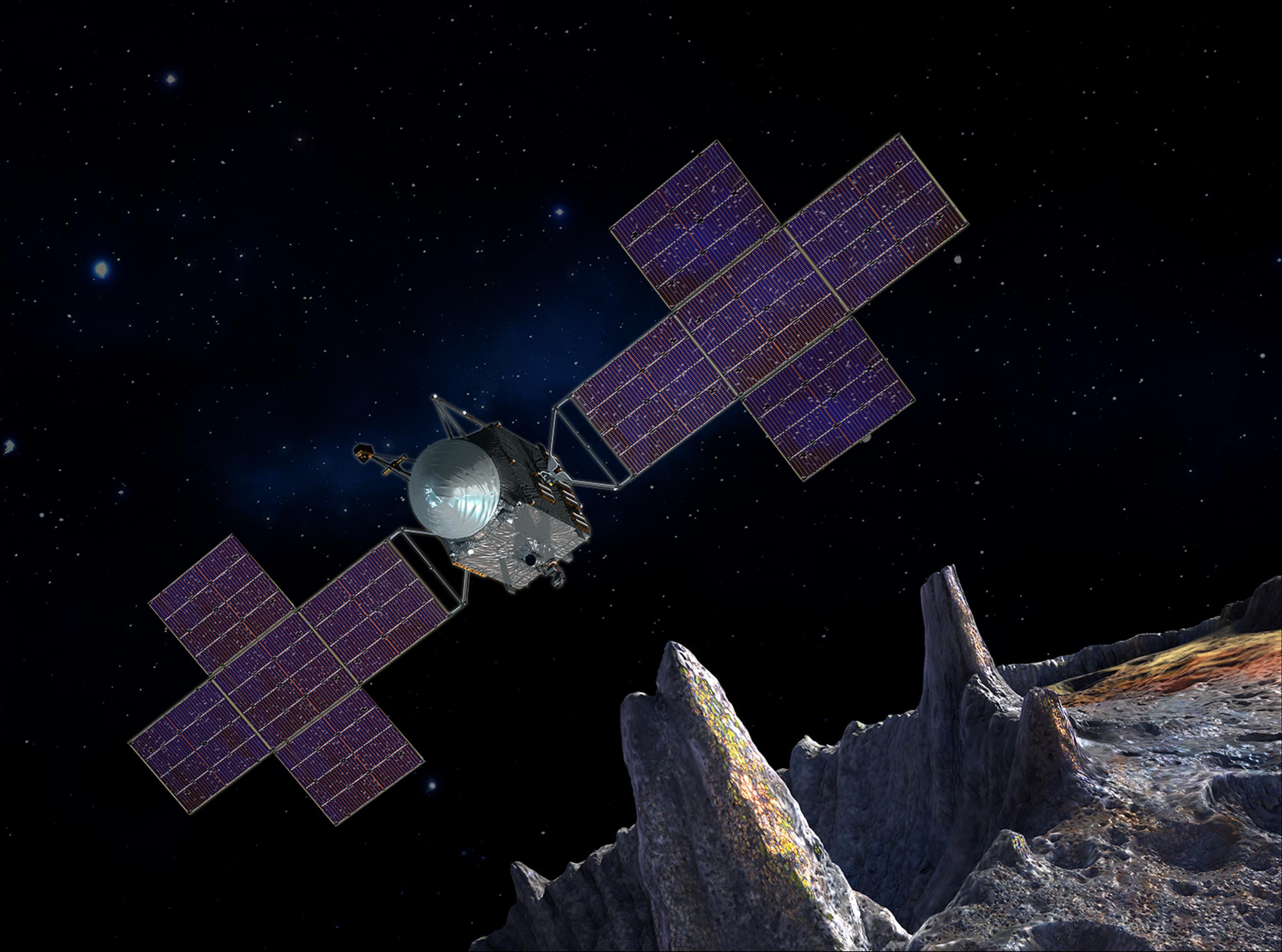
Artist’s concept of the Psyche spacecraft, which will conduct a direct exploration of an asteroid thought to be a stripped planetary core. Image credit: SSL/ASU/P. Rubin/NASA/JPL-Caltech
A spacecraft destined to explore a unique asteroid will also test new communication hardware that uses lasers instead of radio waves.
The Deep Space Optical Communications (DSOC) package aboard NASA’s Psyche mission utilizes photons — the fundamental particle of visible light — to transmit more data in a given amount of time. The DSOC goal is to increase spacecraft communications performance and efficiency by 10 to 100 times over conventional means, all without increasing the mission burden in mass, volume, power and/or spectrum.
Tapping the advantages offered by laser communications is expected to revolutionize future space endeavors – a major objective of NASA’s Space Technology Mission Directorate (STMD).
The DSOC project is developing key technologies that are being integrated into a deep space-worthy Flight Laser Transceiver (FLT), high-tech work that will advance this mode of communications to Technology Readiness Level (TRL) 6. Reaching a TRL 6 level equates to having technology that is a fully functional prototype or representational model.
As a “game changing” technology demonstration, DSOC is exactly that. NASA STMD’s Game Changing Development Program funded the technology development phase of DSOC. The flight demonstration is jointly funded by STMD, the Technology Demonstration Mission (TDM) Program and NASA/ HEOMD/Space Communication and Navigation (SCaN).
Work on the laser package is based at NASA’s Jet Propulsion Laboratory in Pasadena, California.
“Things are shaping up reasonably and we have a considerable amount of test activity going on,” says Abhijit Biswas, DSOC Project Technologist in Flight Communications Systems at JPL. Delivery of DSOC for integration within the Psyche mission is expected in 2021 with the spacecraft launch to occur in the summer of 2022, he explains.
“Think of the DSOC flight laser transceiver onboard Psyche as a telescope,” Biswas explains, able to receive and transmit laser light in precisely timed photon bursts.
DSOC architecture is based on transmitting a laser beacon from Earth to assist lineofsight stabilization to make possible the pointing back of a downlink laser beam. The laser onboard the Psyche spacecraft, Biswas says, is based on a master-oscillator power amplifier that uses optical fibers.
The laser beacon to DSOC will be transmitted from JPL’s Table Mountain Facility located near the town of Wrightwood, California, in the Angeles National Forest. DSOC’s beaming of data from space will be received at a large aperture ground telescope at Palomar Mountain Observatory in California, near San Diego.
Biswas anticipates operating DSOC perhaps 60 days after launch, given checkout of the Psyche spacecraft post-liftoff. The test-runs of the laser equipment will occur over distances of 0.1 to 2.5 astronomical units (AU) on the outward-bound probe. One AU is approximately 150 million kilometers-or the distance between the Earth and Sun.
“I am very excited to be on the mission,” says Biswas, who has been working on the laser communications technology since the late 1990s. “It’s a unique privilege to be working on DSOC.”
The Psyche mission was selected for flight in early 2017 under NASA’s Discovery Program, a series of lower-cost, highly focused robotic space missions that are exploring the solar system.
The spacecraft will be launched in the summer of 2022 to 16 Psyche, a distinctive metal asteroid about three times farther away from the sun than Earth. The planned arrival of the probe at the main belt asteroid will take place in 2026.
Lindy Elkins-Tanton is Director of the School of Earth and Space Exploration at Arizona State University in Tempe. She is the principal investigator for the Psyche mission.
“I am thrilled that Psyche is getting to fly the Deep Space Optical Communications package,” Elkins-Tanton says. “First of all, the technology is mind-blowing and it brings out all my inner geek. Who doesn’t want to communicate using lasers, and multiply the amount of data we can send back and forth?”
Elkins-Tanton adds that bringing robotic and human spaceflight closer together is critical for humankind’s space future. “Having our robotic mission test technology that we hope will help us eventually communicate with people in deep space is excellent integration of NASA missions and all of our goals,” she says.
In designing a simple, high-heritage spacecraft to do the exciting exploration of the metal world Psyche, “I find both the solar electric propulsion and the Deep Space Optical Communications to feel futuristic in the extreme. I’m proud of NASA and of our technical community for making this possible,” Elkins-Tanton concludes.
Biswas explains that DSOC is a pathfinder experiment. The future is indeed bright for the technology, he suggests, such as setting up capable telecommunications infrastructure around Mars.
“Doing so would allow the support of astronauts going to and eventually landing on Mars,” Biswas said. “Laser communications will augment that capability tremendously. The ability to send back from Mars to Earth lots of information, including the streaming of high definition imagery, is going to be very enabling.”
As a “game changing” technology demonstration, DSOC is exactly that. NASA STMD’s Game Changing Development program funded the technology development phase of DSOC. The flight demonstration is jointly funded by STMD, the Technology Demonstration Missions (TDM) program and NASA/ HEOMD/Space Communication and Navigation (SCaN). Work on the laser package is based at the Jet Propulsion Laboratory in Pasadena, California.