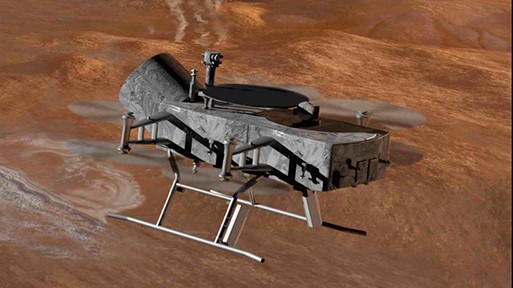
The Dragonfly dual-quadcopter, shown here in an artist’s rendering, could make multiple flights to explore diverse locations as it characterizes the habitability of Titan’s environment. Credit: JHUAPL/Mike Carroll
Dragonfly, a New Frontiers-class mission concept that the Johns Hopkins Applied Physics Laboratory has proposed to NASA, would use an instrumented, radioisotope-powered, dual-quadcopter to explore potential habitable sites where life could be developed on Saturn’s largest moon, Titan.
(See a video here)
The moon is one of a number of “ocean worlds” in our solar system that hold the ingredients for life, and is known to be covered with rich organic material that is undergoing chemical processes that might be similar to those on early Earth, before life developed.
Titan has diverse, carbon-rich chemistry on a surface dominated by water ice, as well as an interior ocean. Dragonfly will take advantage of Titan’s dense, flight-enabling atmosphere to visit multiple sites by landing on safe terrain, and then carefully navigate to more challenging landscapes.
“This is the kind of experiment we can’t do in the laboratory because of the time scales involved,” said APL’s Elizabeth Turtle, principal investigator for the Dragonfly mission. “Mixing of rich, organic molecules and liquid water on the surface of Titan could have persisted over very long timescales. Dragonfly is designed to study the results of Titan’s experiments in prebiotic chemistry.”
The mission would capitalize on the rapid evolution and increased reliability and capability of autonomous aerial systems on Earth. Dragonfly would make numerous flights, moving from one geologic setting to another. (The craft was named by the team for the double-wing-set-equipped insect, which also hops from place to place.)
With Titan’s dense atmosphere and low gravity, flight is substantially easier than on Earth, giving Dragonfly a very broad range of capability. Dragonfly would be powered by a Multi-Mission Radioisotope Thermoelectric Generator (MMRTG); while there is enough sunlight at Titan’s surface to see, there is not enough to use solar power efficiently.
At each site, Dragonfly would sample the surface and atmosphere with a suite of carefully selected science instruments that will characterize the habitability of Titan’s environment, investigate how far prebiotic chemistry progressed, and search for chemical signatures indicative of water- and/or hydrocarbon-based life.
To accomplish these objectives, Dragonfly would take four types of measurements. Mass spectrometry would reveal the composition of the surface and the atmosphere. Gamma-ray spectrometry would measure the composition of the shallow sub-surface. Meteorology and geophysics sensors would measure atmospheric conditions such as wind, pressure, temperature, and other factors, as well as seismic activity. Additionally, a camera suite would characterize the geologic and physical nature of the moon’s surface, and help find subsequent landing sites.
“We could take a lander, put it on Titan, take these four measurements at one place, and significantly increase our understanding of Titan and similar moons,” said Dragonfly project manager Peter Bedini of APL. “However, we can multiply the value of the mission if we add aerial mobility, which would enable us to access a variety of geologic settings, maximizing the science return and lowering mission risk by going over or around obstacles.”
Although the idea of exploring Titan by rotorcraft is not new, technological developments in the last two decades – sometimes referred to as the “drone revolution” – have made such a mission more feasible.
Later this fall, NASA is expected to select a few of the New Frontiers mission proposals for further study. Only one will be chosen for flight as the fourth mission in the planetary exploration program; the APL-led New Horizons mission to Pluto and the Kuiper Belt was the first New Frontiers mission ever selected.
Final mission selection is expected in mid-2019.
To learn more about the Dragonfly mission, visit: http://dragonfly.jhuapl.edu.