Research & Development World

  • R&D World Home
  • Topics
    • Aerospace
    • Automotive
    • Biotech
    • Careers
    • Chemistry
    • Environment
    • Energy
    • Life Science
    • Material Science
    • R&D Management
    • Physics
  • Technology
    • 3D Printing
    • A.I./Robotics
    • Software
    • Battery Technology
    • Controlled Environments
      • Cleanrooms
      • Graphene
      • Lasers
      • Regulations/Standards
      • Sensors
    • Imaging
    • Nanotechnology
    • Scientific Computing
      • Big Data
      • HPC/Supercomputing
      • Informatics
      • Security
    • Semiconductors
  • R&D Market Pulse
  • R&D 100
    • 2025 R&D 100 Award Winners
    • 2025 Professional Award Winners
    • 2025 Special Recognition Winners
    • R&D 100 Awards Event
    • R&D 100 Submissions
    • Winner Archive
  • Resources
    • Research Reports
    • Digital Issues
    • Educational Assets
    • Subscribe
    • Video
    • Webinars
    • PharmSci360
    • Content submission guidelines for R&D World
  • Global Funding Forecast
  • Top Labs
  • Advertise
  • SUBSCRIBE

Earth’s crust was unstable in the Archean eon and dripped down into the mantle

By R&D Editors | December 30, 2013

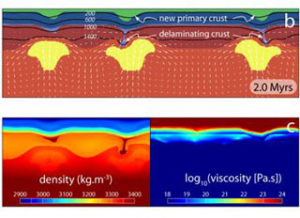
Computer simulation of the processes in the Earth’s mantle. Image: Institute of Geosciences

Earth’s mantle temperatures during the Archean eon, which commenced some 4 billion years ago, were significantly higher than they are today. According to recent model calculations, the Archean crust that formed under these conditions was so dense that large portions of it were recycled back into the mantle. This is the conclusion reached by Dr. Tim Johnson who is currently studying the evolution of the Earth’s crust as a member of the research team led by Prof. Richard White of the Institute of Geosciences at Johannes Gutenberg Univ. Mainz (JGU). According to the calculations, this dense primary crust would have descended vertically in drip form. In contrast, the movements of today’s tectonic plates involve largely lateral movements with oceanic lithosphere recycled in subduction zones. The findings add to our understanding of how cratons and plate tectonics, and thus also the Earth’s current continents, came into being.

Because mantle temperatures were higher during the Archean eon, the Earth’s primary crust that formed at the time must have been very thick and also very rich in magnesium. However, as Johnson and his co-authors explain in their article recently published in Nature Geoscience, very little of this original crust is preserved, indicating that most must have been recycled into the Earth’s mantle. Moreover, the Archean crust that has survived in some areas such as, for example, Northwest Scotland and Greenland, is largely made of tonalite–trondhjemite–granodiorite complexes and these are likely to have originated from a hydrated, low-magnesium basalt source. The conclusion is that these pieces of crust cannot be the direct products of an originally magnesium-rich primary crust. These TTG complexes are among the oldest features of our Earth’s crust. They are most commonly present in cratons, the oldest and most stable cores of the current continents.

With the help of thermodynamic calculations, Dr. Tim Johnson and his collaborators at the US-American universities of Maryland, Southern California, and Yale have established that the mineral assemblages that formed at the base of a 45-km-thick magnesium-rich crust were denser than the underlying mantle layer. In order to better explore the physics of this process, Professor Boris Kaus of the Geophysics work group at Mainz University developed new computer models that simulate the conditions when the Earth was still relatively young and take into account Johnson’s calculations.

These geodynamic computer models show that the base of a magmatically over-thickened and magnesium-rich crust would have been gravitationally unstable at mantle temperatures greater than 1,500 to 1,550 C and this would have caused it to sink in a process called ‘delamination’. The dense crust would have dripped down into the mantle, triggering a return flow of mantle material from the asthenosphere that would have melted to form new primary crust. Continued melting of over-thickened and dripping magnesium-rich crust, combined with fractionation of primary magmas, may have produced the hydrated magnesium-poor basalts necessary to provide a source of the tonalite–trondhjemite–granodiorite complexes. The dense residues of these processes, which would have a high content of mafic minerals, must now reside in the mantle.

Delamination and recycling of Archaean crust caused by gravitational instabilities

Source: Johann Gutenberg Univ., Mainz

Related Articles Read More >

Speaker Giving a Talk at Business Meeting. Audience in the conference hall. Business and Entrepreneurship. Panoramic composition suitable for banners.
BioPharma Supply Chain & Logistics Nexus returns to San Diego in November
How Cypris evolved from selling patent reports to agentic R&D intelligence
New video series: Travel for engineers
Advanced Manufacturing and Process Innovation Special Report: When you can’t hire, you automate
rd newsletter
EXPAND YOUR KNOWLEDGE AND STAY CONNECTED
Get the latest info on technologies, trends, and strategies in Research & Development.

R&D World Digital Issues

Fall 2025 issue

Browse the most current issue of R&D World and back issues in an easy to use high quality format. Clip, share and download with the leading R&D magazine today.

R&D 100 Awards
Research & Development World
  • Subscribe to R&D World Magazine
  • Sign up for R&D World’s newsletter
  • Contact Us
  • About Us
  • Drug Discovery & Development
  • Pharmaceutical Processing
  • Global Funding Forecast

Copyright © 2026 Arrowfly LLC. All Rights Reserved. The material on this site may not be reproduced, distributed, transmitted, cached or otherwise used, except with the prior written permission of Arrowfly
Privacy Policy | Advertising | About Us

Search R&D World

  • R&D World Home
  • Topics
    • Aerospace
    • Automotive
    • Biotech
    • Careers
    • Chemistry
    • Environment
    • Energy
    • Life Science
    • Material Science
    • R&D Management
    • Physics
  • Technology
    • 3D Printing
    • A.I./Robotics
    • Software
    • Battery Technology
    • Controlled Environments
      • Cleanrooms
      • Graphene
      • Lasers
      • Regulations/Standards
      • Sensors
    • Imaging
    • Nanotechnology
    • Scientific Computing
      • Big Data
      • HPC/Supercomputing
      • Informatics
      • Security
    • Semiconductors
  • R&D Market Pulse
  • R&D 100
    • 2025 R&D 100 Award Winners
    • 2025 Professional Award Winners
    • 2025 Special Recognition Winners
    • R&D 100 Awards Event
    • R&D 100 Submissions
    • Winner Archive
  • Resources
    • Research Reports
    • Digital Issues
    • Educational Assets
    • Subscribe
    • Video
    • Webinars
    • PharmSci360
    • Content submission guidelines for R&D World
  • Global Funding Forecast
  • Top Labs
  • Advertise
  • SUBSCRIBE