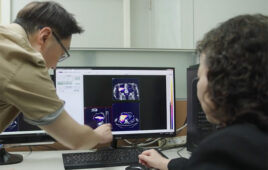
Festo invests 8% of its revenue in R&D [Image from Festo]
In 2024, Festo recorded a turnover of €3.45 billion, down from €3.65 billion in 2023. The company allocated 8.8% of that revenue to research & development, equivalent to approximately €304 million. In comparison, 2023 saw a 7.7% R&D investment on a €3.65 billion turnover (about €281 million). Earlier, Festo had reported R&D investment at “around eight percent” in prior years. The firm holds more than 2,600 patents globally and launches roughly 100 patent-ready products each year.
“This is cutting edge research, trying to develop new technologies and go into new spaces,” Lamontagne said.
The company, headquartered in Esslingen am Neckar, Germany (near Stuttgart) has strategically directed that R&D investment toward its LifeTech division since the early 2000s, recognizing critical overlaps between industrial pneumatics and the growing need for automated lab processes. The firm also has offices in other innovation hubs such as Shanghai and the Boston area (Marlborough).
“What we saw is that these life science customers are looking to automate a lot of processes that are done manually,” Lamontagne explained. “With our strong background in factory automation and industrial automation, we had the skills required, or the knowledge required, to automate these laboratory or life science processes.”
Active in niches such as diagnostics and pharmaceuticals, Lamontagne highlighted one example how Festo’s knack for precision filling could save companies millions. He pointed to one client that was having trouble with automated liquid dispensing of vials. “They were overfilling everything by 10%, but this could add up to tens of millions of dollars per year in wasted drug,” he said. By implementing more accurate dispensing systems, the client was able to “tighten the band for that dispense” and save millions annually, Lamontagne noted.
20-Year R&D journey focuses on miniaturization
Festo’s two-decade research investment has yielded technologies that address recurring challenges in lab automation: space constraints. “Laboratory space is very critical. All of the Festo Life Science products were designed with space-saving in mind,” Lamontagne noted. He added that lab environments require costly HEPA filtration and hazardous material handling capabilities.
The R&D efforts have produced market-leading innovations like media-separated valves that Lamontagne describes as unmatched: “There’s no other valve on the market that is this size that’s able to provide the flow rate that we do with media separation.” These valves are “about 100 times more leak-tight in gas than a standard pneumatic valve,” demonstrating how sustained research investment translates to technical superiority.
At its Marlborough facility, Festo engineers have developed approaches that dramatically reduce footprint. “We’re able to take 16 precision regulators and integrate them onto a single circuit and a single manifold to really save space for the customer,” he explained.
From manual approaches to automated precision for labs
The research focus addresses widespread inefficiencies in life sciences. Lamontagne illustrated the problem with a vivid example: “You’d have somebody who would basically sit all day and twist open the vial, place it back on the rack, and then go through all day like that.”
To solve this specific challenge, Festo developed the EHMD rotary gripper, a device small enough to fit in your hand that can grip and rotate infinitely. But creating laboratory-scale automation required reimagining their industrial expertise. “With an electric gripper, you’re going to have slight heating up. With a pneumatic gripper, you’re not going to heat up at all,” Lamontagne explained, highlighting how Festo adapted their pneumatic knowledge to meet the temperature-sensitive demands of lab work.
This transition from large-scale factory automation to microfluidics wasn’t straightforward. The company leveraged its piezo control technology, used for 30 years in industrial pressure regulators, to create mass flow controllers that handle flows as small as 0.2 liters per minute. “Similar concepts as a product we’ve been providing for 30 years. It’s just that, instead of pressure control, we’re now controlling a flow in a system,” Lamontagne noted.
The company’s Technical Engineering Centers, strategically located in Boston and Shanghai, serve as bridges between industrial capability and laboratory needs. These facilities test proprietary reagents and chemistries for specific customers while developing solutions that work across both domains, from brewery bioreactors to semiconductor manufacturing.
“What I think is important with Festo Life Sciences is these life science products were designed with laboratory automation in mind, where space is really important,” Lamontagne reflected. “I think it’s great to see that space-saving go back into a factory automation example and work really well there.”