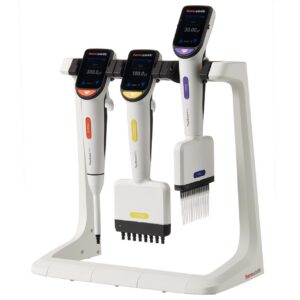
 The new Thermo Scientific FluidEase Pro ClipTip electronic pipettes combine a large, high-resolution touchscreen with ClipTip attachment, electronic tip ejection, Bluetooth 5.0 connectivity, up to five user profiles and a modular charging stand that can support as many as four pipettes.
“Lab users today grew up with smartphones,” said Joyce Ji, Director & General Manager, Liquid Handling Instruments and OEM Consumables at Thermo Fisher Scientific. “They know how to navigate touchscreen devices, and many other lab instruments already use touchscreens.”
The interface centers on a 2-in. color IPS LCD projected-capacitive touchscreen, with direct editing of protocol parameters and visual feedback for volumes, speeds and workflow steps. Thermo Fisher says the touchscreen is intended to shorten training time, reduce setup errors and support more consistent execution across users.
“What the touchscreen allows us to do is we can customize the view of each screen in the user interface,” said Dave Hunter, Global Product Manager at Thermo Fisher Scientific. “We’re not limited by physical buttons.”

Joyce Ji
Thermo Fisher is also treating the interface as a protected design bet. “We have patents,” Ji said. The company’s Finland arm, Thermo Fisher Scientific Oy, has pursued electronic-pipette user-interface patents for more than a decade, covering display-based pipette interfaces with menu shortcuts, alongside ClipTip attachment patents dating to the predecessor E1-ClipTip electronic pipettes.
Integrating a new touchscreen onto the existing ClipTip attachment system required a longer development cycle than a routine product refresh, mostly on the software side. Ji said the core cross-functional team included roughly 20 to 30 people across R&D, manufacturing, hardware design and software design. Moving from early prototype units tested with customers, the alpha stage, to near-production units in broader field testing, the beta stage, took approximately two and a half years, she said, with roughly 20 software versions along the way.
“By the beta stage, the hardware design was largely locked in, and the team focused more on software debugging and refinement,” Ji said.
The testing surfaced specific design calls. Hunter said the finger rest ended up rotating 120 degrees, a choice driven by customer feedback to accommodate both left- and right-handed users. In multichannel workflows, he said, he had seen customers go to unusual lengths to verify tip attachment before dispensing.

Dave Hunter
“Users may rock the pipette to make sure every tip across the eight or 12 channels has sealed properly,” Hunter said. “I have even seen customers go back and hand-check each tip to make sure it is attached.”
Ji said the company gathered feedback from healthcare, major clinical labs, Big Pharma, biotech, academia and research labs. The final product reflects that shared-lab use case: the spec sheet lists up to five user profiles, shared preset protocols, custom calibration options and a multilingual interface with six language options.
The same design process shaped the pipette’s ergonomics. FluidEase Pro shifts routine operation away from repeated thumb motion and toward index-finger control, while ClipTip attachment and electronic tip ejection are intended to reduce the force users apply during repetitive pipetting. For labs where scientists may pipette for hours at a time, Hunter said one of the biggest ergonomic burdens starts before liquid is even moved.
“Traditional pipettes rely on friction fit,” Hunter said. “It’s dependent on the user force to create that seal between the pipette and the tip. And that’s what can cause a lot of repetitive strain injuries.”
FluidEase Pro uses standard USB-C charging, with an optional modular stand that can charge up to four pipettes from one outlet. The spec sheet lists a rechargeable 950 mAh lithium-ion battery and an approximately two-hour charging time. Hunter said the stand was designed partly to save benchtop space in labs that need multiple pipettes ready at once.
The line includes single-channel, eight-channel, 12-channel and 16-channel formats, with weight ranges from 187 to 189 g for single-channel models and roughly 255 to 327 g for multichannel versions, depending on format. Hunter said balance mattered as much as absolute weight because electronic pipettes can become top-heavy when the screen and battery are added.
“Once you hear it click, you know that the tip is securely attached, and you’re going to get a consistent seal every single time,” Hunter said.