Research & Development World

  • R&D World Home
  • Topics
    • Aerospace
    • Automotive
    • Biotech
    • Careers
    • Chemistry
    • Environment
    • Energy
    • Life Science
    • Material Science
    • R&D Management
    • Physics
  • Technology
    • 3D Printing
    • A.I./Robotics
    • Software
    • Battery Technology
    • Controlled Environments
      • Cleanrooms
      • Graphene
      • Lasers
      • Regulations/Standards
      • Sensors
    • Imaging
    • Nanotechnology
    • Scientific Computing
      • Big Data
      • HPC/Supercomputing
      • Informatics
      • Security
    • Semiconductors
  • R&D Market Pulse
  • R&D 100
    • 2025 R&D 100 Award Winners
    • 2025 Professional Award Winners
    • 2025 Special Recognition Winners
    • R&D 100 Awards Event
    • R&D 100 Submissions
    • Winner Archive
  • Resources
    • Research Reports
    • Digital Issues
    • Educational Assets
    • Subscribe
    • Video
    • Webinars
    • Content submission guidelines for R&D World
  • Global Funding Forecast
  • Top Labs
  • Advertise
  • SUBSCRIBE

From Turing to ChatGPT, timeline covers some of the high points in AI’s emergence

By Brian Buntz | August 13, 2024

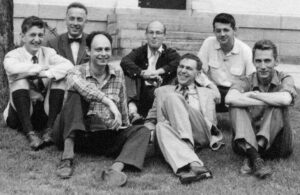
Dartmouth AI conference

the Dartmouth Summer Research Project on Artificial Intelligence was a landmark event organized by John McCarthy, Marvin Minsky, Nathaniel Rochester, and Claude Shannon. [IEEE/Minsky Family]

Imagine a world where machines think like humans. This dream, once confined to mythology and science fiction, is now the driving force behind artificial Intelligence. While researchers didn’t coin the term “artificial intelligence” until the 1950s, the quest to create intelligent machines is centuries old. From the mythical Hephaestus forging mechanical servants in his Olympian workshop to Leonardo da Vinci sketching plans for a mechanical knight, the potential of artificial beings has long captivated humans.

But these early visions were often limited by the technology of their time. It wasn’t until a wave of mathematical and scientific breakthroughs in the 19th and 20th centuries that the dream of AI began to take shape. Think of George Boole’s Boolean algebra, a seemingly abstract concept that would later become the foundation for the logical reasoning of computers. In the 1930s, Alan Turing developed the concept of a universal computing machine, which would become crucial for the development of modern computers and AI.

The term “artificial intelligence” itself was coined in 1956 at the Dartmouth Conference, marking the official birth of AI as a field of study. Our interactive timeline invites you to explore the fascinating evolution of AI from that pivotal moment onward. The timeline covers the early days of perceptrons and expert systems, and includes challenging “AI winters” and the recent resurgence.

Image sources include Wikipedia, IEEE/the Minsky Family, Adobe Stock, IBM, and various digital archives.

Related Articles Read More >

Cursor is using AI to build the next Cursor while grappling with industrial-scale code creation
As OpenAI releases GPT-Rosalind for life sciences research, we test out the new AlphaFold and PubMed plugins in Codex
After 9,000 announced job cuts, Novo Nordisk taps OpenAI as it hires in China
Anthropic and industry leaders debut Project Glasswing to preempt AI-driven cyberattacks
rd newsletter
EXPAND YOUR KNOWLEDGE AND STAY CONNECTED
Get the latest info on technologies, trends, and strategies in Research & Development.

R&D World Digital Issues

Fall 2025 issue

Browse the most current issue of R&D World and back issues in an easy to use high quality format. Clip, share and download with the leading R&D magazine today.

R&D 100 Awards
Research & Development World
  • Subscribe to R&D World Magazine
  • Sign up for R&D World’s newsletter
  • Contact Us
  • About Us
  • Drug Discovery & Development
  • Pharmaceutical Processing
  • Global Funding Forecast

Copyright © 2026 WTWH Media LLC. All Rights Reserved. The material on this site may not be reproduced, distributed, transmitted, cached or otherwise used, except with the prior written permission of WTWH Media
Privacy Policy | Advertising | About Us

Search R&D World

  • R&D World Home
  • Topics
    • Aerospace
    • Automotive
    • Biotech
    • Careers
    • Chemistry
    • Environment
    • Energy
    • Life Science
    • Material Science
    • R&D Management
    • Physics
  • Technology
    • 3D Printing
    • A.I./Robotics
    • Software
    • Battery Technology
    • Controlled Environments
      • Cleanrooms
      • Graphene
      • Lasers
      • Regulations/Standards
      • Sensors
    • Imaging
    • Nanotechnology
    • Scientific Computing
      • Big Data
      • HPC/Supercomputing
      • Informatics
      • Security
    • Semiconductors
  • R&D Market Pulse
  • R&D 100
    • 2025 R&D 100 Award Winners
    • 2025 Professional Award Winners
    • 2025 Special Recognition Winners
    • R&D 100 Awards Event
    • R&D 100 Submissions
    • Winner Archive
  • Resources
    • Research Reports
    • Digital Issues
    • Educational Assets
    • Subscribe
    • Video
    • Webinars
    • Content submission guidelines for R&D World
  • Global Funding Forecast
  • Top Labs
  • Advertise
  • SUBSCRIBE