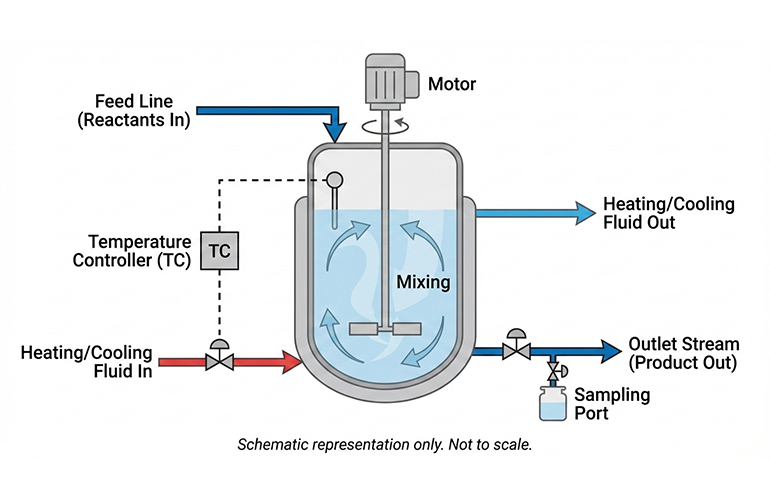
Sample image from Nano Banana Pro. The abbreviated prompt: “Generate a clean technical diagram, in a flat infographic style, that explains the basic flow of a continuous stirred tank reactor (CSTR) used in chemical engineering.
Add clear, readable English labels for each component.”
My neighbor, a chemical engineer, once quipped that AI looks cool but is not practical yet after watching an image model completely botch a mockup for a small construction project.
Nano Banana Pro at a glance
Nano Banana Pro (Gemini 3 Pro Image) is Google’s new flagship image generation and editing model, built on the Gemini 3 Pro backbone and aimed at creative and technical work.
What it adds on top of the original Nano Banana:
- Reasoning and world knowledge. The model uses Gemini 3’s language engine, so it can turn notes, specs or rough ideas into diagrams, infographics or mockups, and can ground visuals in up to date web information.
- Better text, in more languages. Nano Banana Pro is tuned to render legible labels and longer text directly inside the image, and to localize that text while preserving layout and style. That matters for dashboards, packaging and technical diagrams.
- High fidelity control. You can blend up to 14 input images and keep the look of as many as five people consistent, while adjusting lighting, camera angle, depth of field and color grading for 2K or 4K output.
- Local edits, not full do overs. The model supports precise region level editing, which lets you tweak one part of a scene without scrambling everything else.
- Where you can use it. Nano Banana Pro is rolling out in the Gemini app (via the “Thinking” model’s image mode), Google AI Studio and Antigravity, and in Vertex AI and Google Ads for production workflows.
For engineers and R&D teams, Nano Banana Pro could open up fast visualizations that still look more like they belong in a lab report or a design review.
Those early days of AI image generators choking with extra fingers and nonsense text may be numbered. Google is extending its Gemini image lineup with Nano Banana Pro, also known as Gemini 3 Pro Image, an upgraded image generation and editing model built on the Gemini 3 Pro foundation, which means it plugs into a larger multimodal system that can plan scenes, pull in current information, and reason about text and layout instead of just painting pixels.
The launch follows the viral popularity of Gemini 2.5 Flash Image, or “Nano Banana,” and signals that interest in more research oriented image generation is still ramping up, not just for memes but for technical diagrams, documentation and UI design. As always, such images are likely drafts rather than finished products, but the gap between the two is narrowing.
Nano Banana Pro can blend up to 14 input images, including product photos, logos, and reference assets, into a single 2K or 4K frame, while giving users granular control over lighting, camera position, depth of field, and other “physics” parameters. Google positions that capability as a fit for automated ad generation and other large scale creative workflows, but it is equally relevant for technical marketing, concept renders, and experiment visualization.
Another shift the model offers is grounding. It can tap into real time information via Google Search to generate more factual assets, such as biological diagrams, historical maps or infographics that reflect current conditions instead of static training data. That builds on the broader Gemini 3 Pro push toward stronger reasoning and world knowledge, but in this case expressed directly in image form.
Text rendering is also a focus. Early Gemini image models struggled with legible text. Nano Banana Pro introduces state of the art text placement and “logic based” localization, which lets developers translate text inside an image, such as menus or posters, while preserving the original design style. That combination is important for global product teams that need fast, localized visuals without rebuilding layouts from scratch.