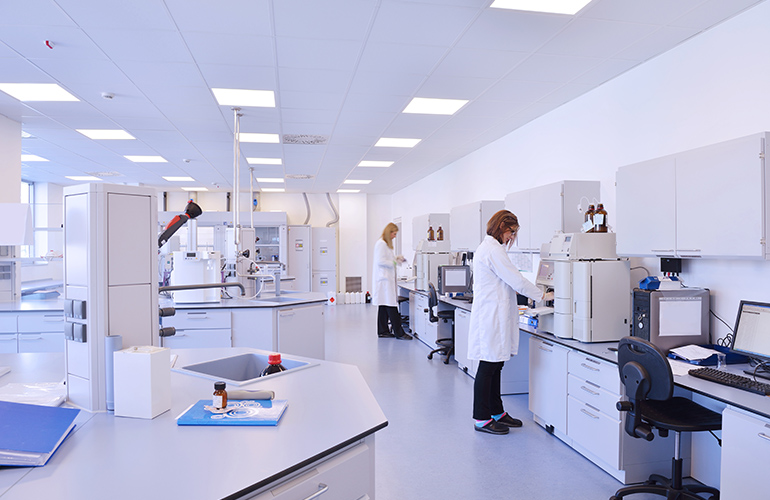
[Adobe Stock]

Ashu Singhal
The term keeps fragmenting. “It’s being defined in a ton of different ways,” said Ashu Singhal, co-founder and president of Benchling, in an interview with R&D World. Singhal’s own definition starts in the wet lab. “I have a very strong belief that science has to happen in the physical world,” he said. The hypothesis is often the easy part. The gruntwork often involves ordering the reagents, setting up the notebook entries, running the assay, capturing the data, and feeding it back into the next round of design.
In an April blog post, Benchling CEO Sajith Wickramasekara laid out the company’s AI Scientist architecture. San Francisco, where Benchling is headquartered, has become the de facto world headquarters of AI, the place where startup billboards are now unavoidable on freeways and bus shelters. From inside that scene, Wickramasekara argues that “Silicon Valley has no idea how medicines are discovered and developed,” and that coding agents have taken over while scientific agents have not, because “AI for science has a big wet lab problem.”
A recent research survey from the Pistoia Alliance supports that thesis. The nonprofit organization found that only 1% of life science professionals report AI having value in the wet lab. While more than half (54%) of respondents said teams focused on regulatory submissions and reporting are seeing benefits from AI, only 13% cited value in automating scientific workflows and experiments.
Singhal splits experimentation into rough thirds. The first is repetitive, well-defined work, the same assay run again and again, worth fully automating on a workcell in-house. The second makes sense to hand to an external CRO. The last is one-off, ad hoc work that may never pay back the cost of automating, which is why he does not expect the bench to empty out. “There’s so many assays that are done that are just one-off ad hoc experiments,” he said, “and that’s why I don’t think humans are ever going to fully leave the lab.”
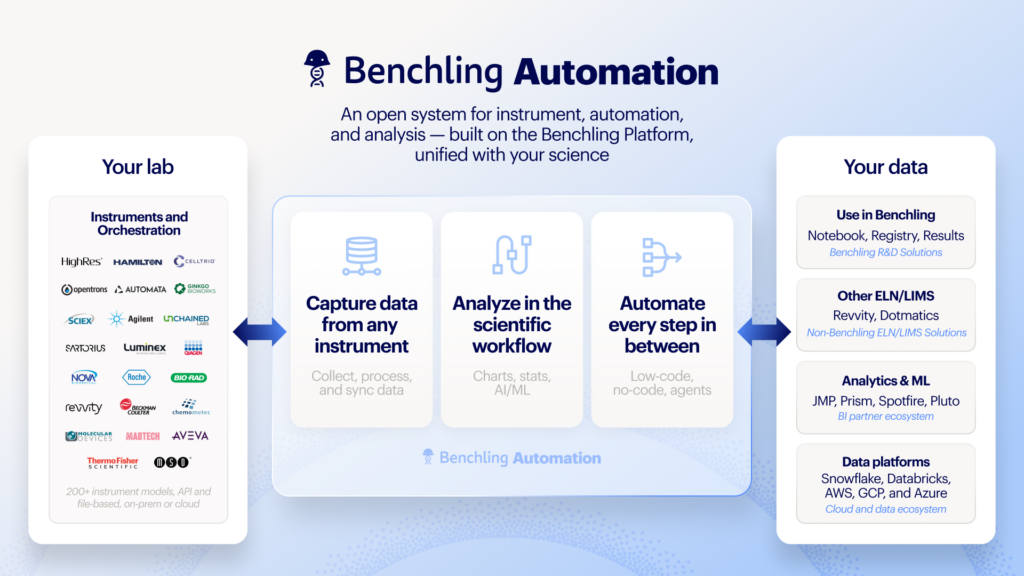
A marketing image of Benchling Automation
Even the automatable portion is often harder than it looks. “Even when you have great hardware for automating an experiment or a great CRO to run it, there is still a lot of work to push the right inputs to those places and process all the outputs so the data becomes useful,” Singhal said.
Benchling has since shipped a string of products aimed at closing the gap between designing an experiment and running it: one-click ordering with CRO partners Twist Bioscience, Adaptyv, and Ginkgo Bioworks; a Model Hub that lets scientists run structure prediction and generative models inside their existing workflows; and AI Connectors built on Model Context Protocol to link scientific data to external AI tools. The latest is Benchling Automation, launched today, which connects instrument data to scientific records across workcells and bench instruments. Launch partners include HighRes, Automata, Ginkgo Bioworks, Celltrio, Opentrons, and Hamilton. When a scientist designs an experiment, the system sends the run to the relevant workcell or instrument and routes both the raw data and the analyzed results back into the notebook entry, tied to the samples that produced them.
What that loop looks like in practice surfaced at the ASGCT annual meeting in May, where Prime Medicine described using Benchling’s AI Scientist on PM359, its prime-edited therapy for chronic granulomatous disease. Working toward a biologics license application, the system synthesized experimental data Prime had been capturing in Benchling since 2022, mapped the evidence to FDA validation requirements, designed targeted follow-up studies, and maintained a living validation package, compressing what the company said would have taken months into days. Singhal describes the mechanic as a gated loop. The AI scientist designs the method and drafts the notebook entry for a scientist to follow, then pauses while a human runs the work at the bench and resumes once the data returns. He frames it in terms his audience already knows: “It’s no different than a coding agent waiting for a set of tests to run.”
In a collaboration announced last June, Merck rebuilt the bioanalytical testing that validates patient samples from vaccine trials, the last mile of vaccine development, around automated workflows on Benchling’s platform. Merck’s regulated bioanalytics group has reported a tenfold efficiency gain, with an Axendia account of the project adding a 25% reduction in rote tasks and support for more than 1.1 million clinical samples while retiring six legacy systems.
Singhal’s case for where Benchling sits rests on three claims. There is a connection into the physical world that model-centric players lack, a data model rich enough to feed an AI scientist, and interfaces a human scientist actually wants to use. The data point is the one he leans on hardest, describing high-quality structured records, “not just capturing paper-on-glass data,” as “the fuel” for the whole system. “We view our role,” he said, “as wiring that together with physical lab automation and CROs to build a harness that can execute a true experiment.”
The product push enters a landscape that is quickly evolving. Lila Sciences has raised $235 million to build what it calls “AI Science Factories.” Medra, with $52 million in Series A funding, is deploying robotic systems that its CEO says can operate more than 75% of the instruments scientists already use. Amazon unveiled Bio Discovery in April. And in the same month, Anthropic deployed Claude Enterprise across more than 30,000 BMS employees while Merck committed up to $1 billion to Google Cloud.
For all the capital pouring into autonomous labs, Singhal’s view of the destination keeps the scientist at the center. “I think the future is an AI scientist actually collaborating with a human scientist to unlock that human’s judgment,” he said, “and having really easy-to-use expert interfaces that a human scientist actually wants to use.”


Tell Us What You Think!
You must be logged in to post a comment.