HerAnova Lifesciences announced the release of HerResolve, a blood-based test to detect endometriosis, last month. HerResolve has been incorporated into fertility and reproductive medicine settings. The test is currently being used by reproductive endocrinologists and OB-GYNs at IVF centers.
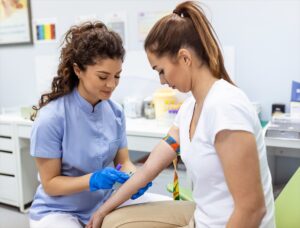
Collecting blood sample for HerResolve. Credit: HerAnova
Endometriosis affects one in ten women of reproductive age, yet diagnosis often takes years and may require invasive surgical procedures. During that time, many patients experience prolonged uncertainty, delayed treatment, and significant impacts on quality of life. Despite advances in imaging and clinical awareness, accessible non-invasive tools to support evaluation have remained limited.
Multi-Omic Approach Achieves Clinical-Grade Accuracy
HerResolve is a multi-omic test that combines proteomics, genomics, and hormonal approaches into a single test. The test detects markers that have been validated to correlate with the presence of endometriosis.
The test demonstrates an accuracy of over 94%, matching the current standard of care. It is also 97% specific and has a positive sensitivity of 80%.
The test could compress diagnostic timelines, which currently stretch from seven to 10 years for endometriosis, on average. “If the test is applied upon the first observation of symptoms, it could theoretically have a window of maybe six months to a year,” said Farideh Bischoff, chief medical officer and head of diagnostics for HerAnova.
From Decade to Months: Compressing the Diagnostic Window
Currently, HerResolve is in use across IVF and fertility clinics. However, the test could have a future beyond these clinics. “I visualize it going beyond IVF, certainly. Not just going into OB-GYN centers, but even into family practice and pediatricians, because endometriosis has been seen in young girls in adolescence,” Bischoff said, “I see this becoming a test that is not limited to a specific clinical area. It should be across all modalities where symptoms that match endometriosis present.”
Credit: HerAnova
HerAnova plans to submit HerResolve for FDA clearance later this year, Bischoff said. FDA clearance could open new paths for the test, including as a companion diagnostic for future clinical trials.
Regulatory Path and Data-Driven Expansion
As HerAnova’s database expands with information from the HerResolve test, the company aims to use it for further machine learning, potentially stratifying cases based on disease stage and infertility.
“By increasing that database to real-world representation, it will give us the tools to then stratify our methods again, all by using machine learning,” Bischoff said. “Can we use this test to see that hormone suppression was successful, and therefore your disease is now under control, and you can proceed to the next step. We can definitely expand into that area with a robust database.”
A Crowded Field Racing Toward Non-Invasive Detection
At least a dozen biotech companies are developing tools to diagnose endometriosis more easily. The field is characterized by diverse methodological approaches—blood, saliva, menstrual fluid, and tissue-based tests—each with distinct advantages and at different stages of development.
Hera Biotech’s MetriDx uses tissue-based single-cell analysis from a uterine brush biopsy, claiming 92% sensitivity and 95% specificity. The French company Ziwig is the only company with a test currently on the market. Its saliva-based test analyzes 109 microRNAs and is available in Switzerland, the UK, Italy, Germany and Norway. NextGen Jane, Proteomics International and Endometrics have tests currently in development.
This crowded but nascent competitive landscape suggests both the urgency of the unmet need and the technical challenges that have kept a gold-standard non-invasive test elusive until now.