Research & Development World

  • R&D World Home
  • Topics
    • Aerospace
    • Automotive
    • Biotech
    • Careers
    • Chemistry
    • Environment
    • Energy
    • Life Science
    • Material Science
    • R&D Management
    • Physics
  • Technology
    • 3D Printing
    • A.I./Robotics
    • Software
    • Battery Technology
    • Controlled Environments
      • Cleanrooms
      • Graphene
      • Lasers
      • Regulations/Standards
      • Sensors
    • Imaging
    • Nanotechnology
    • Scientific Computing
      • Big Data
      • HPC/Supercomputing
      • Informatics
      • Security
    • Semiconductors
  • R&D Market Pulse
  • R&D 100
    • 2025 R&D 100 Award Winners
    • 2025 Professional Award Winners
    • 2025 Special Recognition Winners
    • R&D 100 Awards Event
    • R&D 100 Submissions
    • Winner Archive
  • Resources
    • Research Reports
    • Digital Issues
    • Educational Assets
    • Subscribe
    • Video
    • Webinars
    • Content submission guidelines for R&D World
  • Global Funding Forecast
  • Top Labs
  • Advertise
  • SUBSCRIBE

Hubble Pushed Beyond Limits to Spot Clumps Of New Stars in Distant Galaxy

By Nasa/Goddard Space Flight Center | July 6, 2017

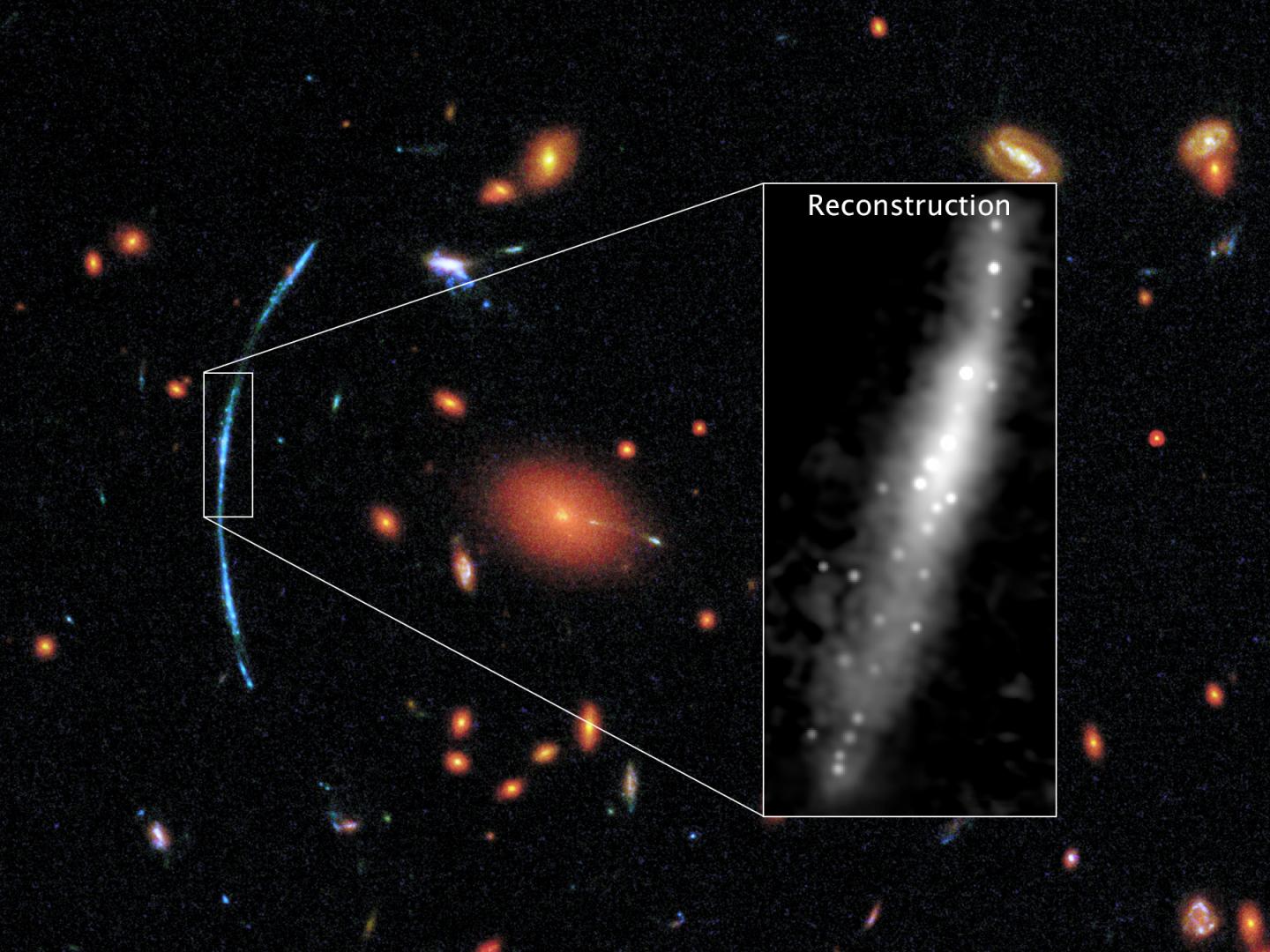
In this Hubble photograph of a distant galaxy cluster, a spotty blue arc stands out against a background of red galaxies. That arc is actually three separate images of the same background galaxy. The background galaxy has been gravitationally lensed, its light magnified and distorted by the intervening galaxy cluster. On the right: How the galaxy would look to Hubble without distortions. Credit: NASA, ESA, and T. Johnson (University of Michigan)

When it comes to the distant universe, even the keen vision of NASA’s Hubble Space Telescope can only go so far. Teasing out finer details requires clever thinking and a little help from a cosmic alignment with a gravitational lens.

By applying a new computational analysis to a galaxy magnified by a gravitational lens, astronomers have obtained images 10 times sharper than what Hubble could achieve on its own. The results show an edge-on disk galaxy studded with brilliant patches of newly formed stars.

“When we saw the reconstructed image we said, ‘Wow, it looks like fireworks are going off everywhere,'” said astronomer Jane Rigby of NASA’s Goddard Space Flight Center in Greenbelt, Maryland.

The galaxy in question is so far away that we see it as it appeared 11 billion years ago, only 2.7 billion years after the big bang. It is one of more than 70 strongly lensed galaxies studied by the Hubble Space Telescope, following up targets selected by the Sloan Giant Arcs Survey, which discovered hundreds of strongly lensed galaxies by searching Sloan Digital Sky Survey imaging data covering one-fourth of the sky.

The gravity of a giant cluster of galaxies between the target galaxy and Earth distorts the more distant galaxy’s light, stretching it into an arc and also magnifying it almost 30 times. The team had to develop special computer code to remove the distortions caused by the gravitational lens, and reveal the disk galaxy as it would normally appear.

The resulting reconstructed image revealed two dozen clumps of newborn stars, each spanning about 200 to 300 light-years. This contradicted theories suggesting that star-forming regions in the distant, early universe were much larger, 3,000 light-years or more in size.

“There are star-forming knots as far down in size as we can see,” said doctoral student Traci Johnson of the University of Michigan, lead author of two of the three papers describing the research.

Without the magnification boost of the gravitational lens, Johnson added, the disk galaxy would appear perfectly smooth and unremarkable to Hubble. This would give astronomers a very different picture of where stars are forming.

While Hubble highlighted new stars within the lensed galaxy, NASA’s James Webb Space Telescope will uncover older, redder stars that formed even earlier in the galaxy’s history. It will also peer through any obscuring dust within the galaxy.

“With the Webb Telescope, we’ll be able to tell you what happened in this galaxy in the past, and what we missed with Hubble because of dust,” said Rigby.
Related Articles Read More >

The science behind the Prada-designed spacesuit for Artemis 
NASA is confident Blue Origin will be ready for Artemis III despite explosion
Blue Origin explosion leaves Artemis experiments in limbo
SpaceX’s Starship V3 rocket completed its launch rehearsal
rd newsletter
EXPAND YOUR KNOWLEDGE AND STAY CONNECTED
Get the latest info on technologies, trends, and strategies in Research & Development.

R&D World Digital Issues

Fall 2025 issue

Browse the most current issue of R&D World and back issues in an easy to use high quality format. Clip, share and download with the leading R&D magazine today.

R&D 100 Awards
Research & Development World
  • Subscribe to R&D World Magazine
  • Sign up for R&D World’s newsletter
  • Contact Us
  • About Us
  • Drug Discovery & Development
  • Pharmaceutical Processing
  • Global Funding Forecast

Copyright © 2026 WTWH Media LLC. All Rights Reserved. The material on this site may not be reproduced, distributed, transmitted, cached or otherwise used, except with the prior written permission of WTWH Media
Privacy Policy | Advertising | About Us

Search R&D World

  • R&D World Home
  • Topics
    • Aerospace
    • Automotive
    • Biotech
    • Careers
    • Chemistry
    • Environment
    • Energy
    • Life Science
    • Material Science
    • R&D Management
    • Physics
  • Technology
    • 3D Printing
    • A.I./Robotics
    • Software
    • Battery Technology
    • Controlled Environments
      • Cleanrooms
      • Graphene
      • Lasers
      • Regulations/Standards
      • Sensors
    • Imaging
    • Nanotechnology
    • Scientific Computing
      • Big Data
      • HPC/Supercomputing
      • Informatics
      • Security
    • Semiconductors
  • R&D Market Pulse
  • R&D 100
    • 2025 R&D 100 Award Winners
    • 2025 Professional Award Winners
    • 2025 Special Recognition Winners
    • R&D 100 Awards Event
    • R&D 100 Submissions
    • Winner Archive
  • Resources
    • Research Reports
    • Digital Issues
    • Educational Assets
    • Subscribe
    • Video
    • Webinars
    • Content submission guidelines for R&D World
  • Global Funding Forecast
  • Top Labs
  • Advertise
  • SUBSCRIBE