Rendering of Science Square, Atlanta, GA
Atlanta’s west side is getting a new kind of lab district. Science Square, an 18-acre mixed-use development next to Georgia Tech’s Midtown campus, is being marketed as a regional life sciences hub, with a purpose-built lab tower, residential high-rises and street-level retail clustered around new pedestrian links and a shared “home for discovery.” Within Science Square Labs, the 364,000-square-foot anchor building designed to house everything from early-stage startups to established R&D groups, venture firm Portal Innovations runs incubator floors where young biotech and medtech companies share benches, equipment and common spaces instead of shouldering the cost of a custom buildout alone.
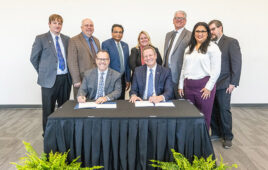
One of the newest tenants in that ecosystem is Biohm Technologies, a Cleveland-based microbiome company (focused on dietary-supplements) built on four decades of work by co-founder and chief science officer Mahmoud Ghannoum, who coined the term “mycobiome” for the fungal side of the gut ecosystem. Biohm’s new research lab at Portal Innovations’ 33,000-square-foot Atlanta site is intended to extend its R&D footprint beyond its Case Western Reserve base. It will support strain development, characterization and product-focused studies of bacterial-fungal interactions in the gut. The space plugs into Portal’s 100-plus shared benches and more than $2 million in modern equipment, giving the company a turn-key way to scale microbiome ingredient development inside a district that is rapidly filling with life science tenants.
Biohm is trying to stand out in a crowded microbiome field by concentrating on the interplay between bacteria and fungi rather than bacteria alone. Ghannoum’s long-running research program has produced a large combined bacterial and fungal microbiome dataset, which the company feeds into its Symbiont discovery platform along with bioinformatics and AI tools. That work underpins products such as Mycohsa, a probiotic blend that Biohm says is supported by several human clinical trials and multiple in vitro studies on biofilm breakdown and gut balance. The Atlanta lab is designed to give that discovery engine more room, from early strain characterization through formulation screens for new probiotic and postbiotic candidates.
Georgia Tech’s engineering and computing programs sit a short walk away, and Portal layers in shared-instrument training, technical mentors and investor introductions. On the facilities side, the life-science-as-a-service model provides more than 100 benches, BSL-2 capability and a shared equipment pool valued in the low millions of dollars, including centrifuges, PCR machines, autoclaves and cold and chemical storage. That setup gives the company a local bench of collaborators and potential hires without having to build a full campus footprint.
Inside the Biohm lab, the work centers on making fungal-bacterial dynamics concrete. Teams move between benches set up for culture work, sample processing and molecular assays, generating the sequencing and metabolite data that underpin Biohm’s diagnostics and ingredients. Rather than treating the space as an extension of a consumer brand, the group can use it to probe questions such as how particular strains behave in co-culture, which combinations are most resilient and how those findings translate into products that are stable, safe and manufacturable at scale.
That plug-in infrastructure also reflects the pace of the market. Analysts expect the human microbiome sector to grow from roughly $1.4 billion in 2025 to more than $7 billion by 2031, with much of today’s revenue coming from supplements while higher-risk drugs and diagnostics mature. In that kind of environment, traditional lab construction cycles that can stretch three to five years are hard to justify. Leasing into a ready-made district lab lets companies like Biohm spend more of their capital on people, studies and data rather than concrete and ductwork.
For Science Square, a microbiome-focused tenant broadens the mix of platforms under one roof. Microbiome, diagnostics, therapeutics and bioindustrial groups share elevators and conference rooms, increasing the odds that a facilities story turns into a scientific one, whether that means a new assay borrowed from a neighbor, an instrument shared or a hire made over coffee downstairs.