Research & Development World

  • R&D World Home
  • Topics
    • Aerospace
    • Automotive
    • Biotech
    • Careers
    • Chemistry
    • Environment
    • Energy
    • Life Science
    • Material Science
    • R&D Management
    • Physics
  • Technology
    • 3D Printing
    • A.I./Robotics
    • Software
    • Battery Technology
    • Controlled Environments
      • Cleanrooms
      • Graphene
      • Lasers
      • Regulations/Standards
      • Sensors
    • Imaging
    • Nanotechnology
    • Scientific Computing
      • Big Data
      • HPC/Supercomputing
      • Informatics
      • Security
    • Semiconductors
  • R&D Market Pulse
  • R&D 100
    • 2025 R&D 100 Award Winners
    • 2025 Professional Award Winners
    • 2025 Special Recognition Winners
    • R&D 100 Awards Event
    • R&D 100 Submissions
    • Winner Archive
  • Resources
    • Research Reports
    • Digital Issues
    • Educational Assets
    • Subscribe
    • Video
    • Webinars
    • Content submission guidelines for R&D World
  • Global Funding Forecast
  • Top Labs
  • Advertise
  • SUBSCRIBE

Iron-Based Molecule Produces Both Fuel and Electricity

By Kenny Walter | November 30, 2018

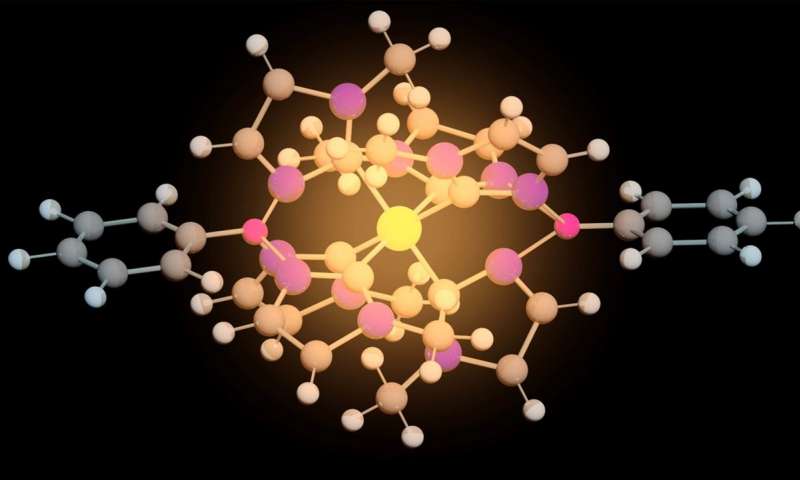
The new iron molecule. Credit: Nils Rosemann

A newly discovered iron molecule could potentially replace the more expensive and rare metals used to produce fuel and electricity with photocatalysts and solar cells.

Both solar cells and photocatalysts are based on technology that involves molecules that contain metals called metal complexes, which absorb solar rays and utilize their energy. However, the metals used in metal complexes are often rare and expensive metals like ruthenium, osmium and iridium.

“Our results now show that by using advanced molecule design, it is possible to replace the rare metals with iron, which is common in the Earth’s crust and therefore cheap,” chemistry professor Kenneth Wärnmark of Lund University in Sweden, said in a statement.

After an extensive search for alternative metals to replace the expensive metals used, the researchers zeroed on iron, which represents 6 percent of the Earth’s crust and is significantly easier to source.

While the researchers previously proved they could produce iron-based molecules whose potential can be used in solar energy applications, the new molecule also includes the ability to capture and utilize the energy of solar light for a sufficiently long time for it to react with another molecule.

The new iron-based molecule also glows long enough to allow researchers to see iron-based light with the naked eye at room temperature for the first time.

“The good result depends on the fact that we have optimized the molecular structure around the iron atom,” Petter Persson of Lund University, said in a statement.

The new iron molecule could be ultimately used in new types of photocatalysts for the production of solar fuel—either as hydrogen through water splitting or as methanol from carbon dioxide. The new findings will also open up other potential areas of application for iron molecules including as materials in light diodes.

The study was published in Science.

Related Articles Read More >

DOE announces first selections for nuclear energy DOME program
Five key trends that defined the show floor at Interphex 2026 
NANO Nuclear could have a reactor on the Moon by 2030 CEO says
DOE to award $100 million in grants amid science funding cuts
rd newsletter
EXPAND YOUR KNOWLEDGE AND STAY CONNECTED
Get the latest info on technologies, trends, and strategies in Research & Development.

R&D World Digital Issues

Fall 2025 issue

Browse the most current issue of R&D World and back issues in an easy to use high quality format. Clip, share and download with the leading R&D magazine today.

R&D 100 Awards
Research & Development World
  • Subscribe to R&D World Magazine
  • Sign up for R&D World’s newsletter
  • Contact Us
  • About Us
  • Drug Discovery & Development
  • Pharmaceutical Processing
  • Global Funding Forecast

Copyright © 2026 WTWH Media LLC. All Rights Reserved. The material on this site may not be reproduced, distributed, transmitted, cached or otherwise used, except with the prior written permission of WTWH Media
Privacy Policy | Advertising | About Us

Search R&D World

  • R&D World Home
  • Topics
    • Aerospace
    • Automotive
    • Biotech
    • Careers
    • Chemistry
    • Environment
    • Energy
    • Life Science
    • Material Science
    • R&D Management
    • Physics
  • Technology
    • 3D Printing
    • A.I./Robotics
    • Software
    • Battery Technology
    • Controlled Environments
      • Cleanrooms
      • Graphene
      • Lasers
      • Regulations/Standards
      • Sensors
    • Imaging
    • Nanotechnology
    • Scientific Computing
      • Big Data
      • HPC/Supercomputing
      • Informatics
      • Security
    • Semiconductors
  • R&D Market Pulse
  • R&D 100
    • 2025 R&D 100 Award Winners
    • 2025 Professional Award Winners
    • 2025 Special Recognition Winners
    • R&D 100 Awards Event
    • R&D 100 Submissions
    • Winner Archive
  • Resources
    • Research Reports
    • Digital Issues
    • Educational Assets
    • Subscribe
    • Video
    • Webinars
    • Content submission guidelines for R&D World
  • Global Funding Forecast
  • Top Labs
  • Advertise
  • SUBSCRIBE