 Cambridge, Massachusetts–based Ketryx, a software platform company that automates regulatory compliance for medical device and life sciences companies, has secured $39 million in Series B funding led by Transformation Capital, pushing its total raised to more than $55 million. The investment comes as the industry grapples with integrating AI into products amid tightening FDA rules, including the Quality Management System Regulation set to take effect in February 2026. Ketryx, claims its tools cut documentation time by up to 90% and speed release cycles by 10 times, with adoption by three of the top five global medtech firms and companies like DeepHealth, HeartFlow, Beacon Biosignals and Aignostics. CEO Erez Kaminski said the funds will fuel global expansion and product development. Transformation Capital partner Vinay Shah joins the board.
Putting validated AI agents to work on compliance workflows

Erez Kaminski
CEO Erez Kaminski said the funds will fuel hiring, product development and global expansion in Boston and Vienna, Austria. “Investors approached us … about 12 days later we had an offer. Transformation Capital felt like the right partner,” he said. “Customers are asking us to expand across divisions, so the capital goes to people and product.”
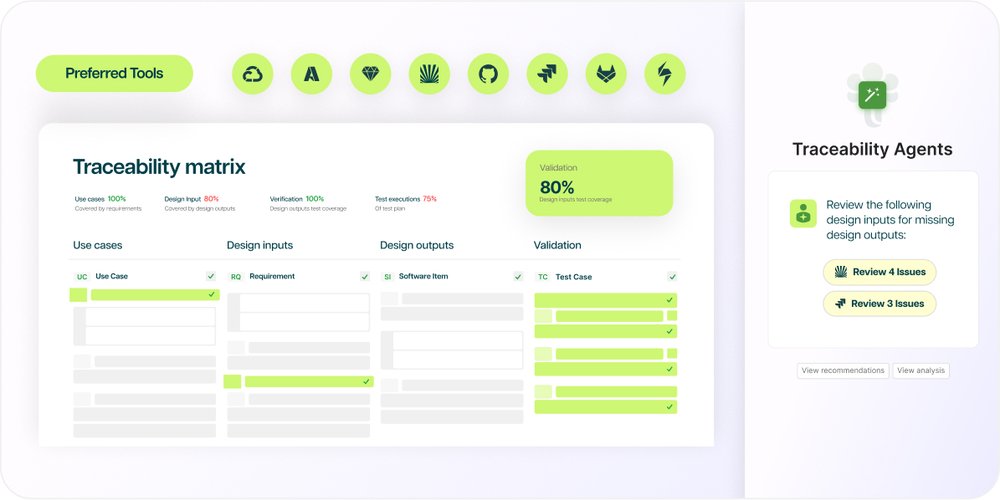
Ketryx uses “validated AI agents” that blend large-language-model drafting with rule-based controls, human checkpoints and audit trails. “We combine LLMs and agentic workflows with process-control AI that proves you executed the right steps and produces evidence that’s submission-ready,” Kaminski said. “We treat Ketryx as the environment the AI must operate in: workflow monitoring, human checkpoints, and a recorded audit trail.”
Kaminski emphasized the broader industry challenge: “Lower the cost of innovation, and you increase its volume. If you think devices are hard, look at automated biopharma manufacturing. It’s even more complex. The more we reduce that complexity and cost, the more patients benefit.”
Even with agent assistance, generative systems can produce unsupported text; the question for regulated teams is whether the process constrains and evidences every step. He noted LLM hallucinations “won’t fully disappear; validation is complex because LLMs span many use cases,” but added: “It’s feasible to comply; you need to understand what’s required and prove it for each version.” In AI terms, Ketryx’s “validated agents” reflect a neuro-symbolic approach: let an LLM draft, but bind it to explicit rules, human checkpoints, and audit trails so each change is constrained, reviewable, and tied to evidence.
Documentation challenges drive automation adoption
Customers have reported significant gains: “Some teams that shipped once a year now release multiple times a week,” Kaminski said. “We have clients releasing daily now. That’s orders of magnitude faster than a decade ago.” For annual releases, “six to nine months can be documentation” without automation. “For a small company, documentation can run $50,000–$500,000; for a very large company, millions, and over many product lines, possibly hundreds of millions,” Kaminski added.
The platform covers end-to-end development: “You can tell the agent what device you want to build, and the predicate, and it scaffolds the regulated development,” Kaminski said. It offers a free tier for teams raising under $2 million. Last year, about 2% of FDA approvals for AI systems came from Ketryx users.
Reflecting on the industry’s evolution, Kaminski noted the disconnect between consumer expectations and medical device reality: “Engineers used to say med-device requires patience; commercial gadgets iterate fast. But that’s not sustainable anymore. Users wonder why their insulin pump doesn’t evolve like a phone app.”
Ketryx plans to extend to other sectors: “The same software-and-evidence problem shows up in robotics, automotive, aerospace/defense, finance, and utilities. We’ll use the funding to hire and take the approach there,” Kaminski said.
“In medtech, long-term success depends on balancing innovation with the uncompromising demands of safety and compliance,” said Bill Hawkins, former Medtronic CEO and new Ketryx investor. “Ketryx has built infrastructure that allows both to advance together.” Hawkins, who got involved through Transformation Capital, told Kaminski during their discussions: “He told me he always assumed someone would solve it once the tech was ready. At the end of the day, we’re talking about producing the right documents from the work, reliably.”
Shah said diligence showed “Fortune 500s and fast-growing innovators consistently pointed to faster releases and lower documentation burden—evidence that compliance can accelerate, rather than slow, progress.”