Research & Development World

  • R&D World Home
  • Topics
    • Aerospace
    • Automotive
    • Biotech
    • Careers
    • Chemistry
    • Environment
    • Energy
    • Life Science
    • Material Science
    • R&D Management
    • Physics
  • Technology
    • 3D Printing
    • A.I./Robotics
    • Software
    • Battery Technology
    • Controlled Environments
      • Cleanrooms
      • Graphene
      • Lasers
      • Regulations/Standards
      • Sensors
    • Imaging
    • Nanotechnology
    • Scientific Computing
      • Big Data
      • HPC/Supercomputing
      • Informatics
      • Security
    • Semiconductors
  • R&D Market Pulse
  • R&D 100
    • 2025 R&D 100 Award Winners
    • 2025 Professional Award Winners
    • 2025 Special Recognition Winners
    • R&D 100 Awards Event
    • R&D 100 Submissions
    • Winner Archive
  • Resources
    • Research Reports
    • Digital Issues
    • Educational Assets
    • Subscribe
    • Video
    • Webinars
    • Content submission guidelines for R&D World
  • Global Funding Forecast
  • Top Labs
  • Advertise
  • SUBSCRIBE

Lab-Scale Prototype Treats Skin Tumors

By Universidad Politécnica de Madrid | April 7, 2017

Researchers from Universidad Politécnica de Madrid, among others, have designed a laser device designed for optical hyperthermia applications.

A joint research project of Universidad Politécnica de Madrid (UPM), Universitat Politécnica de Valencia (UPV), and CIBER’s Bioengineering, Biomaterials and Nanomedicine (CIBER-BBN) has developed a low cost lab-scale device for treatments based on optical hyperthermia applications through laser. This technique is used, for instance, in therapies against skin cancer and it aims to kill the tumor cells by overheating them. This research work has been published in Sensors and Actuators A Physical journal.

According to the researchers, overheating is achieved by irradiating synthesized metallic nanoparticles. “When receiving radiation, the particles heat the tumor tissue reaching a temperature between 42 C and 48 C, by maintaining such temperature we can cause a hypoxia that leads to a cellular death,” explains Roberto Montes, a researcher from UPV.

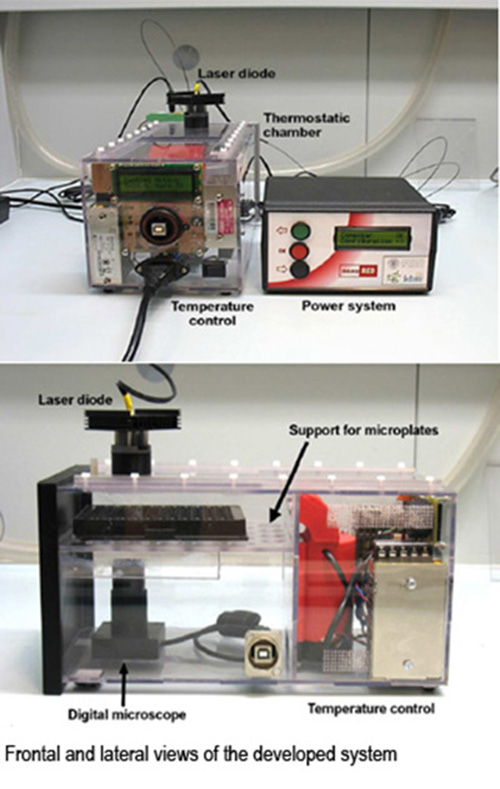
The prototype developed by both UPM and UPV researchers consists of an infrared laser with a power up to 500mW able to provide a power density up to 4W/cm2, a sensor that records the temperature in real time during the irradiation and a laser power regulator, among other components.

“However, if the laser is applied on tissues that were previously impregnated with gold nanoparticles (Au-NPs), which is the case of this study by Andy Hernández y Cristina Latorre, we achieve a located overheating. This presents a great advantage facing other techniques that are not able to distinguish between healthy tissues and damage tissues,” says Montes.

This work shows the keys to elaborate a device for a low cost optical hyperthermia technique. The main innovation compared to other marketed equipment lies on it has all the needed elements for the experimental phase, controlling as many variables as possible.

“When designing the prototype, we payed attention to the smallest details, such the control of temperature at the cabin, since it is essential to carry out a good work,” adds Javier Ibáñez from UPV.

According to the researchers, there are diverse laser applicators in the market used in dermatology and even surgery. At certain power and wavelengths, the laser energy is converted into heat and produces ablation (burn). The new system does not aim to “burn” the cells with the adjacent inflammation that this causes, but to introduce nanoheaters into such cells that when excited by the laser, they increase their temperature between 42 C and 48 C, resulting in hypoxia leading the cells to a “natural death.”

This equipment is already being successfully used in vitro cellular crops and in therapies that combine hyperthermia with the controlled release of drugs. “Although the equipment has been designed to exclusively work in a lab environment, once the technique is developed, it could be easily applied to a hospital environment with small changes. Of course, we are in an initial phase, there is much to do for its clinical usage: animal tissue testing, later testing on living animals, and finally to verify its application in patients,” says Ibáñez.

The work of the UPM and UPV researchers has been published in the Sensors and Actuators A Physical journal and funded by the National Programme for Research.

Source: Universidad Politécnica de Madrid

Related Articles Read More >

The photon frontier: how O2O Lasercom is redefining deep-space data on Artemis II
laser reflect on optic table un quantum laboratory
2026 ultrafast laser buyer’s guide: 86 models compared
NASA R&D 100 Winner enables high-speed data transfer from space
Illustration of ultracold atoms (gold) flowing frictionlessly along a laser boundary (green), representing the quantum phenomenon of edge states.
MIT physicists directly observe frictionless ‘edge state’ flow in ultracold atoms, offering a glimpse of super-efficient electronics
rd newsletter
EXPAND YOUR KNOWLEDGE AND STAY CONNECTED
Get the latest info on technologies, trends, and strategies in Research & Development.

R&D World Digital Issues

Fall 2025 issue

Browse the most current issue of R&D World and back issues in an easy to use high quality format. Clip, share and download with the leading R&D magazine today.

R&D 100 Awards
Research & Development World
  • Subscribe to R&D World Magazine
  • Sign up for R&D World’s newsletter
  • Contact Us
  • About Us
  • Drug Discovery & Development
  • Pharmaceutical Processing
  • Global Funding Forecast

Copyright © 2026 WTWH Media LLC. All Rights Reserved. The material on this site may not be reproduced, distributed, transmitted, cached or otherwise used, except with the prior written permission of WTWH Media
Privacy Policy | Advertising | About Us

Search R&D World

  • R&D World Home
  • Topics
    • Aerospace
    • Automotive
    • Biotech
    • Careers
    • Chemistry
    • Environment
    • Energy
    • Life Science
    • Material Science
    • R&D Management
    • Physics
  • Technology
    • 3D Printing
    • A.I./Robotics
    • Software
    • Battery Technology
    • Controlled Environments
      • Cleanrooms
      • Graphene
      • Lasers
      • Regulations/Standards
      • Sensors
    • Imaging
    • Nanotechnology
    • Scientific Computing
      • Big Data
      • HPC/Supercomputing
      • Informatics
      • Security
    • Semiconductors
  • R&D Market Pulse
  • R&D 100
    • 2025 R&D 100 Award Winners
    • 2025 Professional Award Winners
    • 2025 Special Recognition Winners
    • R&D 100 Awards Event
    • R&D 100 Submissions
    • Winner Archive
  • Resources
    • Research Reports
    • Digital Issues
    • Educational Assets
    • Subscribe
    • Video
    • Webinars
    • Content submission guidelines for R&D World
  • Global Funding Forecast
  • Top Labs
  • Advertise
  • SUBSCRIBE