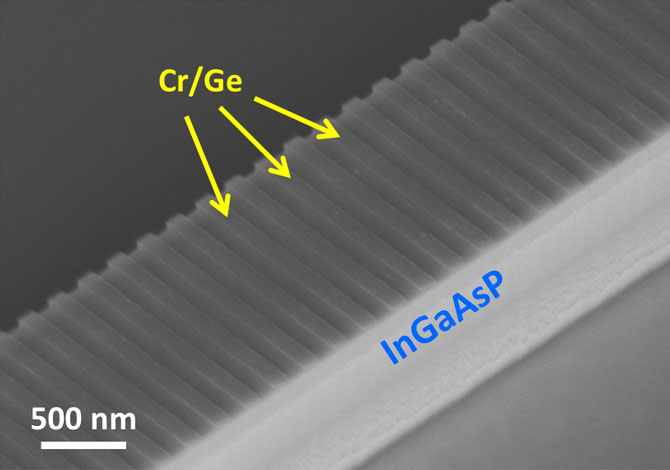
Scanning electron microscope image of the single device capable of lasing and anti-lasing. Indium gallium arsenide phosphide (InGaAsP) material functions as the gain medium, while the chromium (Cr) and germanium (Ge) structures introduce the right amount of loss to satisfy the condition of parity-time symmetry that is required for lasing and anti-lasing. Image: Zi Jing Wong/UC Berkeley
Bringing opposing forces together in one place is as challenging as you would imagine it to be, but researchers in the field of optical science have done just that.
Scientists at the Department of Energy’s Lawrence Berkeley National Laboratory (Berkeley Lab) have for the first time created a single device that acts as both a laser and an anti-laser, and they demonstrated these two opposite functions at a frequency within the telecommunications band.
Their findings, reported in a paper published in the journal Nature Photonics, lay the groundwork for developing a new type of integrated device with the flexibility to operate as a laser, an amplifier, a modulator, and an absorber or detector.
“In a single optical cavity we achieved both coherent light amplification and absorption at the same frequency, a counterintuitive phenomenon because these two states fundamentally contradict each other,” says study principal investigator Xiang Zhang, senior faculty scientist at Berkeley Lab’s Materials Sciences Division. “This is important for high-speed modulation of light pulses in optical communication.”
The concept of anti-lasers, or coherent perfect absorber (CPA), emerged in recent years as something that reverses what a laser does. Instead of strongly amplifying a beam of light, an anti-laser can completely absorb incoming coherent light beams.
While lasers are already ubiquitous in modern life, applications for anti-lasers — first demonstrated five years ago by Yale University researchers — are still being explored. Because anti-lasers can pick up weak coherent signals in the midst of a “noisy” incoherent background, it could be used as an extremely sensitive chemical or biological detector.
A device that can incorporate both capabilities could become a valuable building block for the construction of photonic integrated circuits, the researchers say.
“On-demand control of light from coherent absorption to coherent amplification was never imagined before, and it remains highly sought after in the scientific community,” says study lead author Zi Jing Wong, a postdoctoral researcher in Zhang’s lab. “This device can potentially enable a very large contrast in modulation with no theoretical limits.”
The researchers utilized sophisticated nanofabrication technology to build 824 repeating pairs of gain and loss materials to form the device, which measured 200 micrometers long and 1.5 micrometers wide. A single strand of human hair, by comparison, is about 100 micrometers in diameter.
The gain medium was made out of indium gallium arsenide phosphide, a well-known material used as an amplifier in optical communications. Chromium paired with germanium formed the loss medium. Repeating the pattern created a resonant system in which light bounces back and forth throughout the device to build up the amplification or absorption magnitude.
If one is to send light through such a gain-loss repeating system, an educated guess is that light will experience equal amounts of amplification and absorption, and the light will not change in intensity. However, this is not the case if the system satisfies conditions of parity-time symmetry, which is the key requirement in the device design.
Parity-time symmetry is a concept that evolves from quantum mechanics. In a parity operation, positions are flipped, such as the left hand becoming the right hand, or vice versa.
Now add in the time-reversal operation, which is akin to rewinding a video and observing the action backwards. The time-reversed action of a balloon inflating, for example, would be that same balloon deflating. In optics, the time-reversed counterpart of an amplifying gain medium is an absorbing loss medium.
A system that returns to its original configuration upon performing both parity and time-reversal operations is said to fulfill the condition for parity-time symmetry.
Soon after the discovery of the anti-laser, scientists had predicted that a system exhibiting parity-time symmetry could support both lasers and anti-lasers at the same frequency in the same space. In the device created by Zhang and his group, the magnitude of the gain and loss, the size of the building blocks, and the wavelength of the light moving through combine to create conditions of parity-time symmetry.
When the system is balanced and the gain and loss are equal, there is no net amplification or absorption of the light. But if conditions are perturbed such that the symmetry is broken, coherent amplification and absorption can be observed.
In the experiments, two light beams of equal intensity were directed into opposite ends of the device. The researchers found that by tweaking the phase of one light source, they were able to control whether the light waves spent more time in amplifying or absorbing materials.
Speeding up the phase of one light source results in an interference pattern favoring the gain medium and the emission of amplified coherent light, or a lasing mode. Slowing down the phase of one light source has the opposite effect, resulting in more time spent in the loss medium and the coherent absorption of the beams of light, or an anti-lasing mode.
If the phase of the two wavelengths are equal and they enter the device at the same time, there is neither amplification nor absorption because the light spends equal time in each region.
The researchers targeted a wavelength of about 1,556 nanometers, which is within the band used for optical telecommunications.
“This work is the first demonstration of balanced gain and loss that strictly satisfies conditions of parity-time symmetry, leading to the realization of simultaneous lasing and anti-lasing,” says study co-author Liang Feng, former postdoctoral researcher in Zhang’s Lab, and now an assistant professor of electrical engineering at the University at Buffalo. “The successful attainment of both lasing and anti-lasing within a single integrated device is a significant step towards the ultimate light control limit.”
Zhang is also a professor and director of the National Science Foundation Nanoscale Science and Engineering Center at UC Berkeley.
The work was primarily funded by the DOE Office of Science, and it made use of the Molecular Foundry, a DOE Office of Science User Facility at Berkeley Lab.
Source: Berkeley Lab