Research & Development World

  • R&D World Home
  • Topics
    • Aerospace
    • Automotive
    • Biotech
    • Careers
    • Chemistry
    • Environment
    • Energy
    • Life Science
    • Material Science
    • R&D Management
    • Physics
  • Technology
    • 3D Printing
    • A.I./Robotics
    • Software
    • Battery Technology
    • Controlled Environments
      • Cleanrooms
      • Graphene
      • Lasers
      • Regulations/Standards
      • Sensors
    • Imaging
    • Nanotechnology
    • Scientific Computing
      • Big Data
      • HPC/Supercomputing
      • Informatics
      • Security
    • Semiconductors
  • R&D Market Pulse
  • R&D 100
    • 2025 R&D 100 Award Winners
    • 2025 Professional Award Winners
    • 2025 Special Recognition Winners
    • R&D 100 Awards Event
    • R&D 100 Submissions
    • Winner Archive
  • Resources
    • Research Reports
    • Digital Issues
    • Educational Assets
    • R&D Index
    • Subscribe
    • Video
    • Webinars
    • Content submission guidelines for R&D World
  • Global Funding Forecast
  • Top Labs
  • Advertise
  • SUBSCRIBE

Lasers Could Aid Memory and Treat Anxiety

By Mina Kim, University of Texas at Austin | November 16, 2018

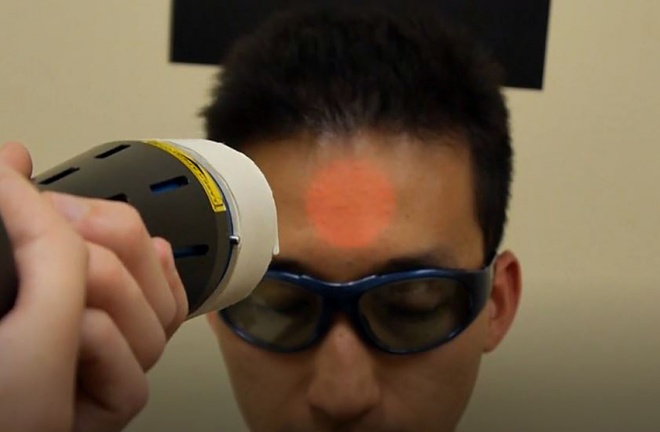
Image: Courtesy of Eric Zaizar

Seeing a therapist for anxiety may soon include seeing a laser as well. Eric Zaizar, graduate student in clinical psychology, and Michael Telch, psychology professor and principal investigator of the project, are currently studying whether a non-invasive laser could increase the efficiency and reduce the relapse rate of exposure therapy, the leading treatment for anxiety.

The laser works by shooting painless infrared energy, directed by a red light, at a person’s brain to speed up reactions involved in memory storage.

Telch says exposure therapy, which gradually exposes the patient to their fears, is already highly successful, but the potential of this laser lies in its convenience.

The laser could also be the successor to the drug methylene blue, which gets its name from turning urine blue, can potentially help treat anxiety but can’t be taken with antidepressants, Telch adds. While the relatively new study hasn’t produced any concrete results yet, Zaizar says there’s a wealth of literature backing the laser’s effects on chronic pain in humans and mental health in animals.

Zaizar says the tool is a thick, semi-cylindrical device aimed at the forehead. Although the light emitted is invisible since it’s infrared, patients will feel some warmth. The duration of the laser treatment is eight minutes, but the important part is when the laser is applied after the therapy session, Zaizar says.

“There’s a window of time right after the exposure therapy when the brain has become very active trying to store this memory,” Zaizar says. “We want to apply the laser during this window to optimize the chances of helping store that.”

The laser aims for a specific region of the brain called the ventromedial prefrontal cortex, Telch says. Zaizar says this is where they hope the light will provide additional “fuel” for boosting memory storage of the exposure. However, Telch says, though the laser’s target is the same for all participants, the exposure itself is different depending on which type of anxiety the patient comes in for.

“We’re taking this (laser) treatment across four different fear domains. These are claustrophobia, social anxiety, contamination fear and anxiety sensitivity, which is when people show exaggerated fear responses to feelings of stress or anxiety,” Telch says.

Beyond the therapy method and types of anxiety set by the study, Zaizar says this treatment could be expanded to psychotherapy and other anxiety disorders if the laser proves beneficial.

Clinician Jolene Jacquart, who works in UT’s Anxiety and Stress Clinic, says the potential scope of the device is exciting, although there is more to implementing this tool clinically even if it’s shown to be successful in trials.

“Despite the science behind the laser indicating its safety, the thought of having someone shine a laser at your head can be scary,” says Jacquart, a clinical pyschology graduate student. “Some people are going to be less willing than others to augment their treatment with the laser method. It also comes down to efficiency … would it significantly reduce the number of sessions? Adopting regular use of the laser would need to be cost-efficient and session-efficient for patients.”

But despite these concerns, Jacquart says she is optimistic about using the technology to help beam away anxiety.

“I think it’s really interesting,” Jacquart says. “Anything we can do to make mental health treatment more effective, efficient and available is important and worth exploring.”

Source: University of Texas at Austin
Related Articles Read More >

NASA R&D 100 Winner enables high-speed data transfer from space
Illustration of ultracold atoms (gold) flowing frictionlessly along a laser boundary (green), representing the quantum phenomenon of edge states.
MIT physicists directly observe frictionless ‘edge state’ flow in ultracold atoms, offering a glimpse of super-efficient electronics
NTT Research scientist in cleanroom suit working on advanced photonic equipment
NTT Research bets light-based computing can tackles AI’s energy crisis
Scientists claim to generate world’s strongest terahertz radiation
rd newsletter
EXPAND YOUR KNOWLEDGE AND STAY CONNECTED
Get the latest info on technologies, trends, and strategies in Research & Development.
RD 25 Power Index

R&D World Digital Issues

Fall 2025 issue

Browse the most current issue of R&D World and back issues in an easy to use high quality format. Clip, share and download with the leading R&D magazine today.

R&D 100 Awards
Research & Development World
  • Subscribe to R&D World Magazine
  • Sign up for R&D World’s newsletter
  • Contact Us
  • About Us
  • Drug Discovery & Development
  • Pharmaceutical Processing
  • Global Funding Forecast

Copyright © 2026 WTWH Media LLC. All Rights Reserved. The material on this site may not be reproduced, distributed, transmitted, cached or otherwise used, except with the prior written permission of WTWH Media
Privacy Policy | Advertising | About Us

Search R&D World

  • R&D World Home
  • Topics
    • Aerospace
    • Automotive
    • Biotech
    • Careers
    • Chemistry
    • Environment
    • Energy
    • Life Science
    • Material Science
    • R&D Management
    • Physics
  • Technology
    • 3D Printing
    • A.I./Robotics
    • Software
    • Battery Technology
    • Controlled Environments
      • Cleanrooms
      • Graphene
      • Lasers
      • Regulations/Standards
      • Sensors
    • Imaging
    • Nanotechnology
    • Scientific Computing
      • Big Data
      • HPC/Supercomputing
      • Informatics
      • Security
    • Semiconductors
  • R&D Market Pulse
  • R&D 100
    • 2025 R&D 100 Award Winners
    • 2025 Professional Award Winners
    • 2025 Special Recognition Winners
    • R&D 100 Awards Event
    • R&D 100 Submissions
    • Winner Archive
  • Resources
    • Research Reports
    • Digital Issues
    • Educational Assets
    • R&D Index
    • Subscribe
    • Video
    • Webinars
    • Content submission guidelines for R&D World
  • Global Funding Forecast
  • Top Labs
  • Advertise
  • SUBSCRIBE