[Adobe Stock]
A wave of new industry analysis reveals a sector leading the pack in AI adoption and maturity, yet struggling to translate that leadership into the disruptive, bottom-line impact promised by the technology. This creates a perceived paradox: if pharma is so far ahead in AI maturity, why isn’t it reaping superior rewards?
The gap between hope and reality
How large is the mismatch between expectations and results? Two recent studies quantify it. MIT NANDA’s “The GenAI Divide: State of AI in Business 2025” reports that 95% of enterprise GenAI pilots show no measurable P&L impact, and only about 5% of custom tools reach production. The shortfall persists because many systems fail to retain context, adapt, or integrate with daily workflows.
Vultr’s 2025 Operationalizing AI in Life Sciences report (finds) finds that 43% of organizations report “transformational” AI maturity (vs. 35% cross-industry), yet only 67% report better revenue or margins than peers (vs. 72% overall).
As the life sciences and pharmaceutical industries accelerate AI adoption, Kevin Cochrane, CMO, Vultr points to the need for more than model innovation to operationalize AI at scale, underscoring the need for “foundational infrastructure designed for security, compliance, and real-time performance.”
“In these industries, AI applications (i.e. identifying drug targets, modeling biological interactions, or analyzing experimental results) are characterized by scientific rigor, long-cycle development, and reproducibility,” Cochrane said. “Generic cloud or off-the-shelf AI solutions don’t cut it.” This reality is thus prompting a strategic pivot toward hybrid and diversified infrastructure models that blend internal controls with trusted, external partners who bring domain expertise, transparency, and scalable, compliant environments to support the sector’s high-stakes, mission-critical applications.”
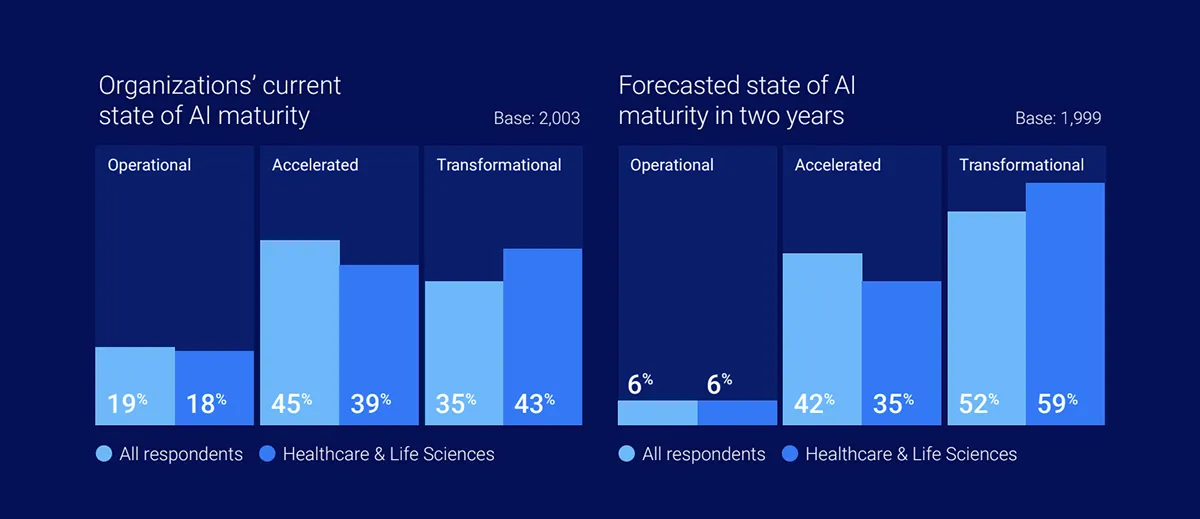
Current and forecast AI-maturity mix. Today, Life Sciences report 43% transformational versus 35% across all industries; in two years, leaders expect 59% transformational versus 52% overall [From the Vultr report]
Challenges in complex workflows
The aforementioned MIT report reached similar conclusions, scoring healthcare and pharma at 0.5/5 on industry disruption, with pilots often clustered in documentation/transcription while 7 of 9 sectors show no structural shifts. As one pharma procurement VP put it in the MIT study: “If I buy a tool to help my team work faster, how do I quantify that impact? How do I justify it to my CEO when it won’t directly move revenue or decrease measurable costs? I could argue it helps our scientists get their tools faster, but that’s several degrees removed from bottom-line impact.”
The problem isn’t limited to life sciences. NANDA argues most near-term value has concentrated in tech and media, with many enterprises stuck in pilots. Part of the reason is that GenAI excels at discrete tasks: summarizing documents, generating reports, automating simple queries. But for complex, multi-step workflows—such as validating manufacturing Quality Control (QC) data, automating regulatory dossier preparation, integrating supply chain logistics forecasting, or validated analytics for Commercial/Marketing operations—brittle tools, hallucinations and a lack of learning often stall progress. While memory methods exist, they’re frequently experimental or expensive to operate at GxP standards.
Still, life sciences leads on maturity, with 82% of organizations in the “accelerated” or “transformational” tiers. Yet, future optimism has tempered slightly: the percentage of leaders forecasting a “transformational” state by 2027 slipped to 59%, down from 64% a year earlier, reflecting more realistic scaling timelines.
Cooling expectations amid market correction
This cooling of expectations reflects a broader market correction as the entire tech industry grapples with the practical realities of deploying AI. Investor concerns over AI returns have triggered selloffs. While stocks like Nvidia are up 32.6% year-to-date as of August 22, 2025, the sector appears to be cooling. OpenAI’s Sam Altman called the market a bubble, echoing dot-com parallels.
Similarly, Gartner is tracking AI trends through its 2025 Hype Cycles, including dedicated ones for Artificial Intelligence, Generative AI, Healthcare and Life Science Data/Analytics/AI, and Life Science Manufacturing. These cycles map maturity, adoption and business impact, showing GenAI has slid into the Trough of Disillusionment after peaking on inflated expectations. Forbes’ Joe McKendrick argues the AI stack is commoditizing fast, becoming like electricity: accessible but not a differentiator unless layered with proprietary data or workflows.
Cochrane notes that Gartner’s positioning of GenAI in the trough of disillusionment, along with technologies such as LLMs and synthetic data, is “largely due to early pilots underestimating the complexity of scaling.” That’s been a theme for technologies like IoT and digital manufacturing as well, which frequently fell into what McKinsey termed “pilot purgatory.” “Challenges like data quality, compliance, security, and infrastructure bottlenecks, particularly GPU capacity constraints, have caused many projects to stall out,” Cochrane added.
But it would be wrong to conclude that GenAI’s potential was overhyped, Cochrane said. “But to see real, transformative impact, it will need to overcome these barriers,” he said.
Moving from experimentation to widespread adoption demands carefully planned roadmaps that integrate AI into existing workflows while addressing regulatory and operational realities. —Cochrane
Pockets of success through targeted infrastructure
And yet, pockets of success show what is possible when organizations get the foundation right. For instance, Vultr client Athos Therapeutics is successfully using AI to analyze massive datasets to identify patients at high risk for chronic diseases, turning predictive models into proactive healthcare interventions. Similarly, Vultr has a case study featuring ImmunoPrecise Antibodies, which is accelerating its drug discovery pipeline by deploying AI to rapidly analyze vast amounts of biological data, identifying the most promising antibody candidates in a fraction of the time it would take human researchers.
These case studies highlight that while generative AI’s broader rollout faces hurdles, targeted infrastructure investments can bridge the gap from pilot to impact. “Achieving meaningful impact requires turning embedded AI capabilities into scalable, production-grade systems through alignment of technology, operations, and organizational strategy,” Cochrane said. “The organizations that succeed will be the ones who build deliberately and invest with purpose.”