Research & Development World

  • R&D World Home
  • Topics
    • Aerospace
    • Automotive
    • Biotech
    • Careers
    • Chemistry
    • Environment
    • Energy
    • Life Science
    • Material Science
    • R&D Management
    • Physics
  • Technology
    • 3D Printing
    • A.I./Robotics
    • Software
    • Battery Technology
    • Controlled Environments
      • Cleanrooms
      • Graphene
      • Lasers
      • Regulations/Standards
      • Sensors
    • Imaging
    • Nanotechnology
    • Scientific Computing
      • Big Data
      • HPC/Supercomputing
      • Informatics
      • Security
    • Semiconductors
  • R&D Market Pulse
  • R&D 100
    • 2025 R&D 100 Award Winners
    • 2025 Professional Award Winners
    • 2025 Special Recognition Winners
    • R&D 100 Awards Event
    • R&D 100 Submissions
    • Winner Archive
  • Resources
    • Research Reports
    • Digital Issues
    • Educational Assets
    • Subscribe
    • Video
    • Webinars
    • PharmSci360
    • Content submission guidelines for R&D World
  • Global Funding Forecast
  • Top Labs
  • Advertise
  • SUBSCRIBE

Light Induces Magnetization in Certain Semiconductors

By University of Waterloo | May 11, 2018

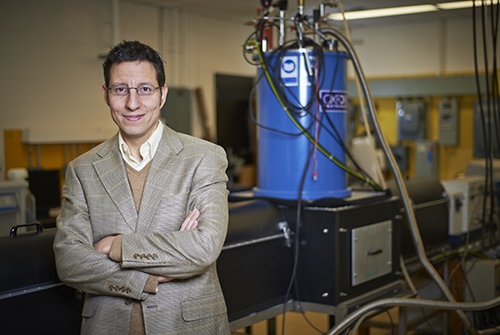
Professor Pavle Radovanovic in front of the magnetic circular dichroism system used in this study.

University of Waterloo chemists have found a much faster and more efficient way to store and process information by expanding the limitations of how the flow of electricity can be used and managed.

In a recently released study, the chemists discovered that light can induce magnetization in certain semiconductors — the standard class of materials at the heart of all computing devices today.

“These results could allow for a fundamentally new way to process, transfer, and store information by electronic devices, that is much faster and more efficient than conventional electronics.”

For decades, computer chips have been shrinking thanks to a steady stream of technological improvements in processing density. Experts have, however, been warning that we’ll soon reach the end of the trend known as Moore’s Law, in which the number of transistors per square inch on integrated circuits double every year.

“Simply put, there’s a physical limit to the performance of conventional semiconductors as well as how dense you can build a chip,” says Pavle Radovanovic, a professor of chemistry and a member of the Institute for Nanotechnology. “In order to continue improving chip performance, you would either need to change the material transistors are made of — from silicon, say to carbon nanotubes or graphene — or change how our current materials store and process information.”

Radovanovic’s finding is made possible by magnetism and a field called spintronics, which proposes to store binary information within an electron’s spin direction, in addition to its charge and plasmonics, which studies collective oscillations of elements in a material.

“We’ve basically magnetized individual semiconducting nanocrystals (tiny particles nearly 10,000 times smaller than the width of a human hair) with light at room temperature,” says Radovanovic. “It’s the first time someone’s been able to use collective motion of electrons, known as plasmon, to induce a stable magnetization within such a non-magnetic semiconductor material.

In manipulating plasmon in doped indium oxide nanocrystals Radovanovic’s findings proves that the magnetic and semiconducting properties can indeed be coupled, all without needing ultra-low temperatures (cryogens) to operate a device.

He anticipates the findings could initially lead to highly sensitive magneto-optical sensors for thermal imaging and chemical sensing. In the future, he hopes to extend this approach to quantum sensing, data storage, and quantum information processing.

The project was funded by the Natural Sciences and Engineering Research Council of Canada and the Canada First Excellence Research Fund in Transformative Quantum Technologies.

The findings of the research appeared recently in the journal Nature Nanotechnology.

Source: University of Waterloo

Related Articles Read More >

SK Telecom puts SK hynix fabs into an NVIDIA Omniverse twin, following Samsung and TSMC
What Apple’s new CEO could mean for its R&D strategy
Copper is hitting its physical limit with AI. Why NTT thinks photonics is could unblock it.
Nanoscale ridges in a substrate add 15 K and 50 Tesla to a superconductor’s limits
rd newsletter
EXPAND YOUR KNOWLEDGE AND STAY CONNECTED
Get the latest info on technologies, trends, and strategies in Research & Development.

R&D World Digital Issues

Fall 2025 issue

Browse the most current issue of R&D World and back issues in an easy to use high quality format. Clip, share and download with the leading R&D magazine today.

R&D 100 Awards
Research & Development World
  • Subscribe to R&D World Magazine
  • Sign up for R&D World’s newsletter
  • Contact Us
  • About Us
  • Drug Discovery & Development
  • Pharmaceutical Processing
  • Global Funding Forecast

Copyright © 2026 WTWH Media LLC. All Rights Reserved. The material on this site may not be reproduced, distributed, transmitted, cached or otherwise used, except with the prior written permission of WTWH Media
Privacy Policy | Advertising | About Us

Search R&D World

  • R&D World Home
  • Topics
    • Aerospace
    • Automotive
    • Biotech
    • Careers
    • Chemistry
    • Environment
    • Energy
    • Life Science
    • Material Science
    • R&D Management
    • Physics
  • Technology
    • 3D Printing
    • A.I./Robotics
    • Software
    • Battery Technology
    • Controlled Environments
      • Cleanrooms
      • Graphene
      • Lasers
      • Regulations/Standards
      • Sensors
    • Imaging
    • Nanotechnology
    • Scientific Computing
      • Big Data
      • HPC/Supercomputing
      • Informatics
      • Security
    • Semiconductors
  • R&D Market Pulse
  • R&D 100
    • 2025 R&D 100 Award Winners
    • 2025 Professional Award Winners
    • 2025 Special Recognition Winners
    • R&D 100 Awards Event
    • R&D 100 Submissions
    • Winner Archive
  • Resources
    • Research Reports
    • Digital Issues
    • Educational Assets
    • Subscribe
    • Video
    • Webinars
    • PharmSci360
    • Content submission guidelines for R&D World
  • Global Funding Forecast
  • Top Labs
  • Advertise
  • SUBSCRIBE