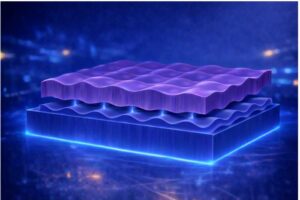
Conceptual illustration of the nanofaceted substrate (bottom, blue) and ultrathin YBCO superconducting film (top, purple). The sculpted ridges in the MgO substrate, roughly 1 nm tall, guide atomic arrangement and electron behavior at the interface, inducing a directional electronic state that enhances superconductivity. (Credit: Chalmers University of Technology / Riccardo Arpaia)
Superconducting materials can carry electricity with zero resistance, but two persistent problems have kept them out of most real-world electronics: they need to be cooled to extreme temperatures, and strong magnetic fields tend to destroy the superconducting state. Researchers at Chalmers University of Technology report a new material design strategy that pushes back on both fronts. By sculpting nanoscale ridges into the surface that an ultrathin superconducting film grows on, the team raised the superconducting onset temperature by more than 15 K and boosted the upper critical magnetic field, the threshold at which superconductivity collapses, by more than 50 tesla compared to thicker reference films of the same composition. The results, published in Nature Communications earlier this year, suggest that engineering the substrate beneath a superconductor can be as powerful as modifying the superconductor itself.
The approach sidesteps a longstanding limitation of cuprate superconductors. Cuprates, a family of copper-oxide compounds, are among the best-known high-temperature superconductors, but their chemistry is essentially locked in during fabrication. In other words, there’s no easy way to tune their electronic properties after the fact. Rather than altering the material’s composition, the Chalmers group pretreated magnesium oxide substrates in vacuum at high temperature, producing a regular pattern of triangular nanofacets roughly 1 nanometer tall and 20 to 50 nanometers wide. When nanometer-thin films of YBCO were deposited on these textured surfaces, the facet geometry guided how atoms in the superconducting layer arranged themselves and how electrons at the film-substrate interface behaved. As a result, this interface can induce a directional electronic state that strengthens superconductivity.
The paper traces the improvements to two distinct physical effects, each operating through different physics. In standard cuprate crystals, competing electronic patterns called charge density waves occupy the Fermi surface and suppress superconductivity, especially around 1/8 hole doping where CDW order is strongest. In the Chalmers team’s 10-nanometer films grown on nanofaceted MgO, the CDW was completely eliminated along one crystal axis while persisting along the other. As a result, the researchers cut the total CDW volume roughly in half and freeing up electronic states that would otherwise work against superconducting pairing. That reduction in competition accounts for the 15 K rise in onset temperature. The 50-tesla gain in critical magnetic field, however, comes from a separate effect: the nanofaceted substrate distorts the material’s electronic structure into a nematic state, where effective electron masses differ sharply between the two in-plane crystal directions. Because the upper critical field scales with the geometric mean of those masses, the anisotropy itself pushes the field limit higher. a relationship the authors confirmed with both Ginzburg-Landau analysis and a microscopic tight-binding model.
The team built in a clean control. They grew the same 10-nanometer YBCO films on strontium titanate substrates, which do not form nanofacets during high-temperature annealing. Those films showed no enhancement at all. The onset temperature and critical field matched the thicker 50-nanometer reference films. The same was true for thicker films on MgO, where the substrate’s facet pattern has little influence because only the first few atomic layers interact strongly with the textured surface. Taken together, the comparison isolates the nanofaceted MgO interface as the source of both improvements and rules out explanations based on thickness alone or simple strain effects.
“Instead of searching for entirely new materials or manipulating the chemical properties of existing ones, we are now showing how superconductivity can be enhanced by sculpting the substrate,” said Floriana Lombardi, Professor of Quantum Device Physics at Chalmers and lead author, in a press release. The Chalmers group argues the approach could extend beyond cuprates to other strongly correlated electron systems where competing electronic orders limit performance. For now, the materials still operate at cryogenic temperatures, room-temperature superconductivity remains distant, but pushing the operating envelope by 15 K and 50 tesla through substrate geometry alone opens practical territory for applications in quantum hardware, high-field magnets, and energy-efficient power systems where every degree and every tesla matters.