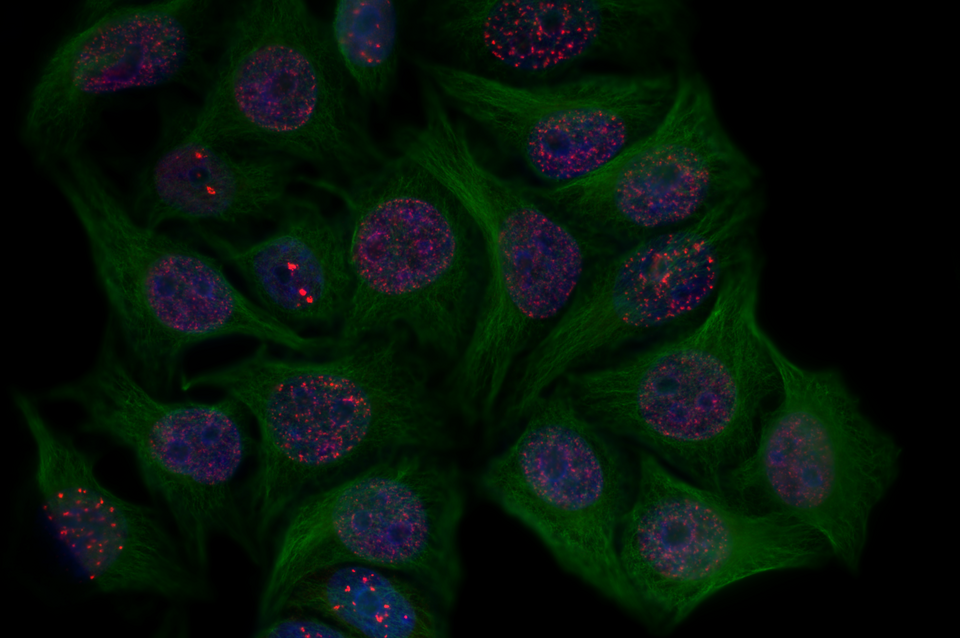
Drug-induced DNA damage in human cancer cells. Red foci (53BP1 protein) mark sites of genome breaks, green shows the cytoskeleton (tubulin), and blue marks DNA (DAPI). DNA damage is one trigger that can push cells into senescence, the state Rubedo’s RLS-1496 is designed to target. Credit: Velichko Artem / Wikimedia Commons (CC BY 4.0)
Longevity medicine is gradually going mainstream in pharma. In April, Insilco Medicine unveiled what it termed the industry’s first longevity board, a panel aimed at accelerating AI-driven aging research into new therapies. Chairing the board is Eli Lilly molecular discovery executive Andrew Adams, alongside Nobel laureate Michael Levitt, Medici Therapeutics CEO Denitsa Milanova, and Insilico co-CEOs Alex Zhavoronkov and Feng Ren.
The board’s stated mission captures both the field’s momentum and its central ambiguity. “Longevity” can still mean anything from supplements and peptide influencers to serious drug development targeting age-related disease. But across the industry, a consensus is forming around the distinction.

Sergey Jakimov
“You can go shallow: good looks, Botox, aesthetics, a consumer-driven cosmetology situation,” said Sergey Jakimov, co-founder and managing partner of LongeVC, an early-stage fund whose portfolio includes Insilico, Rubedo Life Sciences, and Unnatural Products. “Then as you go deeper, you end up addressing age-related diseases through advances in aging biology. This is where our fund operates.”
The companies gaining traction in longevity biotech are translating aging biology into specific disease indications, conventional endpoints, and data packages that regulators and pharma partners already recognize.
Pharma companies have little choice. Aging is not a recognized disease indication, and the FDA has no approval pathway for an anti-aging therapeutic. “There is no anti-aging endpoint,” said Jakimov, who co-founded biomedical data company Longenesis and the Longevity Science Foundation, a nonprofit that funds aging research globally.
“Aging is not an indication until that’s redefined,” said Artem Trotsyuk, Ph.D., an operating partner at LongeVC with a background in bioengineering and AI at Stanford. “Longevity companies go down the same path: pick an indication that exists, and show your endpoints.”
Alex Zhavoronkov, Insilico’s co-CEO and co-founder, described the same logic from the operator’s side. “Most folks out there in pharma, they don’t care much about the effect on aging clocks,” Zhavoronkov said at the Biomarkers of Aging Conference in March. “They care about the primary outcome measures.”
Hong Kong-listed Insilico itself broke through by wrapping aging-derived targets in traditional clinical programs, culminating in a $2.75 billion licensing collaboration with Lilly announced in March.
Insilico is hardly alone. Emeryville, California-based BioAge Labs is developing therapies from targets identified in human longevity cohorts and has landed both a Novartis research collaboration worth up to $550 million and a separate Lilly partnership targeting metabolic aging. Rubedo Life Sciences, another LongeVC portfolio company, is going after inflammatory skin conditions by eliminating senescent cells, with its lead candidate RLS-1496 now in Phase 1 trials for plaque psoriasis, atopic dermatitis, and actinic keratoses.
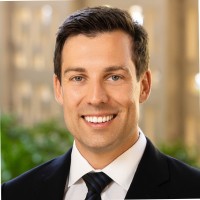
Artem Trotsyuk, Ph.D.
Rubedo CEO Frederick Beddingfield, III, MD, Ph.D., spent a decade at Allergan helping scale Botox through development and approval. “I spent 10 years at Allergan with Botox making people look younger,” Beddingfield said in an interview earlier this year. “Now I’m actually making them younger,” he quipped.
Rubedo’s lead drug candidate, RLS-1496, is a topical GPX4 modulator designed to target pathological senescent cells, the stressed, inflammatory cells that accumulate with age and can disrupt tissue repair. By modulating GPX4, Rubedo aims to make ferroptosis-sensitive senescent cells more vulnerable to programmed cell death while allowing surrounding tissue to return toward a healthier balance. A phase 2 trial published in Nature Medicine found that the first-generation senolytic combination dasatinib plus quercetin missed its primary endpoint in postmenopausal women overall, but showed meaningful bone formation gains in the subgroup with the highest senescent cell burden.
What drew Beddingfield to geroscience was a broader biological question: whether the chronic diseases of aging share common pathways. By the time patients present with Alzheimer’s disease, heart disease, kidney disease, liver disease or metabolic diseases such as diabetes and obesity, he said, the relevant biology may have been developing for years.
“We probably should be treating a decade or two before we are,” Beddingfield said, because those conditions eventually drive death, diminished quality of life or both.
That possibility pulled him toward geroscience. “And I was fascinated by: are there common pathways that contribute to multiple aging diseases?” he said.

Frederick Beddingfield, III, MD, Ph.D.
For Rubedo, that broad question has to enter the clinic through a narrower door. “I knew the FDA is not approving an anti-aging drug per se, a longevity drug,” Beddingfield said. “But they will approve a drug for an age-related disease, and maybe you can get multiple indications.”
Toward a biopharma longevity playbook
Rubedo’s approach, translating geroscience into specific indications with conventional endpoints, reflects a playbook that is becoming standard across the field. The companies gaining traction share a few structural features, and the pattern starts with a basic asymmetry: pharma is primarily a distribution business, and the innovative IP that feeds its pipeline overwhelmingly comes from small biotech. The burden of making aging biology legible to that system falls on the company, not on regulators or partners to change.
“If you distill the Insilico playbook to one big takeaway: you should have your own pipeline,” Jakimov said. “Your own pipeline with unique assets that your unique AI capabilities were able to generate.”
That logic holds even when the underlying science connects to aging. Insilico’s idiopathic pulmonary fibrosis program, for instance, has roots in aging biology, but the clinical program is designed around conventional endpoints in a disease indication the industry already understands.

Alex Zhavoronkov, Ph.D.
“If you want to prove something to this world, and your world talks in concrete data packages and concrete endpoints, it’s you facing the translation issue,” Jakimov said. “Not the world.”
The economics reinforce the model. Insilico has licensed several AI-generated drugs over the past three years, including one deal worth up to $1 billion with $80 million upfront. The company is reinvesting those proceeds into its broader aging and longevity pipeline, a cycle Zhavoronkov has described as what makes Insilico’s aging research “fully sustainable.” That financial loop, combined with the company’s December 2025 listing on the Hong Kong Stock Exchange, gives Insilico a capital structure that few longevity-focused biotechs have achieved.
The AI model layer, meanwhile, has commoditized. Every company has neural networks, open-source data, and a pitch deck claiming a novel architecture. Jakimov said the differentiator is demonstrated therapeutic appetite and early industry partnerships. He pointed to LongeVC portfolio company Unnatural Products, which specializes in designing macrocyclic peptides and has closed three pharma deals since the fund invested, including a Novartis collaboration worth up to $1.7 billion with up to $100 million in upfront or near-term payments.
The inverse is also instructive. “Whenever you see an AI drug discovery company say, ‘Whatever we have, we’re going to sell it as SaaS. We’re going to sell access. That’s our core business model,'” Jakimov said, “that is one of those red flags.” Some platform-first companies, such as Amsterdam-based Cradle, which sells AI-driven protein engineering as a SaaS tool to six of the top 25 pharma companies, argue the model enables focus by keeping them out of the pipeline business entirely. Others, including Schrödinger and Insilico itself, run dual models with software revenue in one lane and a proprietary pipeline in another.
Even with the right playbook, the underlying science remains the constraint. Zhavoronkov has noted that biological validation is far more complex than chemistry benchmarks, where progress is more straightforward to measure. Thomas Fuchs, Eli Lilly’s first chief AI officer, has made a similar observation: biology remains the bottleneck.
For longevity companies that reach the public markets, that timeline collides with a different set of demands. “Public markets are speculative. A large portion of your equity holders are holding for future profit, not because they believe in your business or like you as a person, but because they see a profit thesis. So the only way to maintain that is to generate [news] on a regular basis: more clinical programs, every week or every month. It’s hard, especially if you’re not that successful.”
“The name of the game in public markets is: how fast can you generate news that will maintain confidence in your stock?” Jakimov said. “If you’re not that successful, you need to be 10 times more active with your business development, 10 times more vocal with your clinical achievements.”