Research & Development World

  • R&D World Home
  • Topics
    • Aerospace
    • Automotive
    • Biotech
    • Careers
    • Chemistry
    • Environment
    • Energy
    • Life Science
    • Material Science
    • R&D Management
    • Physics
  • Technology
    • 3D Printing
    • A.I./Robotics
    • Software
    • Battery Technology
    • Controlled Environments
      • Cleanrooms
      • Graphene
      • Lasers
      • Regulations/Standards
      • Sensors
    • Imaging
    • Nanotechnology
    • Scientific Computing
      • Big Data
      • HPC/Supercomputing
      • Informatics
      • Security
    • Semiconductors
  • R&D Market Pulse
  • R&D 100
    • 2025 R&D 100 Award Winners
    • 2025 Professional Award Winners
    • 2025 Special Recognition Winners
    • R&D 100 Awards Event
    • R&D 100 Submissions
    • Winner Archive
  • Resources
    • Research Reports
    • Digital Issues
    • Educational Assets
    • Subscribe
    • Video
    • Webinars
    • PharmSci360
    • Content submission guidelines for R&D World
  • Global Funding Forecast
  • Top Labs
  • Advertise
  • SUBSCRIBE

Making Artificial ‘Cells’ Move Like Real Cells

By American Chemical Society | November 9, 2016

Artificial “cells” could someday zoom around in the body and deliver medicines to specific locations, act as in-tissue diagnosticians and provide viable replacements for whole cells and organs. To do this, they will need to be able to navigate the complex environments of our bodies. Now, in ACS Central Science, researchers report development of lab-made cells that use enzymes to move just like real cells.

Just as a hungry person can walk to the cafeteria as quickly as a person who is full, cells also perform their duties when their fuel levels are high and when their fuel levels are low. Wilhelm Huck, Daniela Wilson, Jan van Hest and colleagues proposed that mirroring the ways that cells maintain this state of “homeostasis” in the face of differing conditions could be harnessed to propel non-living nano-objects in analogous changing environments.

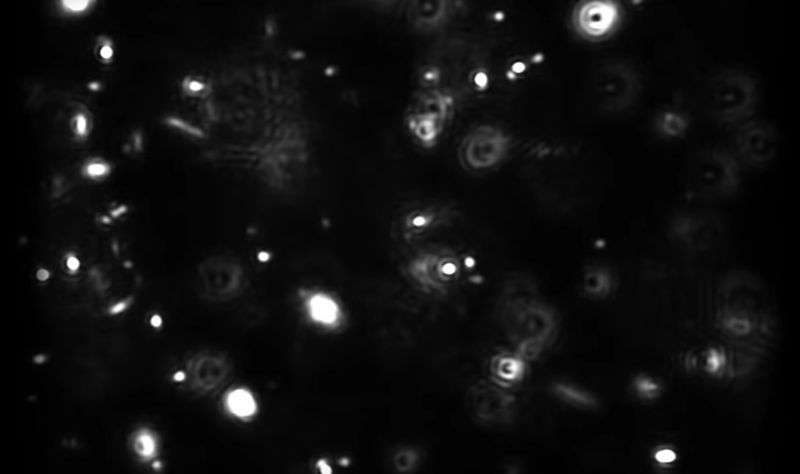
Starting with known regulatory networks of enzymes, the researchers used computer modeling to determine how many and how much of each enzyme would be needed to keep an artificial cell moving. Then they constructed artificial cells containing just those components. Just like for people, the ultimate fuel was sugar. And just like for us, the cells could sustain the same speed as their sugar supply ran down. The authors showed that the artificial cells moved in a directed way, but only when they contained all of the enzymes and the fuel was available in the media. The researchers suggest their concept could be applied to many of the other fuel-dependent characteristics of life beyond movement to make additional molecular life-like systems.

 

Related Articles Read More >

Elkem Silicones rebrands as Bluestar Silicones after ownership change
Martian chemistry: how the Curiosity rover detected organic compounds on Mars
Sandia scientists develop rapid PFAS test using desorption electrospray ionization 
MXenes, the family of 2D transition metal carbides, get a clean surface, and a 160-fold conductivity jump
rd newsletter
EXPAND YOUR KNOWLEDGE AND STAY CONNECTED
Get the latest info on technologies, trends, and strategies in Research & Development.

R&D World Digital Issues

Fall 2025 issue

Browse the most current issue of R&D World and back issues in an easy to use high quality format. Clip, share and download with the leading R&D magazine today.

R&D 100 Awards
Research & Development World
  • Subscribe to R&D World Magazine
  • Sign up for R&D World’s newsletter
  • Contact Us
  • About Us
  • Drug Discovery & Development
  • Pharmaceutical Processing
  • Global Funding Forecast

Copyright © 2026 Arrowfly LLC. All Rights Reserved. The material on this site may not be reproduced, distributed, transmitted, cached or otherwise used, except with the prior written permission of Arrowfly
Privacy Policy | Advertising | About Us

Search R&D World

  • R&D World Home
  • Topics
    • Aerospace
    • Automotive
    • Biotech
    • Careers
    • Chemistry
    • Environment
    • Energy
    • Life Science
    • Material Science
    • R&D Management
    • Physics
  • Technology
    • 3D Printing
    • A.I./Robotics
    • Software
    • Battery Technology
    • Controlled Environments
      • Cleanrooms
      • Graphene
      • Lasers
      • Regulations/Standards
      • Sensors
    • Imaging
    • Nanotechnology
    • Scientific Computing
      • Big Data
      • HPC/Supercomputing
      • Informatics
      • Security
    • Semiconductors
  • R&D Market Pulse
  • R&D 100
    • 2025 R&D 100 Award Winners
    • 2025 Professional Award Winners
    • 2025 Special Recognition Winners
    • R&D 100 Awards Event
    • R&D 100 Submissions
    • Winner Archive
  • Resources
    • Research Reports
    • Digital Issues
    • Educational Assets
    • Subscribe
    • Video
    • Webinars
    • PharmSci360
    • Content submission guidelines for R&D World
  • Global Funding Forecast
  • Top Labs
  • Advertise
  • SUBSCRIBE