Astronomers using the Atacama Large Millimeter/submillimeter Array (ALMA) in Chile have created the largest image of the central region of the Milky Way ever produced by ALMA, revealing a complex network of filaments of cosmic gas. The data will allow astronomers to investigate the lives of stars in the most extreme region of the galaxy, next to the supermassive black hole at its center.
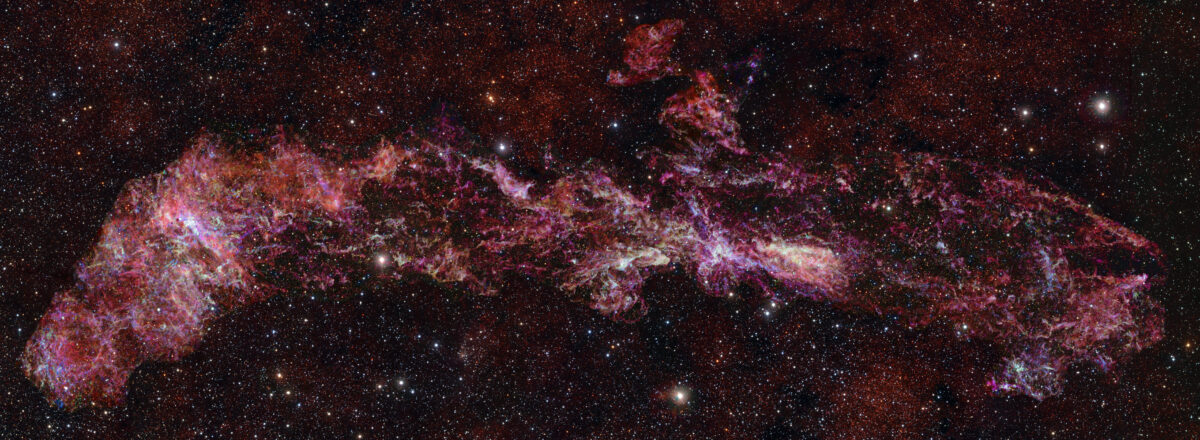
The survey has charted the distribution of dozens of different molecules, five of which are shown here in different colours: sulphur monoxide (cyan), silicon monoxide (green), isocyanic acid (red), cyanoacetylene (blue), and carbon monosulphide (magenta). Credit: ALMA/ACES
“It’s a place of extremes, invisible to our eyes, but now revealed in extraordinary detail,” says Ashley Barnes, an astronomer at the European Southern Observatory (ESO) in Germany who is part of the team that obtained the new data.
Discovering star formation in extreme environments
The new image, which spans more than 650 light-years, provides a unique view of the cold gas within the Central Molecular Zone (CMZ) of the Milky Way, revealing gas structures dozens of light-years across as well as small gas clouds around individual stars. This cold gas is the raw material from which stars form.
The ALMA CMZ Exploration Survey (ACES) characterizes the molecular inventory of the cold molecular gas in the CMZ. ACES has detected dozens of different molecules, including silicon monoxide as well as organic compounds like methanol, acetone and ethanol.
“The CMZ hosts some of the most massive stars known in our galaxy, many of which live fast and die young, ending their lives in powerful supernova explosions, and even hypernovae,” says ACES leader Steve Longmore, a professor of astrophysics at Liverpool John Moores University, UK.
Cold molecular gas flows along filaments feeding into clumps of matter that can grow into stars. This process has been examined in the outskirts of the Milky Way, but the extreme conditions of the CMZ change how stars form. With ACES, scientists hope to better understand how stars form in this extreme environment.
“We anticipated a high level of detail when designing the survey, but we were genuinely surprised by the complexity and richness revealed in the final mosaic,” says Katharina Immer, an ALMA astronomer at ESO who is also part of the project.
Overcoming the optical barrier
The galactic center of the Milky Way is obscured by dense clouds of cosmic dust, rendering it invisible to optical telescopes. ACES utilizes ALMA’s 66 high-precision antennas to detect millimeter-wavelength emissions, which penetrate these “curtains” to reveal the cold molecular gas beneath.
By utilizing the 12-meter array in Band 3 (3 mm), ACES achieved a contiguous spatial resolution of approximately 0.1 parsecs. This allowed the team to resolve the ‘sub-sonic’ kinematics of the gas, watching the slow, cold movement of matter before it collapses into a star.
This research was presented in a series of papers presenting the ACES data, to appear in Monthly Notices of the Royal Astronomical Society. The data itself will be available from the ALMA Science Portal.